

Introduction
The U.S. Dollar Index continues to trade within a range, but the market structure is starting to shift slightly after weeks of heavy selling pressure earlier this year.
While equities and risk assets have continued pushing higher, the dollar has struggled to regain strong momentum. The recent bounce in DXY has helped stabilize price action in the short term, but buyers still have work to do before the broader trend can fully turn back bullish.
What stands out right now is how compressed the market has become. The dollar is no longer collapsing as it did during the March weakness, but it is also struggling to generate the kind of momentum needed to break back into a sustained uptrend.
That leaves DXY sitting in an important middle ground where upcoming macro data and Federal Reserve expectations will likely determine the next larger move.
DXY Daily Chart Technical Analysis
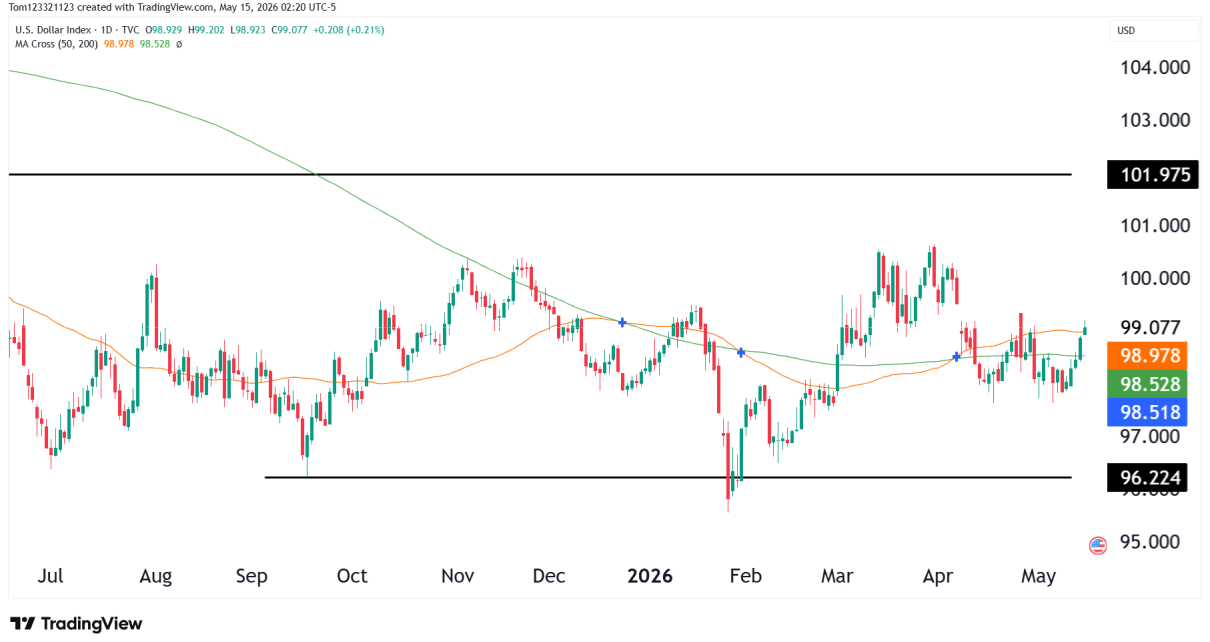
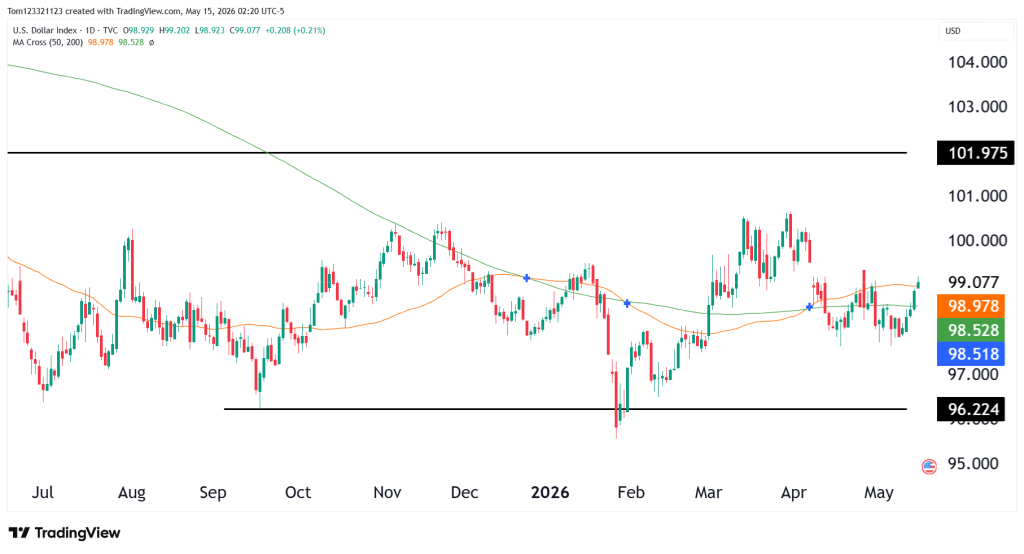
The daily chart shows DXY continuing to hold above the major support region near 96.20 while gradually attempting to build a higher base.
Price has now reclaimed both the 50-day and 200-day moving averages, which is an important technical improvement compared to the weakness seen earlier this year. However, the market still remains below the larger resistance zone near 100–102, where previous rallies have repeatedly failed.
One important detail is that volatility has started cooling significantly compared to the sharp swings seen during the first quarter of the year. That usually signals the market is waiting for a stronger catalyst before committing to a larger move in either direction.
As long as DXY holds above the mid-98 region, buyers maintain some short-term control. A break back below that area would likely reopen downside pressure toward the major range lows.
It is important to monitor the price action of the Dollar because it impacts how equities move significantly. If the Dollar is stronger, equities will find it more difficult to rally and vice versa since they are priced in Dollars.
Key Levels
- Major resistance: 101.90–102.00
- Near-term resistance: 99.80–100.00
- Current support: 98.40–98.50
- Major range support: 96.20
The dollar needs a sustained move back above 100 for us to see the trend as shifting to bullish again.
If buyers fail to hold the current support structure near 98.50, the market could quickly rotate back toward the lower end of the range.
Market Drivers and Upcoming Events
Federal Reserve expectations remain the biggest driver for DXY right now.
Upcoming CPI, PPI, and labor market data will heavily influence how markets price future interest rate decisions. Any signs that inflation is cooling faster than expected could weaken the dollar further as traders increase expectations for rate cuts later this year.
Treasury yields also continue playing a major role. If yields begin rising again, DXY could regain momentum quickly. If yields continue softening, however, the dollar may struggle to sustain rallies.
Global risk sentiment is another important factor. Strong equity markets and improving appetite for risk assets have reduced demand for defensive dollar flows recently.
At the same time, geopolitical tensions remain important to monitor. Developments in the Middle East, energy markets, and global trade conditions can all quickly increase safe-haven demand for the U.S. dollar if uncertainty rises again.
Scenarios and Probabilities
| Scenario | Description | Estimated Probability |
|---|---|---|
| Consolidation | Continued rangebound movement between 98 and 100 | 45% |
| Bullish Recovery | Break above 100 leads to stronger upside momentum | 30% |
| Renewed Weakness | Loss of support sends DXY back toward range lows | 25% |
This analysis is provided for educational and informational purposes only and should not be considered financial or trading advice. Trading futures, forex, and other leveraged financial instruments carries a high level of risk and may not be suitable for all investors. Past performance is not indicative of future results. Before making any trading decisions, conduct your own research, assess your risk tolerance, and consult with a qualified financial advisor if necessary.