


Introduction
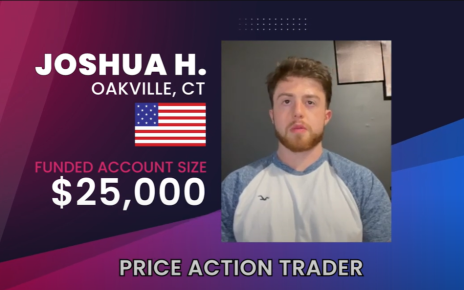
Jack K. is a futures trader from Beverly, Massachusetts, who has spent the last five years specializing almost entirely in bond futures markets. This is why we wanted to feature him today, because bond trading is not nearly as popular as other instruments like Crude or the Nasdaq.
Unlike many modern retail traders who rely heavily on indicators, algorithms, or technical analysis, Jack’s approach is much more focused and specialized.
He trades the 10-Year Note (ZN) and 30-Year Bond (ZB) futures markets using pure order flow through Jigsaw Trading, making decisions directly from the DOM (Depth of Market) and ‘tape reading’. Rather than looking for lagging signals or complicated technical overlays, he focuses on real-time liquidity, absorption, exhaustion, fake breakouts, and momentum shifts directly from the order book itself.
Since joining OneUp Trader in January 2025, Jack has withdrawn a total of $38,682 trading bond futures, a market that many retail traders overlook entirely.
What makes his performance interesting is that bond futures trading is very different from the fast-moving NASDAQ or ES scalping strategies we often feature. Bond markets typically move more slowly and require a deeper understanding of market structure, liquidity behavior, and institutional trading. It is a niche that demands patience, precision, and significant screen time to master.
Let’s take a closer look at the statistics behind Jacks most recent funded accounts and break down what traders can learn from his approach.
Funded Account Statistics
For this breakdown, we’ll focus on one of Jack’s most recent funded accounts, where he generated a total profit of $6,351.47 across 1,504 trades.
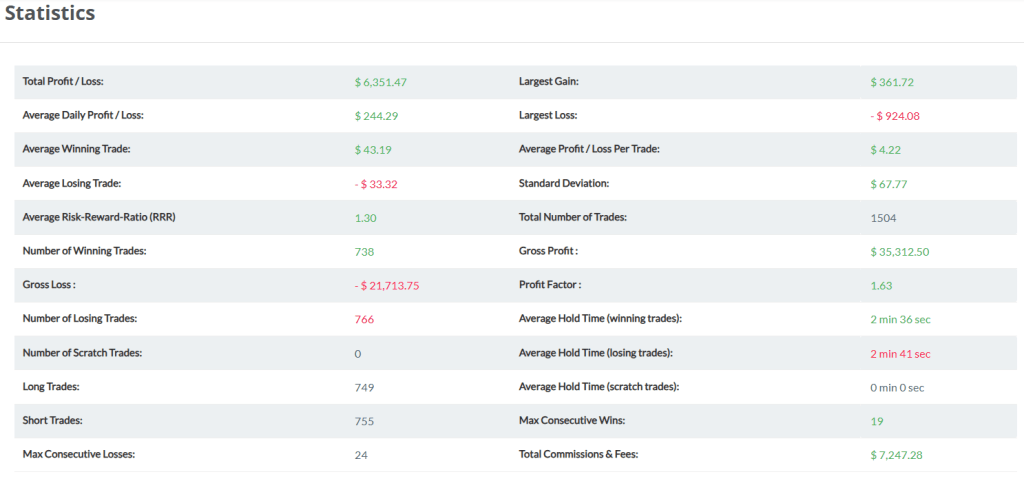
At first glance, the trade count immediately stands out. Over 1,500 trades is significantly higher than many of the swing or intraday traders we feature, but context matters here because Jack’s strategy is specifically built around short-term order flow opportunities inside highly liquid bond futures markets.
This is not a trader waiting for one or two large setups per day. Instead, he operates in an environment where small inefficiencies in the order flow can create opportunities throughout the session. His edge comes from precision and repetition rather than trying to capture massive market swings.
A Strategy Built Around Order Flow
One of the most unique aspects of Jack’s trading is his complete reliance on the DOM. Most retail traders use charts as their primary decision-making tool, but Jack takes a very different approach, trading almost entirely from the order book itself.
His focus is on identifying ‘absorption’ at key levels, spotting exhaustion when buying or selling pressure begins to weaken, and recognizing fake breakouts before momentum reverses.
This style of trading requires intense concentration and experience because there are no signals telling you exactly when to enter or exit. Everything comes down to reading liquidity.
After spending five years focused specifically on ZB and ZN futures, Jack has clearly developed a strong understanding of how these markets behave intraday. If he had to trade NQ or CL, for example, the results would likely be very different because those markets behave very differently, as do the liquidity conditions.
This is an important point for traders to understand. It is often a far better approach to focus on one market and strategy than to focus on dozens. ‘A jack of all trades is a master of none.’
Profitability Through Repetition and Consistency
Another important element of this account is the relationship between win rate and risk-reward.
Jack’s average winning trade comes in at $43.19, while the average losing trade is -$33.32, resulting in a positive risk-reward ratio of 1.30. While that may not seem particularly big on paper, the key is the consistency behind it.
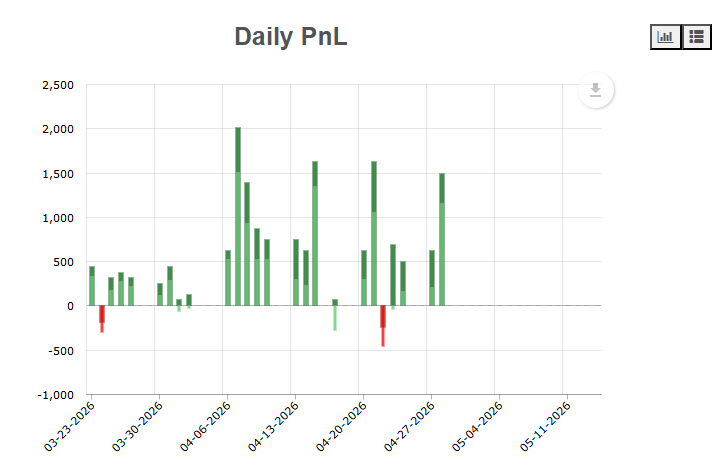
Over more than 1,500 trades, even relatively small statistical edges can compound profitability. This is something newer traders often misunderstand. Many traders believe they need huge winners or massive risk-reward ratios to become profitable, but many good trading strategies are built around repeatedly executing small, high-probability setups while maintaining disciplined risk control.
With a profit factor of 1.63, Jack is generating $1.63 in profit for every $1 lost. Over such a large sample size, that becomes significant because it shows the strategy is not dependent on a few oversized trades. Instead, profitability is being built steadily through repetition, execution quality, and consistency.
High Frequency Done Right
Normally, when traders see an account with over 1,500 trades, concerns about overtrading immediately come up. However, that is not always the case.
Jack’s average holding times are extremely short:
- Winning Trades: 2 minutes 36 seconds
- Losing Trades: 2 minutes 41 seconds
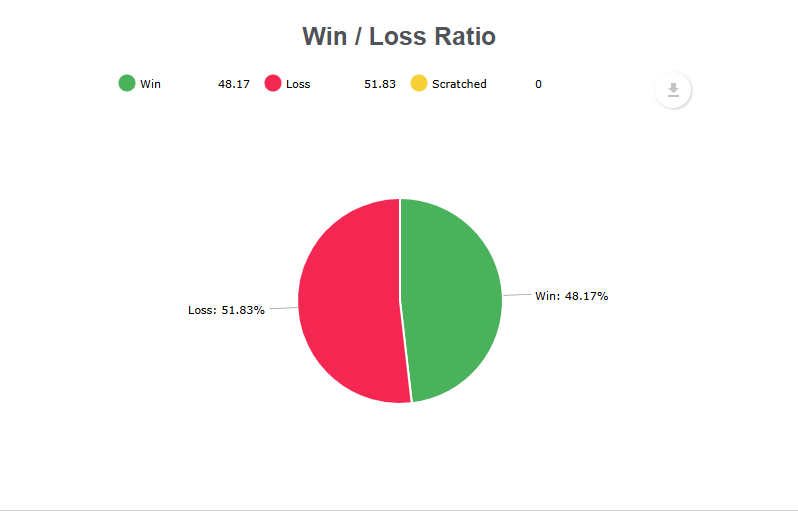
What makes this interesting is how balanced the holding times are between winners and losers. One of the most common problems traders face is holding losing trades significantly longer than winning trades, often because of hesitation or emotional decision-making.
In Jack’s case, both are managed very similarly, which means he is following very precise rules. As traders, we know that consistency is not easy to maintain because of the emotions involved, such as greed and fear.
Risk Management and Psychological Discipline
The largest gain was $361.72, while the largest loss was -$924.08. Although the loss was a lot larger than the average trade, it remained relatively controlled given the volume of trades and fast-paced nature of order flow trading.
Another key metric is the maximum consecutive losses, which reached 24 trades. For many traders, a losing streak that large would trigger emotional decision-making, revenge trading, or abandoning the strategy altogether. Professional traders understand that even profitable systems experience difficult periods.
What matters is whether the edge holds over a large sample size, and in Jack’s case, the overall profitability means he maintained consistency despite inevitable drawdowns. That discipline is often what separates consistently profitable traders from inconsistent ones.
Preparation and Trading Routine
Before each session, he reviews the economic calendar, marks key levels from prior sessions, checks platform stability, and mentally reviews his rules and risk parameters.
He also admits one of his weaknesses is being overly selective and waiting too long for ideal conditions before entering trades. This is a common challenge among experienced traders. Once discipline is developed, traders can become too cautious and miss good opportunities while waiting for perfect setups.
Finding the balance between patience and execution confidence is often one of the final stages of a trader’s development.
The OneUp Trader Experience
Jack rated his OneUp Trader experience a perfect 10 out of 10 and highlighted the platform’s straightforward rules, ease of use, and trader-friendly environment as some of the main reasons he chose the firm.
Having also traded with other prop firms, he told us that OneUp Trader stood out for its transparency and simplicity.
According to Jack:
“OneUp Trader has been an outstanding experience from start to finish. The evaluation process is fair and transparent, the rules are clear, and the platform support has been excellent. Getting funded has been a smooth process and I would highly recommend OneUp Trader to any serious futures trader looking to scale their capital.”
What Traders Can Learn From Jack
Jack’s performance highlights several important lessons that many traders can learn from:
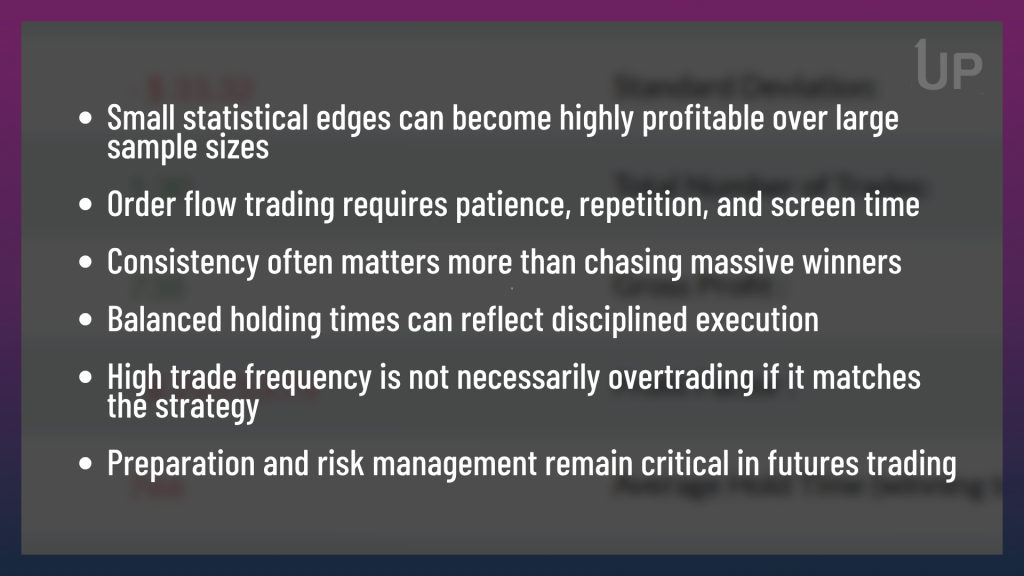
Perhaps the biggest takeaway is that there is no single “correct” way to trade profitably. Some traders rely on technical indicators, others focus on macro analysis, while traders like Jack build an edge by specializing deeply in one specific market and mastering its behavior over time.
Final Thoughts
Jack’s trading reflects what professional trading often looks like in reality. It is not about predicting huge market moves or constantly searching for the next perfect indicator. Instead, it is about developing a repeatable process, understanding a market deeply, and executing a small edge consistently over time.
Specializing in bond futures and pure order flow trading is not an easy path. It requires thousands of hours of screen time, patience, and the ability to stay disciplined during both winning and losing periods. However, the results show what can happen when a trader commits fully to mastering a specific method.
With more than $38,000 withdrawn since joining OneUp Trader, Jack has demonstrated that consistency and specialization can produce strong long-term results, even in one of the more niche areas of futures trading.
Most importantly, his performance serves as another reminder that profitable trading does not need to look flashy or complicated. Finding an edge, understanding it deeply, and executing it consistently is often what matters most over the long run.