


Introduction
It’s time for another Funded Trader Spotlight, and this week we’re featuring a trader from Russia who has achieved something incredible!
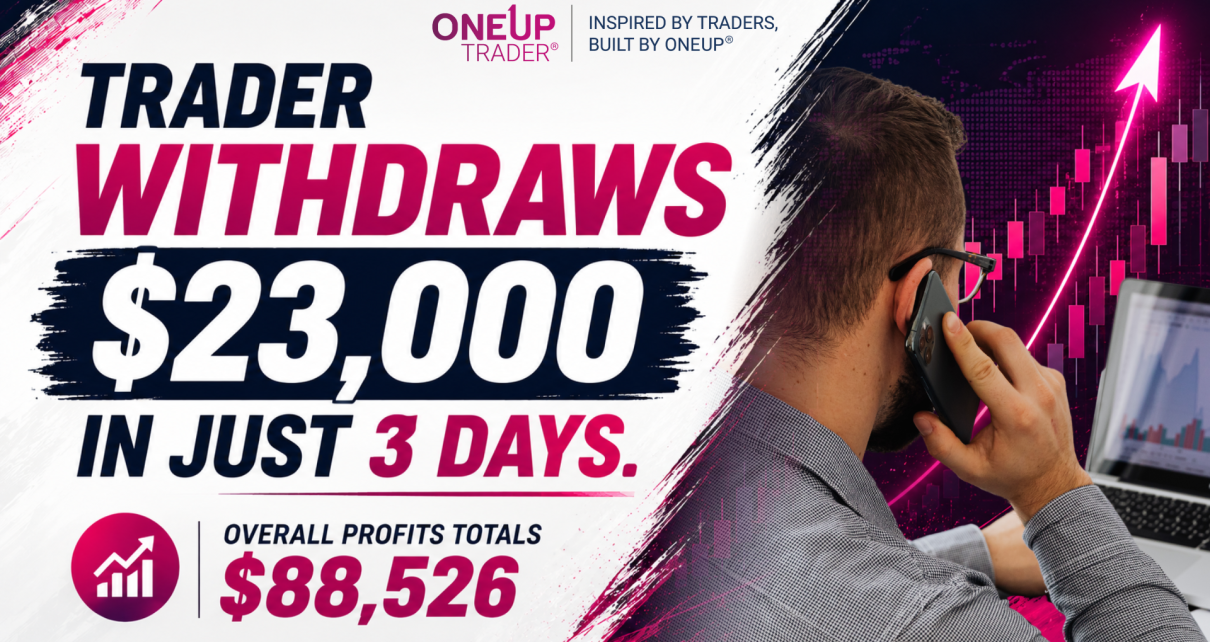
Ruslan recently withdrew $23,000 from his funded account in just three trading days, bringing his total withdrawals to a very impressive $88,526. What makes this even more remarkable is the strategy he used to achieve this. Ruslan took only 32 trades, demonstrating his selectivity and discipline.
Today, we will take a closer look at his statistics, trading system, and overall performance to learn lessons from his success.
Main Funded Account Performance
In a very short period of time, he generated:
- Total Withdrawn: $88,526
- Total Trades: 32
- Win Rate: 81%
- Profit Factor: 4.76
- Average Daily Profit: $4,079
At first glance, the win rate is what stands out the most because 81% is very high. This doesn’t tell the full picture, however, so we need to look deeper into how he has a win rate like that and if it is something sustainable.
High Win Rate With Balanced Risk
Ruslan’s numbers tell a very specific story about how he trades. His average winning trade sits at $995, while his average loss is -$915. That puts him close to a 1:1 risk-to-reward ratio, which on its own isn’t particularly forgiving. With a setup like that, profitability depends heavily on one thing: accuracy. You have to be right more often than you’re wrong.
That’s exactly what he does. His edge doesn’t come from oversized winners or catching huge moves. It comes from being consistent. He keeps his losses under control, avoids letting trades get away from him, and executes the same way over and over. There’s very little room for emotional decision-making in a system like this.
He told us, “I look for a big player in the market and go after him.”
What makes this approach interesting is how different it is from the style many traders aim for. A lot of people focus on having a high risk-to-reward ratio, where one winner can cover several losses. Ruslan’s approach instead of relying on a few big wins, stacks smaller, consistent gains while keeping losses tight.
The real lesson here is about alignment. Your win rate, your risk-to-reward ratio, and your execution all need to fit together. If one piece is out of place, the system doesn’t work. Traders often copy parts of someone else’s strategy without understanding how those parts connect, and that’s where problems start.
There isn’t a single “correct” way to be profitable. Some traders win big but less often. Others win frequently and keep their downside controlled. Both models can work, but only if they’re executed consistently. What matters most is choosing a structure that fits you, then sticking to it with discipline.
Holding Time
Another detail adds to the picture. His winning trades are held for close to two hours on average, while his losing trades last about 57 minutes.
When a position is working, he gives it space to develop instead of rushing to lock in profit. There’s patience there, and a willingness to let the trade play out. At the same time, his losing trades don’t drag on. He cuts them before they turn into something bigger, which keeps his downside under control.
This balance is harder than it looks. Many traders do the opposite. They take profits too early because they’re afraid of giving gains back, then hold onto losing trades hoping they’ll recover. That creates a negative cycle where small wins are constantly offset by larger losses.
Here, the behavior is flipped. He lets winners breathe and keeps losses contained.
Trading Multiple Markets Without Losing Focus
Ruslan traded a range of instruments, including:
- Gold (GC)
- Silver (SI)
- E-mini S&P 500 (ES)
- NASDAQ (NQ)
This can be a good idea or a bad idea, depending on what the strategy is. For example, a false break strategy can be used on many different markets because the basic criteria are the same. A trend following system might not be as effective because each market trends very differently. Imagine trying to trade the same moving average pullback system on Nasdaq futures and natural gas futures…
This is important.
Many traders assume that trading more markets leads to more opportunities. In reality, it often leads to confusion and inconsistent execution.
In Ruslans’ case, even though he monitors many markets, he only acts when a clear opportunity appears.
Trading Background & Approach
He’s been trading for four years, and his motivation is simple and practical. He wants a stable income and the freedom to travel. That kind of goal tends to shape how someone trades. It pushes you toward consistency over excitement and process over impulse.
Most traders trade from a place of emotion, projecting their own beliefs onto the market. For example, a trader’s process could be something like the following:
‘I think the market is going to go up now, I hope it will, I could make a few hundred dollars and then be finished for the day. That sounds really great, imagine, I would be really happy to get that today.‘
Then slowly the emotions start to rule the process, and the trader acts from there and not from probability. A good trader would never have a thought process like this because he doesn’t hope for anything; he only acts based on what he sees and doesn’t believe it will go up or down. He simply sees the probabilities, and if the market is aligning correctly with his strategy, then he executes.
This is how Ruslan became successful.
It’s a reactive approach. He’s not trying to predict where price will go next or build a narrative about the market. Instead, he waits for the market to show him what it’s doing, then acts on it. That removes a lot of unnecessary pressure. Prediction can easily turn into bias, and bias often leads to forcing trades that aren’t really there. This is how traders get so upset when the market doesn’t do what they want it to do, as if they can control it; they feel betrayed if it doesn’t do what they simply believe it will do.
OneUp Trader Experience
Ruslan joined the OneUp Trader funded trader program in 2025 after hearing positive feedback from friends in Europe.
The main reason for choosing it was simple:
- Stability
- Fast payouts
He rated the platform as very easy to use and gave the overall experience a 10 out of 10.
Final Thoughts
When you step back and look at the full picture, Ruslan has many qualities that stand out, not only the over $85K withdrawal or the 81% win rate. His numbers, his behavior, and his mindset all point in the same direction.
He trades multiple markets, but doesn’t force trades. He waits for the right conditions, follows larger players, and reacts rather than predicts. That keeps his decision-making grounded in what’s actually happening, not what he hopes will happen.
And maybe the most important part is his goal. He’s not trying to hit home runs or prove anything. He wants a stable income and the freedom to live how he wants. That leads to a simpler, more controlled approach.
The takeaway is straightforward. Profitable trading doesn’t come from one metric or one trick. It comes from building a system where everything supports everything else, then executing it with discipline. There are different ways to get there, but consistency is what makes any of them work.