

Introduction
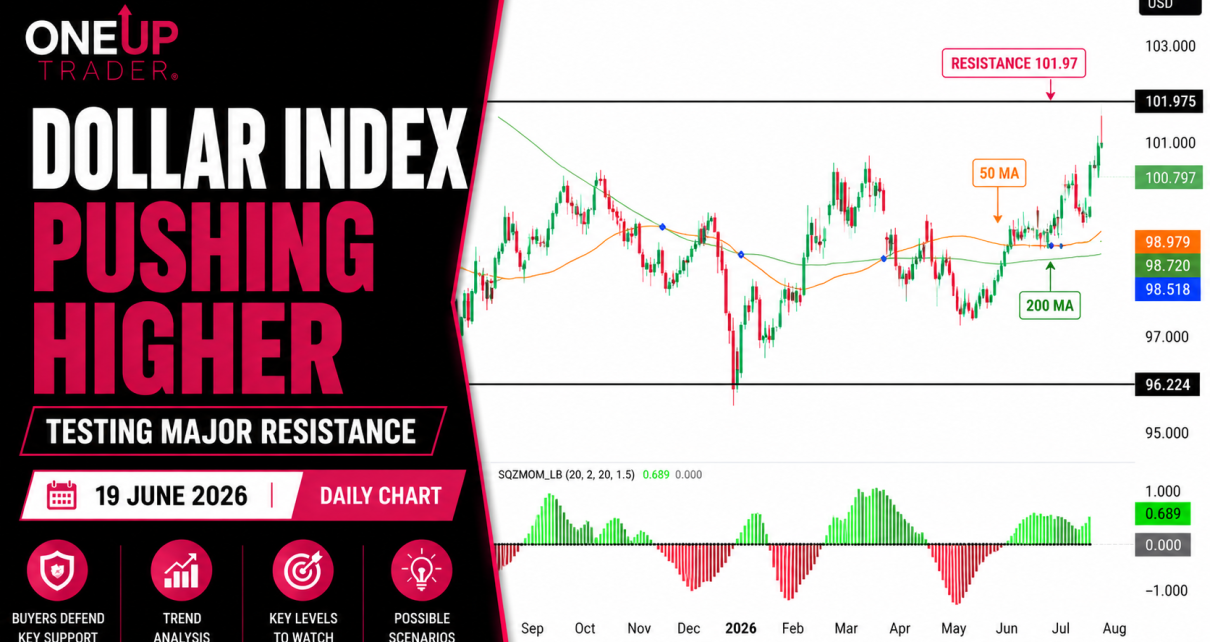
The U.S. Dollar Index continues to grind higher after spending most of the first half of the year trapped inside a broad consolidation range. While the move is not explosive, it is one of the stronger bullish stretches we have seen from DXY in several months.
U.S. equities rebounded sharply on Thursday, with the S&P 500 gaining 1.1% as investors bought the previous session’s dip following the Fed’s hawkish outlook. While concerns over higher inflation and potential future rate hikes initially pressured risk assets, improving sentiment around a U.S.-Iran peace agreement helped support markets. The U.S. Dollar remained firm on expectations of tighter monetary policy, while oil prices traded mixed as traders assessed the impact of the reopening of the Strait of Hormuz on global crude supply.
Unlike equity indexes or commodities, the Dollar rarely produces large directional moves in short periods of time. Because of that, even a 1-2% move can be significant from a macro perspective. Right now, DXY is beginning to push toward the upper end of its multi-month range near 102, which could become an important test over the coming weeks.
The question now is whether buyers can finally break the range that has capped the Dollar throughout 2026, or if this is simply another rally into resistance, and what this means for our equity trades.
DXY Trend Analysis
Important Points
The technical picture has improved considerably over the past month.
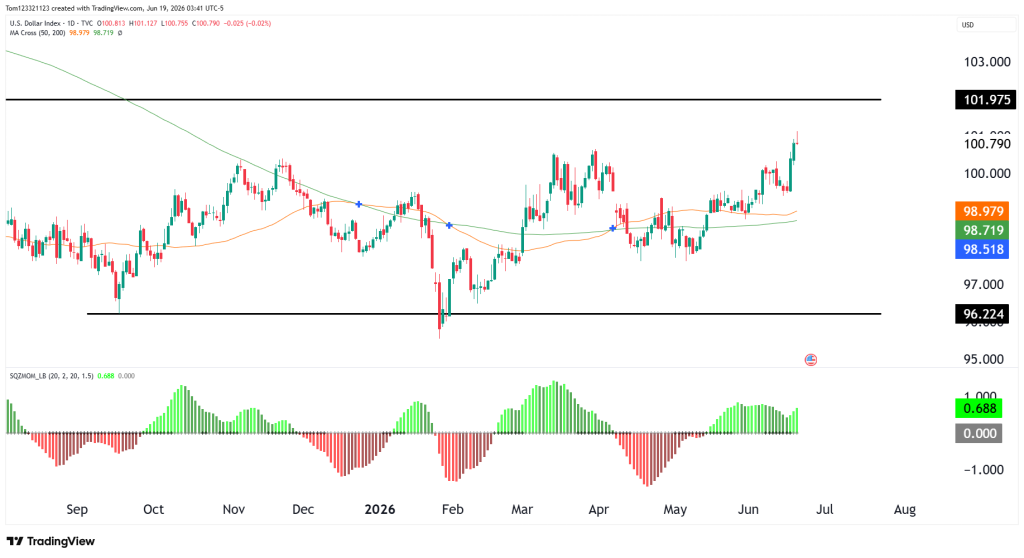
Price is now trading above both major moving averages, momentum has turned positive again, and buyers continue defending pullbacks before they can develop into larger corrections.
Current technicals show:
- The 50-day moving average near 98.98
- The 200-day moving average near 98.72
- Current price trading around 100.90
- Major resistance near 101.97
- Multi-month support near 96.22
One of the most encouraging developments for bulls is that DXY has successfully reclaimed both moving averages and turned them into support. Throughout late 2025 and early 2026, rallies repeatedly failed once they approached the upper part of the range. This time the structure looks healthier.
Momentum has also begun building again after a brief slowdown in April and May. Looking at the histogram beneath the chart, buying pressure remains positive and is starting to accelerate higher.
Estimated Probabilities for DXY
| Scenario | Estimated Probability | Market Interpretation |
|---|---|---|
| Breakout above 101.97 resistance | 45% | Buyers extend the current recovery and strengthen the trend |
| Consolidation below 102 resistance | 40% | Market pauses while digesting recent gains |
| Rejection back toward moving averages | 15% | Resistance holds and sellers regain short-term control |
Key Support and Resistance Levels
Major Resistance Levels
- 101.97
- 102.50
- 103.50
Major Support Levels
- 100.00 psychological support
- 98.98 (50-day moving average)
- 98.72 (200-day moving average)
DXY Possible Trades
Bullish Continuation Trade
The current structure favors buyers. As long as DXY remains above both moving averages, traders will likely continue watching for a move toward the 102 resistance area and potentially a breakout beyond it.
Consolidation Trade Setup
Given how important the 102 level has been historically, a period of sideways consolidation would not be surprising. Markets often pause before major breakout attempts.
Bearish Rejection Trade
For bears to regain control, DXY would likely need to fail near resistance and lose both moving averages again. Until that happens, pullbacks appear corrective rather than trend-changing.
This analysis is provided for educational and informational purposes only and should not be considered financial or trading advice. Trading futures, forex, and other leveraged financial instruments carries a high level of risk and may not be suitable for all investors. Past performance is not indicative of future results. Before making any trading decisions, conduct your own research, assess your risk tolerance, and consult with a qualified financial advisor if necessary.