



Introduction
It is time for another funded trader success story, and today, we are looking at Alexander, a trader from Palmira, Colombia, who passed the $50K evaluation with OneUp Trader.
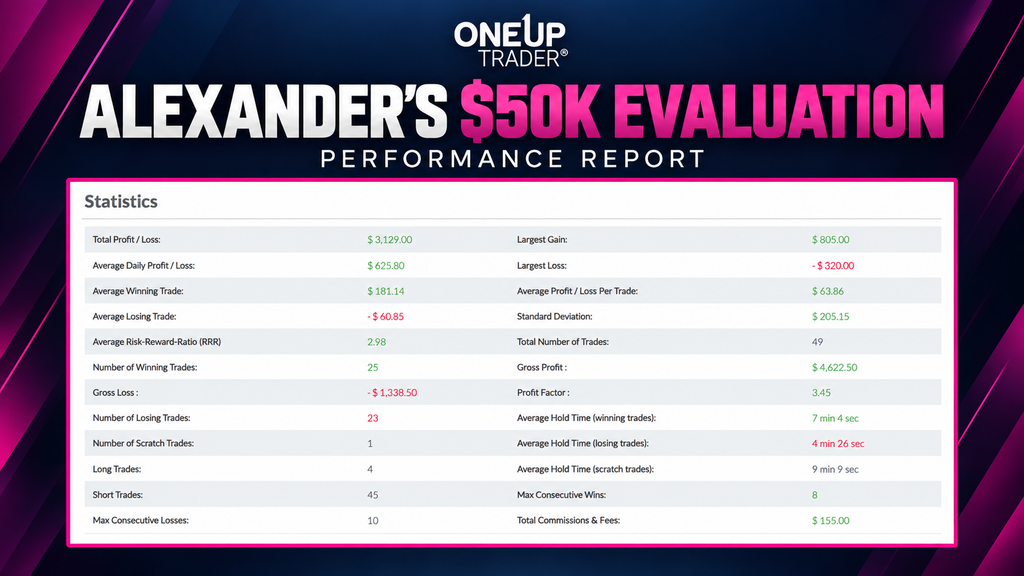
The freelance designer has four years of trading experience and has been with us since June 2025. His evaluation report shows $3,129 in profit across 49 trades.
His average winner was almost three times the size of his average loser, helping him finish profitably while winning just over half his trades. Let’s take a closer look at how he approached the evaluation and what we can learn from him.
Alexander at a glance
- Trader from Palmira, Colombia, with a professional background in design.
- Four years of trading experience and with OneUp Trader since June 2025.
- Passed the $50K evaluation using a scalping and intraday approach.
- Trades through NinjaTrader.
- Recorded $3,129 after costs across 49 evaluation trades.
- Average winner of $181.14, compared with an average loss of $60.85.
- Identifies resilience, patience, and consistency as strengths, while working on distractions.
From design to a new financial profession
Alexander was drawn to trading by the opportunity to develop a new profession that combined financial knowledge with discipline.
“The opportunity to grow and build a new profession based on finance and discipline.”
— Alexander, translated from Spanish
He trades equity index futures, energy, metals, and micro contracts through NinjaTrader. He describes himself as a scalper and intraday trader, explaining in his interview that the $50K account suited his strategy and trading style.
Watch Alexander discuss his evaluation and trading routine in his full interview in Spanish. Quotations in this article have been translated into English.
How does Alexander prepare before a trade?
Alexander begins preparing around 20 to 30 minutes before the US market opens. He reviews relevant news, studies his charts, and marks the areas where he wants to watch price react. His analysis moves from the daily chart down to the one-minute timeframe, getting an idea of the longer-term picture before moving to his entry timeframe.
“I mark important zones and wait for price reactions before looking for an entry that fits my trading plan and strategy.”
— Alexander, translated from Spanish
Marking a level gives him an area to watch. The reaction at that level helps him decide whether an entry meets his conditions. For other traders, the practical lesson is to define what needs to happen before placing the order.
For a step-by-step approach to preparing for an evaluation, see our guide on how to pass a prop firm evaluation.
What his 49 evaluation trades show
Alexander’s performance report records $3,129 in total profit after commissions and fees, with an average daily profit of $625.80 and an average profit per trade of $63.86. These figures are from his 50K evaluation, which he passed in just 3 days of trading.
His profit factor was 3.45, meaning he generated approximately $3.45 in gross trading profits for every dollar of gross trading losses, before commissions and fees.
It is a strong evaluation result, although 49 trades remain a limited sample for judging long-term performance which we know, but if Alexander can continue with this while funded, he will be on the right track to making his first withdrawal!
How did a 51% win rate produce that result?
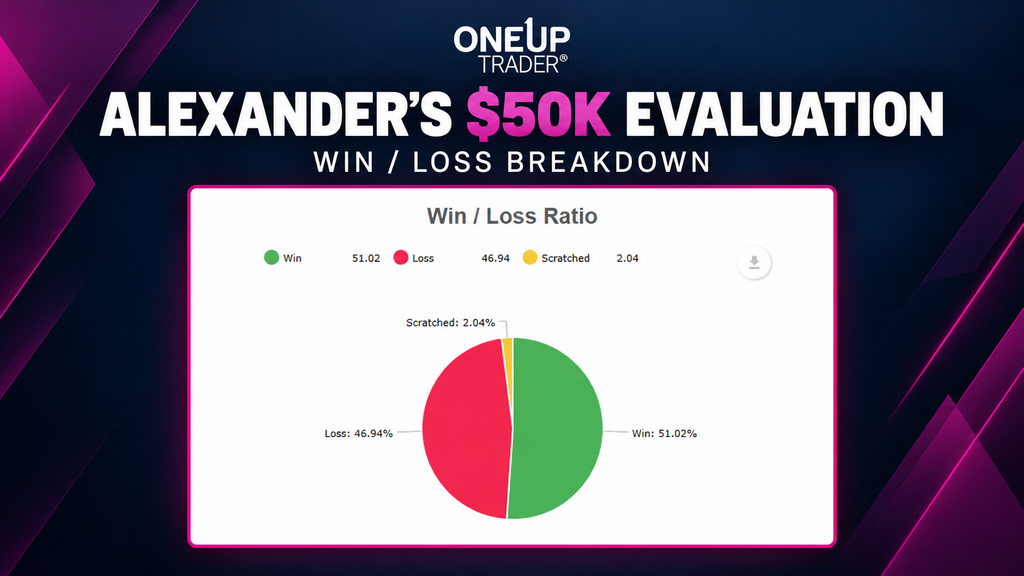
Alexander recorded 25 winning trades, 23 losing trades, and one scratch trade. That gave him a win rate of 51.02%, with losses accounting for 46.94% and the scratch trade making up the remaining 2.04%.
His average winning trade was $181.14, while his average losing trade was $60.85. His average winner was therefore approximately 2.98 times the size of his average loser.
Let’s look at a simplified example using ten trades, with five winners and five losers at those averages:
- Five winners: 5 × $181.14 = $905.70
- Five losers: 5 × $60.85 = $304.25
- Difference: $601.45
This hypothetical uses his reported averages, rather than ten actual trades. It shows how larger winners could leave a positive result even with an equal number of wins and losses.
His holding times add another detail. Winning trades lasted an average of 7 minutes and 4 seconds, compared with 4 minutes and 26 seconds for losing trades. His winners stayed open around 1.6 times as long on average. His largest gain was $805, while his largest loss was $320.
What traders can take from this is to review win rate alongside average win and average loss. The relationship between those figures explains much more than any one of them alone.
A successful evaluation still included ten losses in a row
Alexander’s report lists a maximum of ten consecutive losing trades, compared with a best winning streak of eight.
The report does not show the individual losses in that sequence, so we cannot calculate its cost from the overall average loss. It does show why losing runs need a place in a trader’s risk plan. A profitable evaluation can still include several unsuccessful trades in succession.
Why did the consistency rule stand out to him?
One of Alexander’s strongest comments about OneUp Trader concerned the evaluation’s consistency requirement. He said he liked the rule so much that he was working on his strategies with it in mind.
Under OneUp’s current guidance, the combined net profits from the three other best trading days must reach at least 80% of the largest day’s net profit. The comparison uses daily net results, rather than the size of an individual winning trade.
As a hypothetical example, if the best day produces $1,000 in net profit, the other qualifying days need to total at least $800. Results of $400, $250, and $200 would add up to $850 and meet that requirement.
Alexander says the evaluation structure helped him organize his objectives and develop discipline. For readers, the useful lesson is to understand how the rules affect the trading plan before starting.
See the official evaluation rule definitions for the current consistency requirements.
How does he keep his attention on the plan?
Alexander identifies resilience, patience, and consistency as his strengths. When asked about weaknesses, he gives a straightforward answer:
“Distractions sometimes make me lose focus.”
— Alexander, translated from Spanish
His preparation depends on observing price around the zones he has marked. If a distraction causes him to miss that reaction, the preparation becomes harder to put into practice. Reviewing what interrupted his attention gives him something specific to improve next time.
Why did Alexander choose OneUp Trader?
Alexander discovered OneUp Trader through a trading friend. His friend’s experience and OneUp’s time in the market helped build his confidence in trying the evaluation.
He rated his overall experience 8 out of 10, said he was very satisfied with the evaluation, and found the platform and connection setup easy. He also highlighted the clarity of the website, dashboard, and account information.
In his interview, he described the process after passing as quick and straightforward. He said the fees matched what had been explained to him at the start, with no unexpected charges in his experience.
His longer-term goal is to build meaningful monthly trading income. Passing the evaluation is an important step toward that goal, with his first withdrawal still ahead of him.
The takeaway
Alexander passed his $50K evaluation with $3,129 in reported profit after costs across 49 trades. He won just over half of them, with average winners almost three times the size of his average losers.
His preparation follows a clear sequence: review the news, work through the timeframes, mark important zones, and wait for a reaction that fits his plan.
For other traders, his results show why the size of wins and losses matters alongside win rate. His next task is to build on that performance as he works toward his first withdrawal.
Interested in becoming a funded trader?
Disclaimer: Individual results vary and are not typical. Evaluation results are simulated and do not represent withdrawals. Passing an evaluation does not guarantee future profits or payouts. Futures trading involves substantial risk of loss. Evaluation and payout rules may change; check OneUp Trader’s current rules.