


Introduction
Laura has been trading for six years, balancing it alongside a full-time career in sales, a role that demands quick thinking, constant decision-making, and the ability to act under pressure.
She carries that same mindset into her trading and primarily focuses on scalping the E-mini S&P 500 (ES) and the NASDAQ (NQ).
Based in Bucharest, Romania, she has withdrawn an impressive overall total of $48,100 after trading multiple funded accounts with the OneUp Trader funded program. In 2026 alone, her withdrawals have already exceeded $24,000, including $17,640 in March.
While the total payout is impressive, the real insight comes from looking deeper in the sense that when you break down her individual accounts, the results vary significantly, revealing far more about her strategy, execution, and decision-making process than the impressive amount withdrawn number alone.
We’ll take a closer look at her statistics and what traders can learn from the way she approaches the market.
Main Funded Account Statistics
For this breakdown, we’re focusing on 3 of Laura’s funded accounts and her most recent account from which she withdrew $11,600 from.
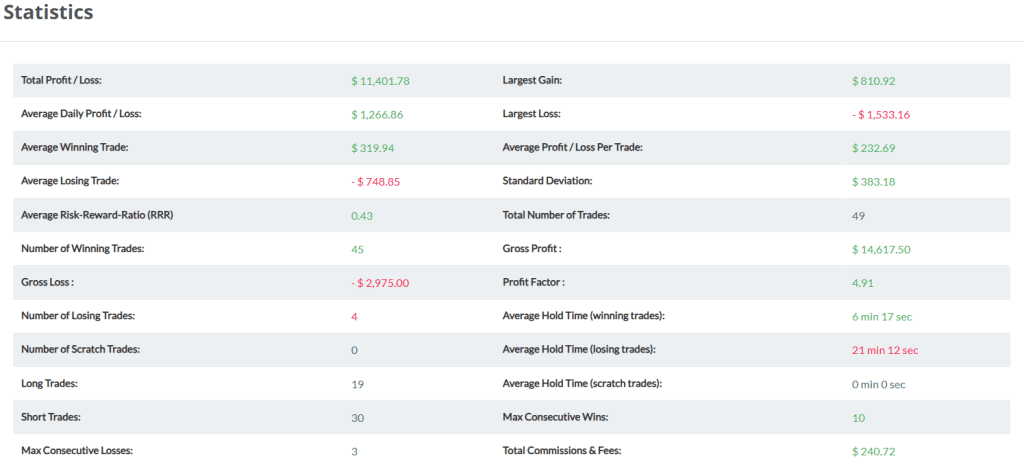
Across these funded accounts, Laura generated a combined profit of over $19,000, with each account showing noticeable performance differences.
Looking at the averages across the three accounts:
- Average Profit per Account: ~$5,000–$6,000
- Average Trades per Account: ~40–50
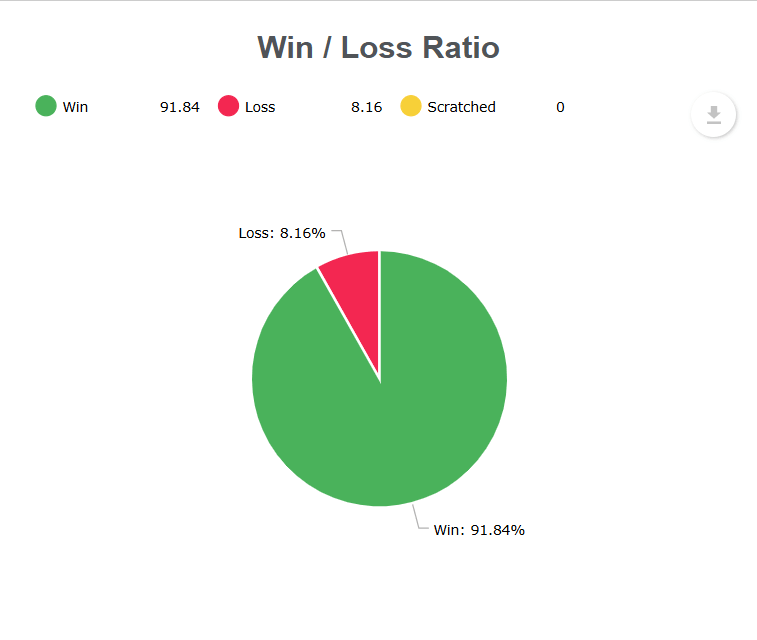
- Win Rate Range: ~85% to 92%
- Profit Factor Range: ~1.4 to 4.9
A win rate consistently above 80% is achieved through a scalping strategy that captures small, frequent market moves. With a relatively low number of trades per account, she is not overtrading. Instead, she is using a scalping strategy with high accuracy.
But there are more elements to her strategy besides the high win rate.
High Win Rate, Low Risk-Reward
Across all three accounts, one pattern remains consistent, and that is her average winning trades are significantly smaller than her losing trades.
For example:
- Winning trades range roughly between $140 and $320
- Losing trades range between -$600 and -$750
This results in a risk-reward ratio below 0.5 across all accounts.
This type of system can mean that a few losses in a row can blow the account, but Laura’s system is built around taking advantage of the market moves when they are in line with her strategy, and she doesn’t mind if she loses the account. She simply returns to the evaluation to try again. In the chart below we can see that for eight days straight, she makes nearly $2,000 and then has one big loss.
As we have mentioned many times, this strategy can work for traders at the OneUp Trader funded trader program because they can simply return to the evaluation and get funded again. The express accounts also mean they can get funded in only 5 days from the day they lose their funded account.
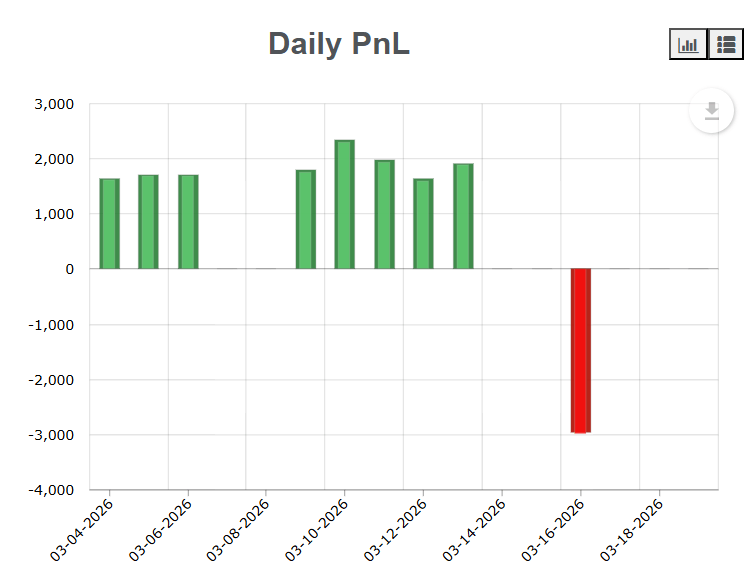
Laura’s approach depends heavily on maintaining a high win rate. The system works because losses are relatively rare, not because winners are significantly larger.
Many traders are taught to aim for large risk-reward ratios, but in practice, some strategies operate in the opposite way. The trade-off is simple: if losses are larger, they must happen less frequently. The thing is that this is only really possible with OneUp Trader because a system like this would never work in a self funded account. It would eventually end up in the account going to zero. It shows that with funded trader programs, you can still make money in trading without being a perfect trader.
What Makes This Performance Interesting
What makes her results interesting is how much they vary between accounts.
One shows a profit factor of around 1.4, while another is close to 5.0, which is a big difference. Even with the same trader, the same strategy, and similar market conditions, results can still change depending on execution, timing, and decisions made during the session.
This is something many traders underestimate. Consistency doesn’t mean getting the same result every time. Even a solid system can produce very different outcomes in the short term. What matters is that over a larger sample, the approach remains profitable, which her overall performance clearly shows.
Holding Time and Trade Management
Another important statistic to look at is holding time.
Across Laura’s accounts, winning trades are usually closed quickly, while losing trades tend to be held longer. We’ve seen this pattern come up more than once. Profits are taken fast, but losses are given more time to turn around. In scalping, that can work when the win rate is high, but it also adds risk.
You can see that in some of the larger losses, with one reaching as much as -$1,900.
This is where execution really matters. Even a small improvement in how losses are handled could make a noticeable difference in overall consistency, especially since her win rate is already strong.
Trading Background & Approach
Laura’s approach to trading is straightforward. She focuses on charts, reacts quickly, and relies on speed as one of her main strengths. That aligns well with a scalping strategy, where execution timing is more important than complex analysis.
At the same time, she identifies emotions as her main weakness.
Larger losses and extended holding times often reflect hesitation or a reluctance to exit trades. This is one of the most common challenges in trading, regardless of experience level.
What stands out in her case is that despite this, she has still managed to maintain strong overall profitability.
OneUp Trader Experience
Laura found OneUp Trader through an affiliate and chose the platform for its simplicity and ease of use.
She rated the experience highly, particularly highlighting how easy it was to set up and operate. For traders managing multiple accounts, a stable and straightforward platform becomes even more important.
In her case, being able to scale across several funded accounts and withdraw over $40,000 reflects both her own consistency and the flexibility of the OneUp Trader funded trader program. Traders can get funded on up to 3 accounts at a time!
What Traders Can Learn From This
Laura’s performance highlights several important ideas:
- High win rate strategies can work even with low risk-reward ratios
- Scalping does not require high trade frequency if execution is precise
- Results can vary significantly across accounts, even with the same strategy
- Loss management plays a major role in long-term consistency
- Emotional control remains one of the biggest factors in trading performance
Perhaps the most important takeaway is that profitability does not come from perfect execution, but from maintaining an edge over time. It is also about realizing that you dont have to be a perfect trader at OneUp Trader to be successful. This is what the platform offers traders, the ability to withdraw sizeable profits and get funded as many times as possible.
Final Thoughts
Laura’s results are a good reminder that there’s no single “correct” way to be profitable in trading. Her approach goes against what many traders are taught, yet it works because she understands the strengths and limits of her system and sticks to it.
What stands out isn’t just the profit, but the consistency behind it. Even with variation between accounts, larger-than-average losses, and the emotional challenges she openly acknowledges, she continues to produce solid results over time. That’s what separates a working strategy from a theoretical one.
Her performance also highlights the advantage of the funded model. It allows traders to lean into strategies that may not survive in a personal account, while still giving them the opportunity to generate real income.
In the end, this isn’t about being perfect. It’s about finding an edge, managing risk in a way that fits your approach, and executing well enough, consistently enough, to stay profitable over the long run.