



A $50,000 evaluation does not give you $50,000 of room to trade with. That is just your buying power; the drawdown is something different, and it is important you know how it works before you start trading.
This guide shows how OneUp Trader’s trailing drawdown works, when it locks, and how to size trades so a normal losing streak can’t reach it. If you size off the account balance instead, the trail can stop you before your trading edge has time to show itself.
What is OneUp Trader’s trailing drawdown?
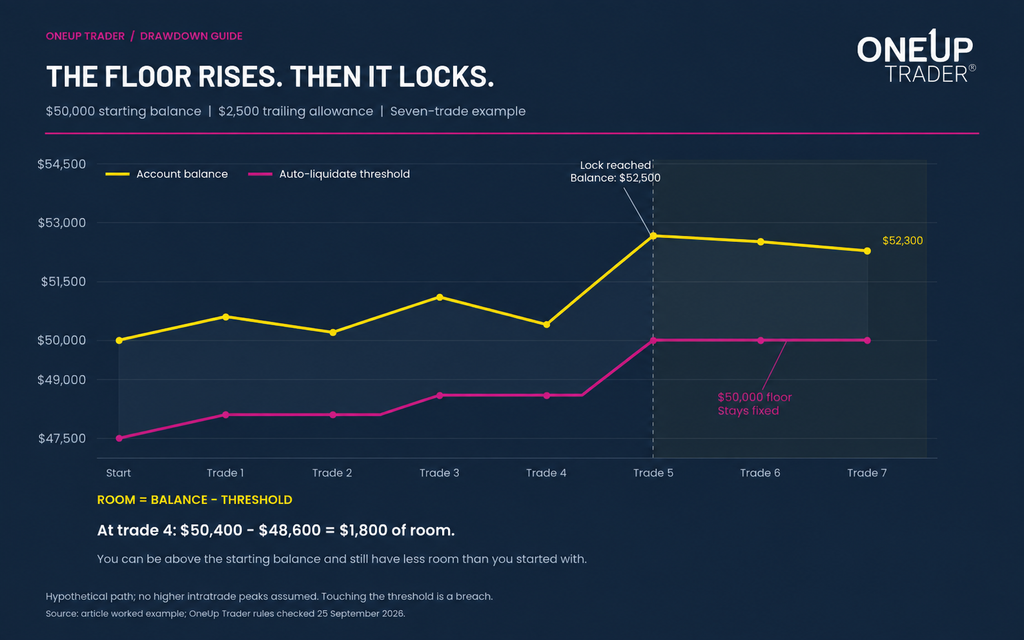
- The trailing drawdown (also called the auto-liquidate threshold) is a balance level your account must stay above. Touching it is a breach.
- On a $50,000 account, the starting drawdown is $2,500 below the account balance, so the threshold begins at $47,500.
- It is calculated in real time during the session, not at the close.
- It includes commissions and fees.
- When your balance makes a new high, the threshold moves up by the same amount.
- It never moves down.
- Once the threshold reaches your initial starting balance, it locks there and stops trailing.
- Size your risk off the starting drawdown amount, not off the full account size.
How does the trailing drawdown move during a session?
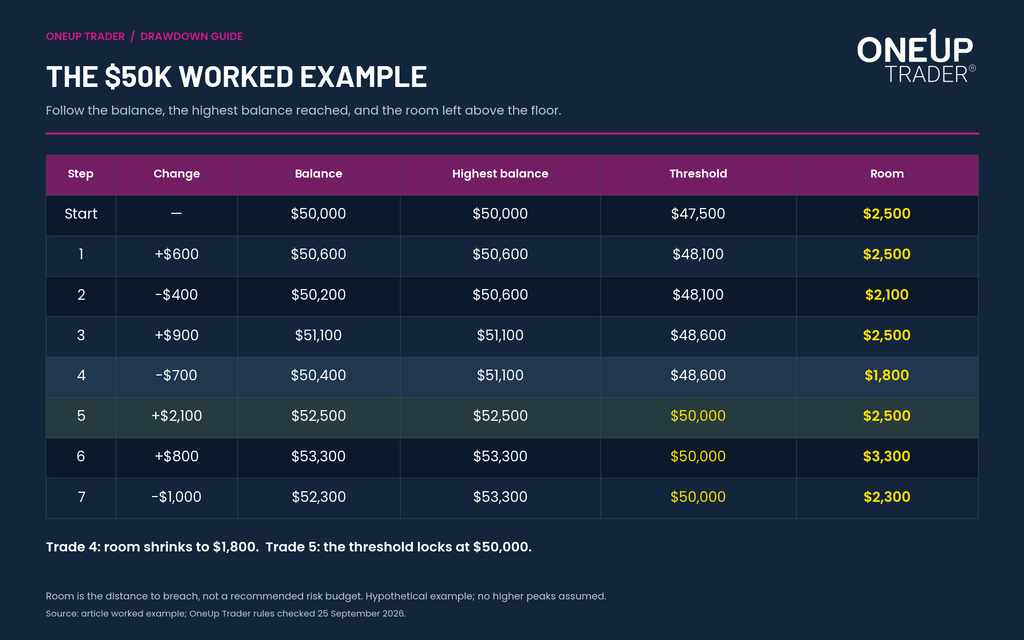
Let’s use the same account size we started with: a $50,000 evaluation with a trailing drawdown starting at $47,500.
In the table below, “room” means account balance minus threshold, the most you can lose before you touch the trailing drawdown.
Three things to take from the table:
- Wins don’t add room before the drawdown locks at the initial starting balance. At steps 1 and 3, the threshold rises with the new high. Room stays at $2,500.
- Losses take room away. At step 4, you’re up $400 on the account but only $1,800 from the threshold.
- The threshold stops at $50,000. From step 6 on, profit adds room instead of lifting the floor.
Does open profit move the threshold?
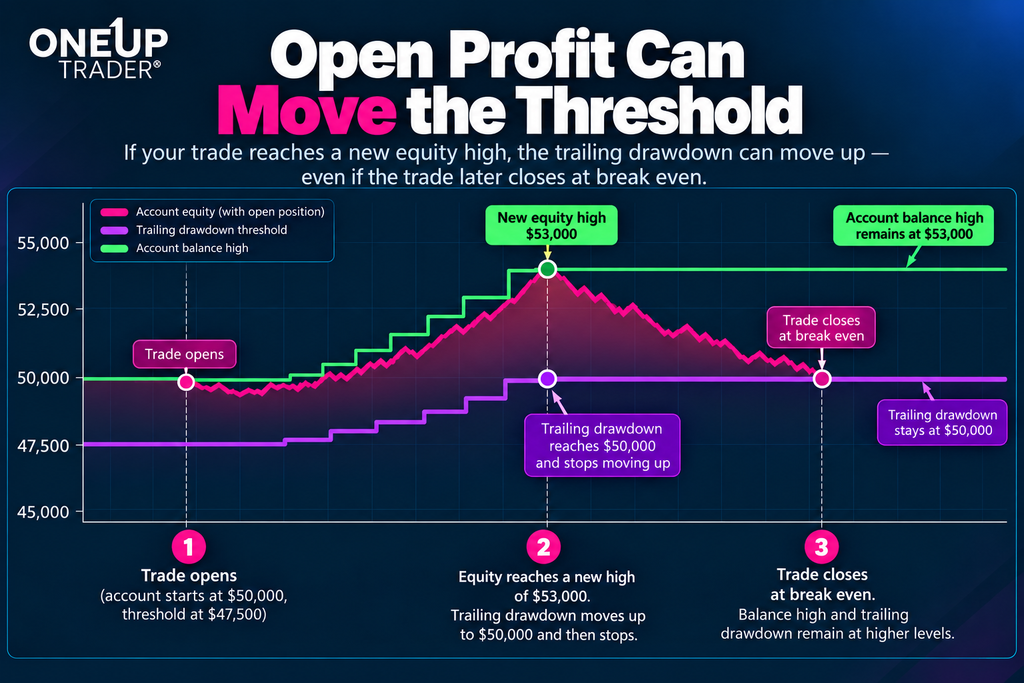
Yes. The threshold is calculated in real time, so if open profit pushes your equity to a new high, the threshold moves up with it. Giving that profit back doesn’t move it down.
The chart above shows this in three steps. At point 1, the trade opens, marking the first trade taken on the account. As the trade plays out, it takes the account balance to new highs (green line). At point 2, the trade takes the account balance (pink line) to its highest point thus far, and the drawdown threshold (purple line) steps up behind it until reaching the initial starting balance. The trader continues to hold the trade, and it starts running against them. At point 3, the trader gives all the profit back and hits the drawdown. (This is only a hypothetical example to explain how the drawdown trails the account balance high)
When does the trailing drawdown stop trailing?
As we can see in the example above, it stops when the threshold reaches your initial starting balance. Once it locks at the starting balance, that floor stays there no matter how high the account balance goes. It could even go to $1M, which would essentially mean a $1M drawdown. This is for both the evaluation and funded accounts.
How should you size risk against the trailing drawdown?
The Position sizes off the room you have in the drawdown, not the account. A common rule of thumb is to risk 1% of the account per trade. On $50,000, that’s $500, which is 20% of a $2,500 allowance on every trade. It is better to size it based on what you can afford to lose ($2,500) instead.
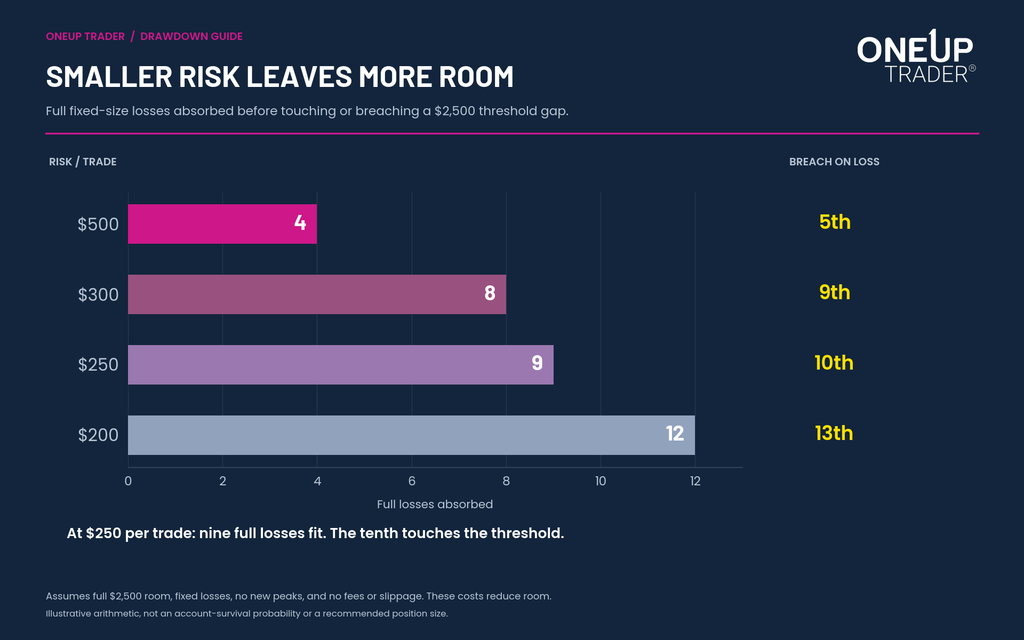
These are simple “full losses until you’re done” counts, not a backtest. At roughly a 45% win rate, long losing streaks show up often enough that risking $500 on a $2,500 room is fragile. Cutting risk to about $200–$250 per trade leaves more room for a normal bad run before you touch the threshold. If your losses cluster in a choppy week, you need even more cushion than this table suggests.
Resize when your drawdown room shrinks
Before the drawdown locks at your initial starting balance, the room you have to trade with changes after every trade. Set your position sizing based on what’s left, not on the starting allowance. This is playing defense and is about preserving capital.
At step 4 in the example, the drawdown room is $1,800. At $250 a trade, you can take seven full losses. At $500, you can take three, and the fourth breaches.
What mistakes blow evaluations because of trailing drawdown?
- Sizing off the account size. 1% of $50,000 is 20% of a $2,500 allowance. Five straight losses, and the account is done.
- Letting open winners round-trip. A trade that runs and comes back can lift the threshold while your closed balance goes nowhere. Decide in advance where you’ll protect open profit.
- Treating the threshold as a line you can touch. Your balance must not hit it. A stop that lands exactly on it breaches it, and slippage and commissions can push you past, so leave a buffer.
- Keeping the same size after a pullback. The drawdown room shrinks after every loss before the lock. Same size means each trade takes a bigger share of what’s left.
- Thinking it resets each day. The threshold never moves down. A bad Tuesday carries into Wednesday.
- Doing the math in your head. Check the live auto-liquidate threshold before each session. Write it down and keep tracking it in the R|Trader dashboard.
How is the trailing drawdown different after you’re funded?
The rule still applies. On a funded account, your balance must not touch or go past the trailing drawdown. It is still calculated in real time and includes commissions and fees.
Two funded details affect your drawdown room:
- Withdrawals. Taking money out lowers your balance. The threshold does not move down with it, so a withdrawal shrinks the room you can trade with. OneUp Trader pays out profits only above a withdrawal threshold.
- The first 90 days. During the probation period, your net PnL must be above the initial starting balance at the end of each 15-calendar-day interval. That is separate from the trailing drawdown, but a deep dip can threaten both.
For the full path from evaluation to payout, read How to Pass a Prop Firm Evaluation (and Get Paid After).
FAQ
What is the auto-liquidate threshold on OneUp Trader?
It’s another name for the trailing drawdown. It’s the balance level your account must stay above. Touching it is a breach.
Does the trailing drawdown go back down after a loss?
No. It only moves up when your balance makes a new high. A loss leaves it where it is, so your room shrinks.
When does the trailing drawdown lock?
When the threshold reaches your initial starting balance. With a $2,500 allowance on a $50,000 account, that happens when your balance first reaches $52,500. The threshold then stays at $50,000.
How much should I risk per trade against a trailing drawdown?
Base it on your room, not the account size. At $250 a trade, a $2,500 allowance takes nine full losses before the tenth touches the threshold, before commissions. Pick a size that survives the losing streaks your win rate can produce.
Does the trailing drawdown reset each day?
No. It never moves down, so losses from one session carry into the next.
You can start an evaluation when you’re ready. For the full route from evaluation to payout, read How to Pass a Prop Firm Evaluation (and Get Paid After). For current figures, check the evaluation rules and profit and withdrawal info.
This article is for education only. It is not financial or legal advice. Evaluation and funded accounts use simulated or firm capital, not your own brokerage account. Examples are hypothetical. Rules and figures can change, so check the live OneUp Trader terms before you trade.