


Introduction
Gold futures have broken lower since our previous analysis, the support that buyers had been defending throughout late May and early June has broken to the downside.
From here it is important to see how the bulls react at this level. If we see continued selling pressure, we could see GC fall to $3,600.
Gold Futures Trend Analysis
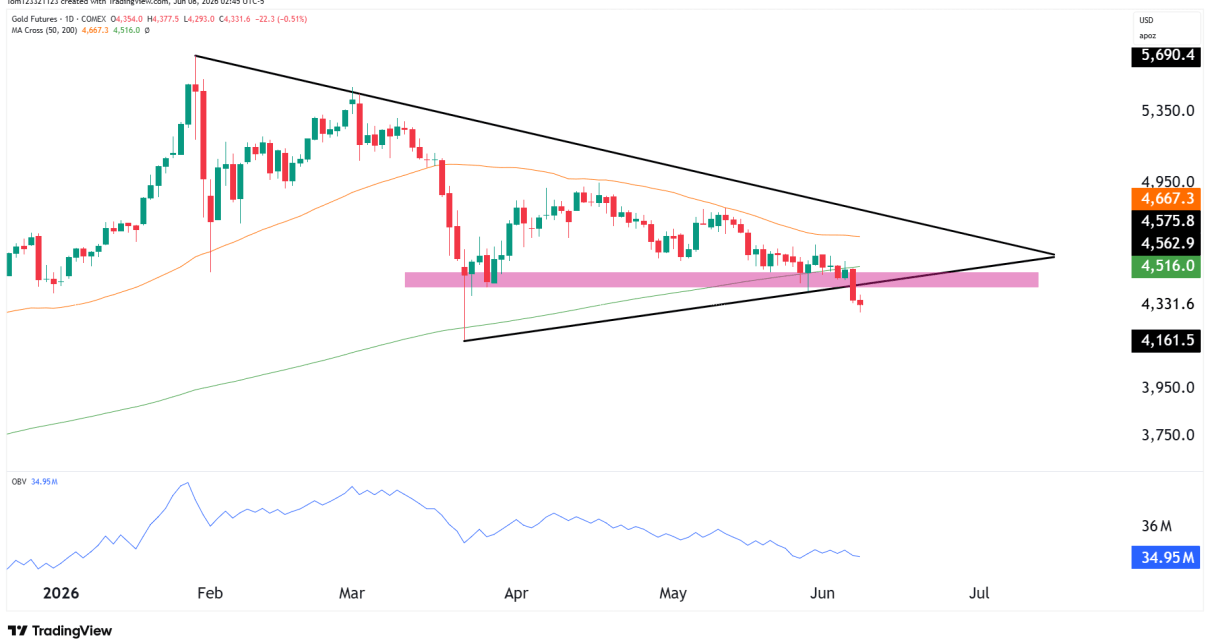
The broader long-term trend remains bullish while Gold continues trading above the 200-day moving average. However, the short-term structure has clearly weakened following the recent breakdown.
Current technicals show:
- The 50-day moving average near 4,667
- The 200-day moving average near 4,516
- Current price trading around 4,330
- Former support zone near 4,400–4,450 now acting as resistance
- Major swing low support near 4,160
One of the most important developments on the chart is the failure of the triangle structure we discussed previously.
Rather than breaking higher through descending resistance, price lost the lower trendline and quickly moved below the support zone that buyers had defended multiple times during April and May.
When a market spends weeks building a consolidation pattern and then breaks lower, it often signals that sellers have gained the upper hand in the short term.
Support Has Failed
The biggest change from our previous analysis is simple: support is no longer support.
The 4,400–4,450 area acted as a floor for nearly two months. Buyers repeatedly stepped into that region and prevented larger declines from developing.
Now that price has broken beneath it, traders will likely begin viewing that same area as resistance on any recovery attempts.
This type of support-to-resistance flip is one of the more important technical developments currently visible on the chart.
Estimated Probabilities for Gold Futures
| Scenario | Estimated Probability | Market Interpretation |
|---|---|---|
| Continued decline toward 4,160 support | 50% | Sellers maintain control following the breakdown |
| Consolidation below 4,450 resistance | 35% | Market stabilizes after the recent selloff |
| Recovery back above 4,450 support | 15% | Buyers reclaim key levels and regain momentum |
Key Support and Resistance Levels
Major Resistance Levels
- 4,400–4,450
- 4,667 (50-day moving average)
- 4,850
Major Support Levels
- 4,160 swing low
- 4,000 psychological support
- 3,500–3,600 longer-term demand zone
Gold Futures Possible Trades
Bearish Continuation Trade
The breakdown below support shifts momentum toward sellers. As long as Gold remains below the former support zone, traders will likely continue watching for downside continuation toward the 4,160 swing low.
Resistance Rejection Trade
Any short-term bounce back into the 4,400–4,450 region could become important. If sellers defend that area and prevent buyers from reclaiming support, it would reinforce the current bearish structure.
Bullish Recovery Trade
For buyers, the first objective is reclaiming the former support zone. A move back above 4,450 would be the first indication that the recent breakdown may have been a false move. Until that happens, the burden of proof remains on the bulls.
Final Thoughts
Gold futures have moved from consolidation into breakdown territory after losing a key support zone that had been holding for several months.
The next major area to watch sits near the April swing low around 4,160. If buyers fail to stabilize price before reaching that level, the correction could continue expanding. On the other hand, a recovery back above 4,450 would improve the short-term outlook considerably.
For now, sellers hold the advantage while Gold remains below former support and beneath the declining 50-day moving average.
Let us know your thoughts in the comment section below.
This analysis is provided for educational and informational purposes only and should not be considered financial or trading advice. Trading futures, forex, and other leveraged financial instruments carries a high level of risk and may not be suitable for all investors. Past performance is not indicative of future results. Before making any trading decisions, conduct your own research, assess your risk tolerance, and consult with a qualified financial advisor if necessary.