

Introduction
Most traders believe the key to success in financial markets is finding the perfect strategy. They spend months testing indicators, switching systems, watching YouTube videos, and searching for the ‘holy grail’ that finally changes everything. At first, this feels like progress because learning new concepts creates the impression that success is getting closer.
But over time, many traders run into the same problem. Even after finding strategies that can produce solid results, they still struggle to stay consistent.
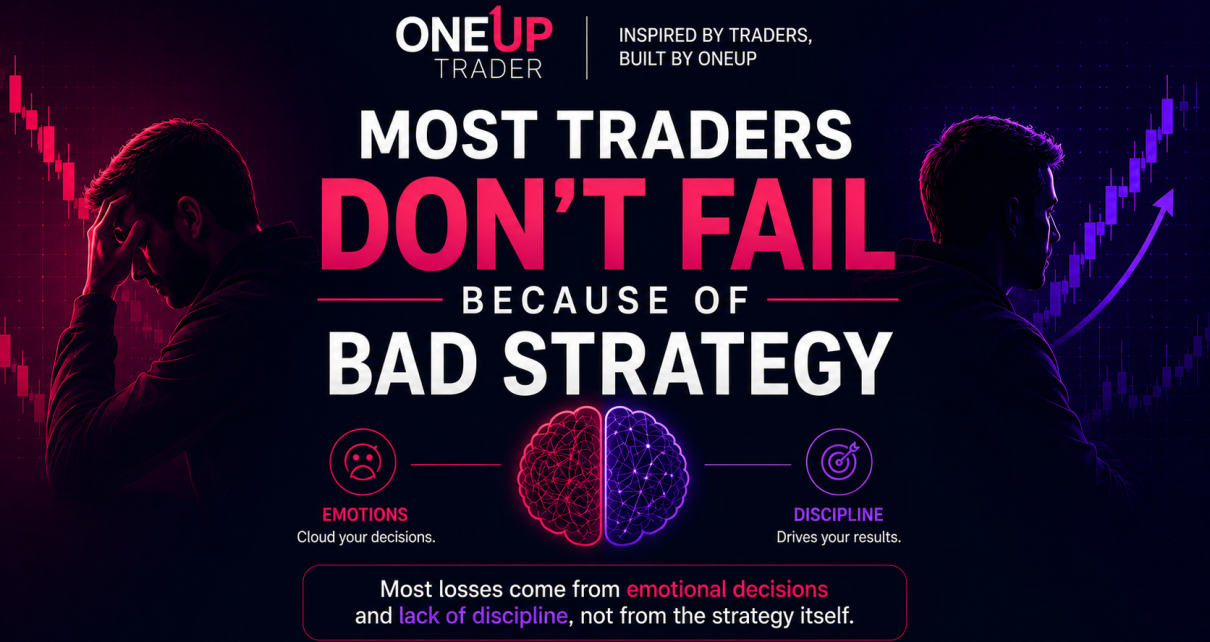
This is because most trading failures are not caused by a lack of knowledge. In many cases, traders already understand the basics of entries, exits, and risk management. The real difficulty lies in consistently applying those rules under emotional pressure and maintaining discipline. Fear, impatience, greed, and frustration almost always have a greater impact on trading performance than the strategy itself.

The Strategy Obsession
The trading industry constantly promotes the idea that there is always a better strategy available. Every day, traders are exposed to new indicators, automated systems, and social media posts showing huge profits and luxury lifestyles. This creates the belief that successful traders have discovered something hidden that other people have missed. This is how traders remain on the hamster wheel, convinced that they will eventually find the system that will make them a millionaire.
As a result, many traders constantly switch and never commit to one system or method. One month they focus on scalping. The next month they trade breakouts. Then they move to supply and demand or price action. They fill their archives with hundreds of different strategies, which they spend hours and hours testing, only to find that they are missing something, and they restart the process again.
We are not saying that doing your best when creating a system is an incorrect approach because it is very necessary for success. What is important is to develop a good strategy that suits you as a trader, has an edge over time, and to trust it.
The problem is that traders dont stick to it for long enough because when the inevitable losing streak arrives, they abandon the system and believe it to be a failure. The strange thing is that when the winning streak is there, they are convinced they have finally found the winning formula. Traders dont want to accept the reality that losers are a part of the game. They think something has suddenly gone wrong with their system, and the cycle repeats itself again.
Solution for “The Strategy Obsession”
The solution is not to endlessly search for more strategies, but to develop confidence through repetition. Traders need to understand that no strategy produces perfect results. Every system experiences losing streaks, periods of drawdown, and changing market conditions.
Instead of switching methods after a difficult week, traders benefit more from tracking performance over a larger sample size. Reviewing 50 or 100 trades provides a far more accurate picture than reacting emotionally to a few losses. This allows traders to evaluate whether the strategy actually has an edge instead of making decisions based on short-term emotions.
It is also important to simplify the learning process. Many traders overload themselves with indicators, conflicting opinions, and constant market commentary. Focusing on one approach, one set of rules, and one style of trading often creates far more consistency than trying to master everything at once.
Over time, confidence is built through disciplined execution rather than constant searching.
Most Trading Mistakes Are Emotional
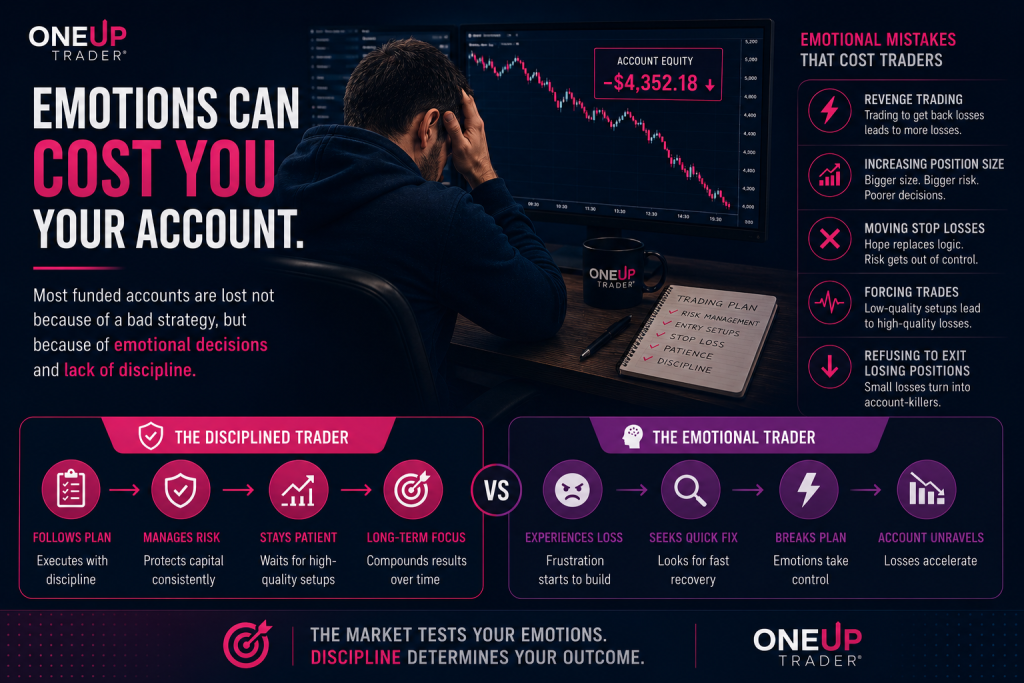
When traders lose their funded accounts in a funded trader program, the cause is rarely because of their system. More often, losses are linked to emotional decision-making and lack of discipline.
This can include revenge trading after a loss, increasing position size impulsively, moving stop losses, forcing trades during low-quality market conditions, or refusing to exit losing positions. These mistakes usually happen when traders stop following their plan.
For example, a trader may begin the day with proper discipline and risk management. After taking a few losses, frustration starts to build. Instead of staying patient, they begin searching for a quick recovery. At that point, the goal shifts from executing well to recovering emotionally.
This is where many accounts begin to unravel. The market places traders in situations where emotions directly affect decision-making, which is why trading psychology matters so much. A trader can have a strategy with a positive edge and still fail if emotions consistently interfere with execution.
Solution for “Most Trading Mistakes Are Emotional”
Improving trading psychology starts with creating structure before emotions appear. Traders often try to control emotions in the middle of stressful situations, but preparation beforehand is usually far more effective.
One practical solution is to create clear rules for entries, exits, risk limits, and daily loss thresholds. When decisions are made in advance, there is less room for emotional reactions during live market conditions.
Journaling also plays a major role in improving discipline. Traders who document their trades, emotions, and decision-making patterns begin to identify recurring mistakes much faster. Many emotional habits become obvious once they are written down consistently.
Another important adjustment is learning when not to trade. After multiple losses, frustration often clouds judgment. Taking a short break, stepping away from the screen, or ending the trading session early can prevent emotional decisions from escalating into major account damage.
Why Discipline Matters More Than Excitement
One of the biggest misconceptions about trading is that successful traders are constantly active in the market. In reality, many experienced traders are extremely selective.
They spend large amounts of time waiting for quality setups rather than forcing unnecessary trades. They focus heavily on protecting capital and managing risk. This often appears boring compared to the fast-paced trading content seen online.
Social media tends to highlight dramatic profits, oversized trades, and high-adrenaline moments. What it rarely shows is the consistency required to survive long term.
Professional traders understand that survival is critical. A trader who protects capital during difficult periods can continue trading when better market conditions arrive. A trader who constantly takes emotional risks may experience occasional large wins, but eventually those decisions usually create serious damage. Traders need to ask themselves if what they are doing is sustainable long-term. A good question before each trade is to ask, ‘Would a professional trader take this trade?’
The Importance of Risk Management
Risk management is one of the most overlooked aspects of trading. Many traders understand the concept intellectually but struggle to apply it in a correct way.
Position sizing plays a major role in emotional control. When traders risk too much on a single trade, emotions become significantly stronger. Small market movements begin to feel personal, which often leads to impulsive decisions.
On the other hand, controlled risk allows traders to think more objectively. Losses become manageable rather than overwhelming. This makes it easier to follow predefined rules instead of reacting emotionally.
Experienced traders understand that risk management is not simply about protecting money. It is also about protecting decision-making quality. Once emotions take control, discipline tends to disappear quickly.
Solution for “The Importance of Risk Management”
Strong risk management begins with accepting that losses are a normal part of trading. Traders who try to avoid losses completely often end up taking even larger risks in an attempt to recover quickly.
One of the most effective solutions is reducing position size to a level where emotions remain manageable. If a trader feels extreme stress during normal market fluctuations, the risk is usually too high. Smaller position sizes make it easier to think clearly and follow predefined rules objectively.
Consistency in risk exposure is also critical. Many traders risk small amounts during calm periods but suddenly increase size after losses or during periods of overconfidence. Maintaining consistent risk per trade helps stabilize both performance and emotional decision-making.
Setting maximum daily loss limits can provide another layer of protection. Once that limit is reached, stepping away from the market prevents emotional revenge trading from creating larger problems.
Ultimately, good risk management is less about maximizing profits and more about staying in the game long enough for skill and consistency to develop.
Why Funded Trading Evaluations Are Difficult
Funded trading evaluations expose emotional weaknesses very quickly. Rules such as daily drawdown limits and maximum loss limits force traders to remain disciplined under pressure.
Traders who rely on emotional recovery trades or oversized positions often struggle in this environment. At first, some traders view these rules as restrictive. However, they are designed to reinforce behaviors that are important in professional trading.
Successful traders generally focus on consistency, patience, controlled risk, selective execution, and long-term survival. They are usually not trying to double accounts quickly or take unnecessary risks.
This mindset shift is important. Many developing traders focus almost entirely on profit, while experienced traders focus heavily on protecting capital first. Over time, this difference in approach becomes significant.
Consistency Is Often Boring
One of the more difficult lessons in trading is realizing that consistency rarely feels exciting. Good trading is often repetitive. It involves waiting patiently, managing risk carefully, and avoiding emotional decisions.
For traders influenced by social media, this can feel disappointing at first. Many people enter trading expecting constant action and fast financial progress. When markets become slow or conditions are unclear, they feel pressure to force opportunities.
This is where unnecessary mistakes often happen. The reality is that professional trading usually looks much less dramatic than people expect. Strong traders understand that avoiding poor trades is just as important as finding good ones.
Patience is not passive in trading. It is a skill.
What Consistent Traders Tend To Do Differently
Consistent traders are not perfect. They still experience losses, frustration, and emotional pressure. The difference is that they create systems and habits that reduce emotional decision-making.
This often includes risking smaller amounts per trade, following predefined rules, accepting losses quickly, tracking performance honestly, avoiding impulsive trades, and focusing on long-term consistency instead of short-term excitement.
Many struggling traders approach the market with the need to constantly prove themselves. They want immediate results and emotional validation.
Consistent traders usually approach the market differently. Their primary focus is execution. They understand that profitability is often the result of repeating disciplined behavior over long periods of time.
Final Thoughts
Most traders do not fail because they lack access to information. Today, trading education is widely available. Strategies, chart analysis, and technical concepts can all be learned relatively easily.
The difficult part is maintaining discipline when emotions become uncomfortable. That is why consistency matters so much.
A trader who can manage risk, stay patient, and follow a structured process often has a major advantage over traders constantly reacting emotionally to market movements.
In the long run, trading success usually depends less on finding a perfect strategy and more on the ability to execute consistently under pressure. That difference changes everything.