


Two traders take the same futures trading setup. Both lose their first two trades. One closes the platform with enough room to trade tomorrow. The other increases size, tries to recover everything, and loses the account.
This is a hypothetical comparison, but it shows why an entry signal is only part of passing a prop firm evaluation. The same losing sequence can be manageable or account-ending depending on position size and stopping rules.
A good strategy still needs room to work. If a few ordinary losses can reach your drawdown limit, you have built a plan that depends on avoiding an ordinary part of trading.
The aim is to reach the target with a process you can keep using after funding. That starts with understanding what can end the account.
Why do most traders fail prop firm evaluations?
The avoidable mistakes to watch for are:
- Sizing trades from the advertised account size instead of available drawdown room.
- Increasing risk after losses to recover faster.
- Forcing trades to reach the profit target or finish on the earliest eligible day.
- Letting one unusually large winning day create a consistency shortfall.
- Trading without written entry, stop, size, and skip rules.
- Taking setups during news or market conditions they have not tested.
- Buying another evaluation without reviewing why the last one failed.
There is no universal failure rate behind this list. These are practical failure points to check in your own trading. A rule breach can end an evaluation; other mistakes can leave you taking more risk while still short of qualification.
Why is the trailing drawdown more important than the account size?
A $50,000 account label does not mean you can lose $50,000. What matters is the gap between your current equity and the drawdown threshold that ends the evaluation.
At OneUp Trader, the trailing drawdown is calculated during the session, includes commissions and fees, and rises with new balance highs. It does not fall after losses. During evaluation, it stops rising when the threshold reaches the initial starting balance. Touching the threshold is a breach, according to the current rule definitions.
Open profit matters too. If an open trade pushes equity to a new high, the trail can move up. Giving that profit back does not move the threshold down. Your closed trade result alone may therefore hide how much room you lost.
Before placing an order, write down your live equity, current threshold, and the difference between them. Keep part of that gap as a buffer for costs and slippage rather than treating every dollar as available risk.
For the mechanics, read how OneUp Trader’s trailing drawdown works. Then check the live platform value before each session and after meaningful changes in equity.
How can a few oversized losses wipe out a $50K evaluation?
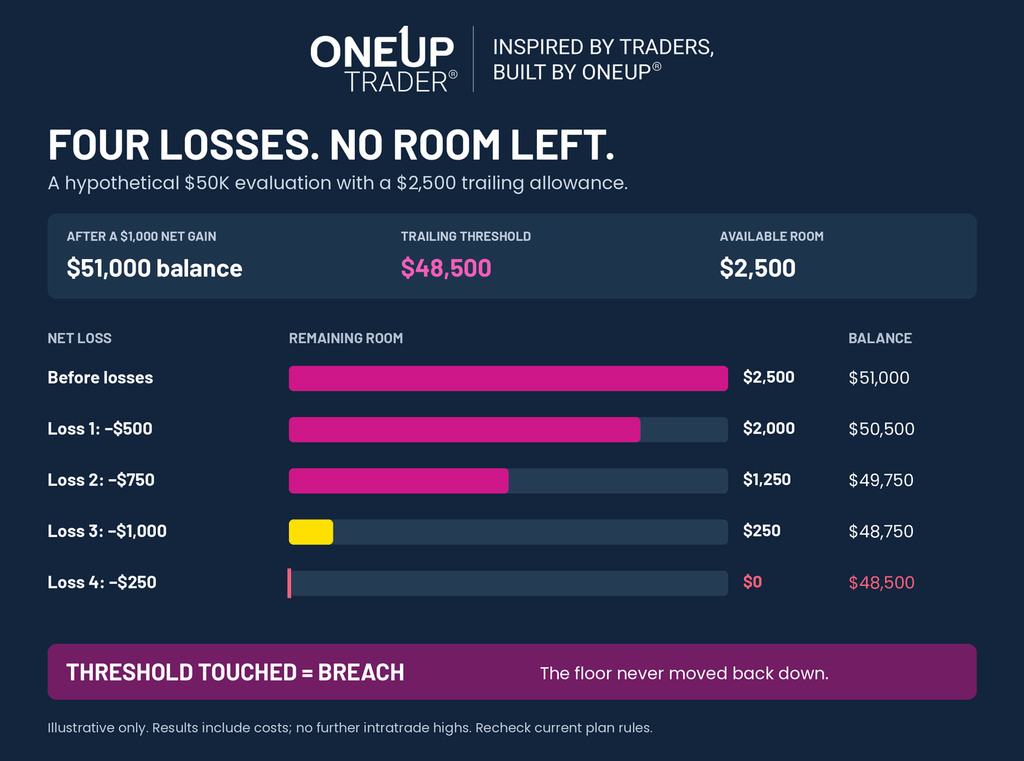
Hypothetical worked example: Assume a $50,000 starting balance and a $2,500 trailing allowance. These are illustrative inputs, not a substitute for checking your current OneUp plan.
The threshold begins at $47,500. A $1,000 net gain lifts the balance to $51,000 and the threshold to $48,500. Available room is still $2,500.
The trader then takes progressively larger losses, followed by a final attempt with the little room left.
| Step | Net result | Balance | Threshold | Remaining room |
|---|---|---|---|---|
| Start | — | $50,000 | $47,500 | $2,500 |
| Initial gain | +$1,000 | $51,000 | $48,500 | $2,500 |
| Loss 1 | −$500 | $50,500 | $48,500 | $2,000 |
| Loss 2 | −$750 | $49,750 | $48,500 | $1,250 |
| Loss 3 | −$1,000 | $48,750 | $48,500 | $250 |
| Loss 4 | −$250 | $48,500 | $48,500 | $0 — breach |
All results include costs. For simplicity, assume no additional intratrade equity highs lift the threshold.
The account ends only $1,500 below its starting balance because the earlier gain moved the floor upward. The trader can no longer use the original $47,500 threshold.
For comparison, four hypothetical net losses of $200 would use $800 of the $2,500 cushion, leaving $1,700. That does not make $200 the right risk for everyone. It shows how sizing changes the amount of bad trading an account can withstand.
Your risk budget needs to survive a plausible losing sequence with room left over.
Why does increasing size after a loss make recovery harder?
After a loss, you have less room. Increasing size means the next trade risks more dollars against a smaller cushion.
Recovery trading often sounds reasonable: “One normal winner with twice the contracts gets me back.” But the next trade does not become more likely to win because you need it to. Another loss can turn a manageable session into an account problem.
Decide your response before the session starts. Set a maximum dollar loss for the day and a rule for stopping after repeated losses. A hypothetical plan might stop after two full planned losses, but the right limit depends on the strategy and available room.
Do not widen a stop or add contracts because you dislike the running loss. If conditions invalidate the trade, follow the exit you planned.
Also review combined exposure. Being long two equity index contracts in different markets can still leave both positions vulnerable to the same move. Count the risk across open trades, not just the risk on each order ticket.
Why does chasing the profit target lead to bad trades?
The profit target is a qualification requirement. It is not evidence that today offers enough opportunity to reach it.
Traders often become least selective near the finish. A trade they would normally skip suddenly looks acceptable because they are “only one winner away.” Others push too hard early, aiming to finish on the first possible day.
OneUp’s published evaluation rules currently list minimums of 10 trading days for the standard Evaluation and five for Pro. Other plans differ. A minimum is an eligibility condition, not an instruction to hit the target by that date.
Plan around setups you can recognize and execute. Set a maximum number of attempts or a trading window if those limits fit your strategy. Do not turn either into a quota that forces activity.
If another billing period would stretch your budget, decide that before purchasing or renewing. Financial pressure outside the platform is a poor reason to increase risk inside it.
Can one huge winning day stop you from qualifying?
A large winning day can leave you short of a consistency requirement even after you reach the profit target. That is different from automatically breaching the account.
Under OneUp’s current published formula, the combined net profit from your three other best days must reach at least 80% of your largest winning day. Check the current consistency explanation for the complete application to your plan.
Hypothetical example: Your best day makes $1,000 net. Your next three best days make $200, $150, and $150. Their $500 total is below the $800 requirement.
Now suppose you force another oversized session and make $1,500. You have raised the biggest-day benchmark, so the calculation changes again. A bigger result does not necessarily finish the job.
Track the requirement alongside your profit target. Keep risk within the plan that produced your ordinary trading results, and allow qualifying opportunities to arrive.
Do not deliberately lose money to alter your results or force trades to manufacture qualifying days. The useful adjustment is to how you trade future sessions.
What should a written trading plan actually include?
A useful plan tells you what to do when money and emotion make decisions harder. It should fit on one page and answer five questions:
- Entry: What observable event allows me to enter?
- Stop: What price or condition proves the trade wrong?
- Size: How many contracts fit that stop within my risk budget?
- Skip rules: Which conditions make this setup unsuitable?
- Stopping rules: What ends my session, whether I am winning or losing?
“Trade a pullback” is incomplete. A hypothetical plan could specify a pullback after an opening-range breakout, an entry trigger, a stop beyond the pullback low, and no entry if price has returned inside the range.
Choose the stop from the setup, then calculate position size. Do not squeeze the stop closer merely to afford more contracts. If an appropriate stop is too expensive, use a smaller contract where suitable or skip the trade.
Afterward, record whether you followed the plan separately from whether you made money. A profitable rule-breaking trade still needs review.
Discipline alone cannot make an unprofitable strategy work. Review results across a meaningful sample, including costs and different market conditions, before committing to repeated evaluations.
Should you trade news and low-quality sessions during an evaluation?
Permission to trade an event does not mean your strategy is suited to it.
OneUp’s economic release guidance currently exempts evaluation traders from its requirement to be flat around releases. Funded traders face event-specific restrictions. Check the current guidance and your agreement rather than assuming the same permissions continue after funding.
For your own plan, the question is whether you have evidence that the setup works under those conditions. Around major releases, execution and price movement can differ from an ordinary session. An intended stop price is not a guarantee of the final loss.
Check the calendar before opening the platform. Mark events relevant to your market and decide when you will stop initiating trades or wait for conditions to settle.
Low-quality sessions are specific to the strategy. A quiet range may suit a tested mean-reversion approach while repeatedly stopping out a trend-following setup.
Define what unsuitable conditions look like before they happen. If your setup needs sustained direction and every breakout keeps returning to the range, standing aside protects the account from trades you never planned to take.
What should change after a failed evaluation—or after funding?
After a failure, identify the cause before buying another account. Was the strategy losing after costs? Did position size exceed the plan? Did you misunderstand the trail? Each problem needs a different fix.
Review the trades that did the damage. If you repeatedly broke your own limits, rehearse the corrected process in simulation before paying to try again. A fresh account does not remove the habit.
After funding, review the funded agreement and current payout terms. Do not assume evaluation permissions, withdrawal eligibility, and available room remain identical. Passing is one stage; keeping the account eligible for withdrawals is another.
For the wider process, read How to Pass a Prop Firm Evaluation and Get Paid.
What belongs on your “don’t fail” checklist?
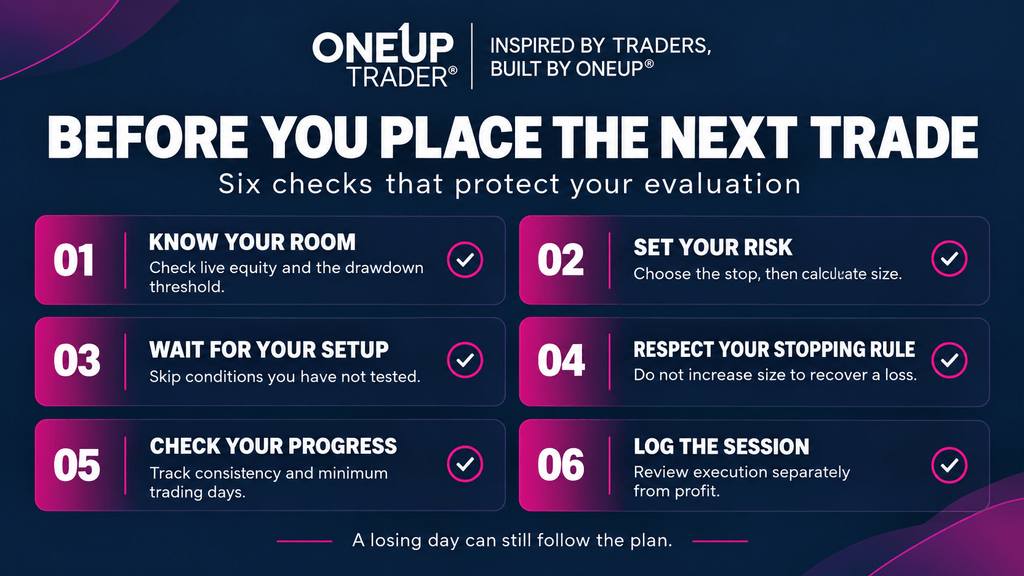
Copy this into your trading journal and complete it before each session.
Account and limits
- I checked the current rules for my account and stage.
- Live equity: ______. Threshold: ______. Available room: ______.
- I reserved a buffer for costs and slippage.
- Maximum risk per trade: ______. Daily loss limit: ______.
- My size leaves room for several losses, not just the next trade.
Trade selection
- Today’s setup and entry trigger: ______.
- Stop location and contract size: ______.
- Conditions that make me skip: ______.
- Relevant news times and trading window: ______.
- Combined risk across open positions fits my limit.
Execution and review
- I will not increase size to recover a loss or force the target.
- My stopping rule today is: ______.
- I checked minimum-day and consistency progress without making either a trade quota.
- I will log results, costs, and whether each trade followed the plan.
- If funded, I checked payout eligibility and the room a withdrawal would leave.
A losing day can still meet every item on this checklist. Protecting the account gives a tested strategy time to produce results; it does not guarantee them.
If the rules fit your strategy and budget, you can start a OneUp Trader evaluation when your plan is ready.
This article is for educational and informational purposes only, not investment advice. Futures trading involves significant risk. Examples are hypothetical and do not predict results or guarantee funding or payouts. Rules were checked on 7 October 2026 and may change. Always verify your plan’s current evaluation rules, funded agreement, and payout requirements on the provider’s official pages.