



- Iranian missiles and drones hit the United Arab Emirates on Monday.
- The US White House said it was nearing a memorandum of understanding to end the Iran war.
- Market participants are awaiting the nonfarm payrolls report.
Oil prices plunged on Wednesday after reports that the US and Iran were nearing a deal to end the war. Meanwhile, market participants are eagerly awaiting the US nonfarm payrolls report to see the impact of higher oil prices on the labor market.
Tensions in the Middle East have escalated since last week. On Monday, Iranian missiles and drones hit the United Arab Emirates. Meanwhile, the US tried to forcefully open the Strait of Hormuz. These developments sent oil prices higher on Monday.
However, sentiment shifted again on Tuesday after Trump announced that he had paused his project, which involved escorting commercial ships safely through the Strait of Hormuz. His reason for pausing Project Freedom was that the US and Iran were nearing a deal to end the war.
Oil prices fell over 7% on Wednesday after White House said it was nearing a memorandum of understanding to end the war. Meanwhile, Iranian officials said they were evaluating the peace proposal. If they agree, it will not only end the war but also create a framework for nuclear talks.
Analysts believe this is the nearest the two nations have been to ending the war. Nevertheless, Trump cautioned that if Iran rejects the proposal, the war would intensify.
“If they don’t agree, the bombing starts, and it will be, sadly, at a much higher level and intensity than it was before,” Trump said in a social media post.
On data, the US released a report on Tuesday showing continued expansion in the services sector. The ISM PMI came in at 53.6 compared to the forecast of 53.7. A separate report showed job vacancies at 6.87 million, slightly above the forecast of 6.86 million.
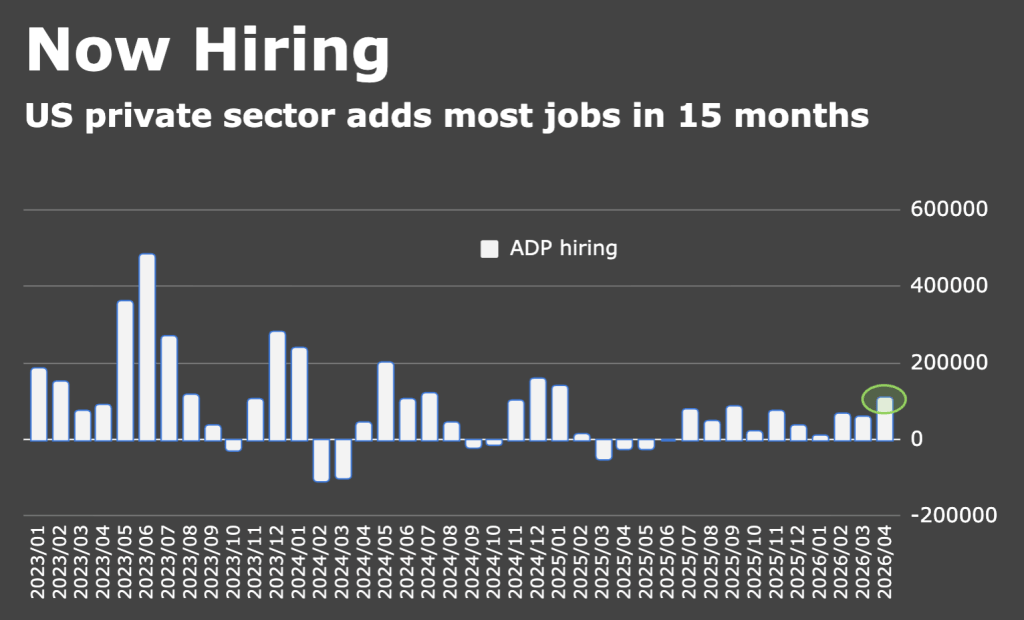
US private employment (Source: Heisenberg Report)
On Wednesday, data revealed 109,000 new jobs in the private sector. Economists had expected an addition of 118,000 jobs. Still, it was a significant increase from the previous month’s 61,000. It is clear that the economy is expanding rapidly, and this might pressure the Fed to tighten monetary policy.
Market participants will watch the nonfarm payrolls report on Friday for more clues on the Fed’s policy path. A hot number will increase rate hike expectations. Meanwhile, a soft figure will allow the Fed to continue easing policy.