


Introduction
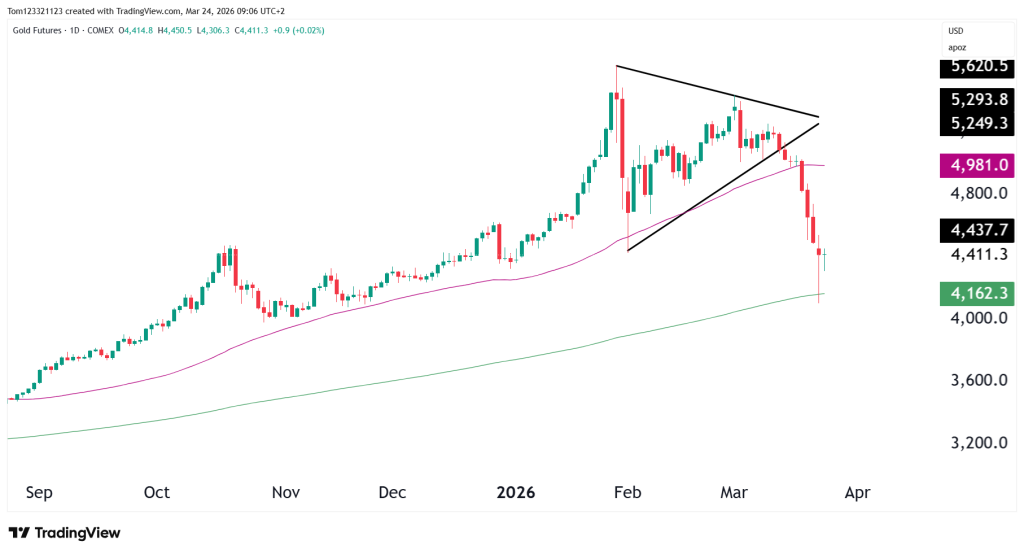
Gold has now moved well beyond the initial breakdown we looked at in the previous analysis. What started as a loss of the $5,000 level has developed into a volatile drop, with price now trading near $4,400 and testing toward $4,150.
In our prior analysis, the key idea was that a break below $5,000 would likely trigger continuation toward $4,437. That level has now been reached and broken with momentum, confirming that sellers have fully taken control in the short term.
The 200 MA has held and moving forward; that is going to be the most important level for bulls to maintain. Undoubtedly, there has also been an unwinding of positions, likely due to the conflict in the Middle East and the strengthening of the Dollar.
What Has Changed Since the Last Analysis
The earlier analysis pointed to three main things to watch. The $5,000 level was expected to turn into resistance, $4,437 was the next key support, and sellers would stay in control unless the price could push back above the broken structure.
That’s exactly what’s happened.
Price couldn’t get back above $5,000. It dropped through the $4,437 support and then picked up speed, falling further toward the 200-day moving average around $4,160.
What’s changed now is the strength of the move. It’s no longer a steady decline. The selloff is speeding up and gaining momentum, which often means the market is entering a more aggressive, forced selling phase. This might be over, however, as the 200-day MA has held strong support.
Timeframe Context
- Daily: Strong bearish momentum, breakdown in progress
- Intraday: Likely to see sharp bounces, but within a broader downtrend
For traders, this is important. Intraday strength should be treated cautiously unless key higher levels are reclaimed.
Macro & Fundamental Context
The fundamentals are now clearly working against gold.
Strong U.S. Dollar
The dollar has remained firm near recent highs. A strong dollar directly pressures gold, as it reduces its relative attractiveness globally.
Shifting Risk Sentiment
Despite ongoing geopolitical tensions, markets are showing signs of stabilization in risk assets, reducing the urgency for safe-haven positioning.
Positioning Unwind
Gold had a strong run into the $5,300 region. The breakdown likely triggered a wave of profit-taking and forced exits.
Key Technical Levels
Resistance
$4,800 – $5,000
Major resistance zone. This includes:
- Prior support
- 50-day moving average
- Breakdown area
Any move into this region is likely to face selling pressure.
Support
$4,150 – $4,160 (200-day MA)
This is the most important level right now.
- First major long-term support
- Current reaction zone
$4,000 (Psychological level)
If the 200-day breaks, this becomes the next key level.
$3,800 – $3,900
Deeper structural support if the selloff extends.
Possible Trades
- If price fails to hold the 200-day MA (~$4,150), expect continuation toward $4,000
- If price bounces but fails near $4,800–$5,000, downside likely resumes
- If price reclaims $5,000, the breakdown structure begins to weaken
Probability Table
| Scenario | Description | Estimated Probability |
|---|---|---|
| Bearish Continuation | Break below $4,150 leads to move toward $4,000 | 50% |
| Stabilization | Price holds near 200-day MA and consolidates | 30% |
| Relief Bounce | Bounce toward $4,800–$5,000, but remains corrective | 20% |
Final Takeaway
Gold has shifted from just breaking down to moving strongly lower.
The $4,437 level from the earlier analysis didn’t hold, and now price is testing the 200-day moving average. That’s the last big support keeping the broader uptrend intact.
As long as gold stays below $5,000, sellers are still in control. The main thing to watch now is whether price can hold around the 200-day, or if it keeps dropping toward $4,000.
This analysis is for educational and informational purposes only and does not constitute trading advice or a recommendation to buy or sell any futures contracts. Futures trading involves significant risk and may not be suitable for all investors. Always conduct your own research and consult with a licensed financial professional before making trading decisions.