

Introduction
Thousands of traders join a funded trader program every month, but only a small percentage end up making something of it.
The reason usually isn’t a lack of knowledge or an inability to trade well. Most traders understand charts, indicators, how to do technical analysis, and how to create a plan. What separates successful traders though, from everyone else, is their ability to stay disciplined, manage risk, and remain consistent.
We have seen thousands, if not tens of thousands, of traders come through the OneUp Trader-funded trader program, and one thing always stands out, and it is these three things. Discipline, risk management, and consistency. Mastering those gives you a far greater chance of becoming a funded trader and making a withdrawal.
Without talking too much about what a funded trader program is and how it benefits traders, in this guide, we have condensed the most important elements that, if followed, give you a greater chance of passing one and remaining funded. Before we get into the checklist, let’s first understand why traders drop off and what OneUp Trader is.
Why Most Traders Drop Out of Funded Trader Programs
Getting funded is often easier than staying funded. First of all, why is that? It is simple because in most funded trader programs like OneUp Trader, you have an unlimited number of tries. Even if you get funded and lose the account, you can get funded again by completing the evaluation.
When it comes to getting funded and staying funded so you can make your first withdrawal, one common issue is not fully understanding the rules. Every evaluation has specific requirements, including profit targets, drawdown limits, and minimum trading days. Traders sign up before fully knowing what they are getting into. It is important to read over all the rules and have a clear understanding of what you need to do in order to get funded.
Another challenge is trading without a clear plan. Constantly changing strategies, chasing new setups, or making impulsive decisions is a sure-fire way to fail.
Emotions also play a major role. Fear, frustration, greed, and revenge trading can quickly derail a solid strategy. Successful traders learn to treat trading as a process rather than an emotional experience.
Risk management is another area where many traders struggle. Taking oversized positions, refusing to accept losses, or moving stop losses can quickly lead to drawdown violations and failed evaluations.
Keep these points in mind as we go on in this guide because no system, no matter how perfect it is on paper cannot succeed without the correct mindset and risk management to follow it.
What the OneUp Trader Funded Trader Program Actually Is
OneUp Trader offers a structured and easy-to-understand way for traders who want to trade the futures markets without risking their own capital.
The process begins with an evaluation account. During this stage, traders trade in real market conditions while following the rules and working toward a profit target. A minimum of 10 trading days is required before an evaluation can be submitted for review.
Reviews are completed within a few business days, and traders receive access to a funded account. 99.9% of traders who submit their accounts for review go on to funding with no problems. The rare occasions where traders are denied funding are if they are below the age of 18.
After becoming funded, traders can make withdrawals from day one. There are no restrictions at all. If a trader makes $100,000 on the first day, they can take it out immediately! OneUp Trader allows traders to keep 100% of the first $10,000 withdrawn and up to 90% after that.
Account Size Choices
OneUp Trader offers account sizes ranging from $25,000 to $250,000.
Choosing the right account size is an important decision. While larger accounts provide more buying power and greater profit potential, they also require more discipline and emotional control and have a higher profit target.
Many newer traders benefit from selecting an account size that is small at first and then upgrading later on if they need more buying power.
The goal isn’t to trade the biggest account available. The goal is to trade well enough to pass the evaluation and maintain consistent performance over time.
Risk and Drawdown Rules
Every funded trader program includes risk management rules. These rules are designed to encourage disciplined trading and remove the gamblers mentality.
Trailing drawdowns encourage steady account growth while discouraging excessive risk-taking. Minimum trading day requirements help ensure traders demonstrate consistency rather than relying on a few fortunate trades.
Profit targets are also part of the evaluation process. Traders need to hit this target before they can submit their account for review.

________________________________________________________________________________________________________________
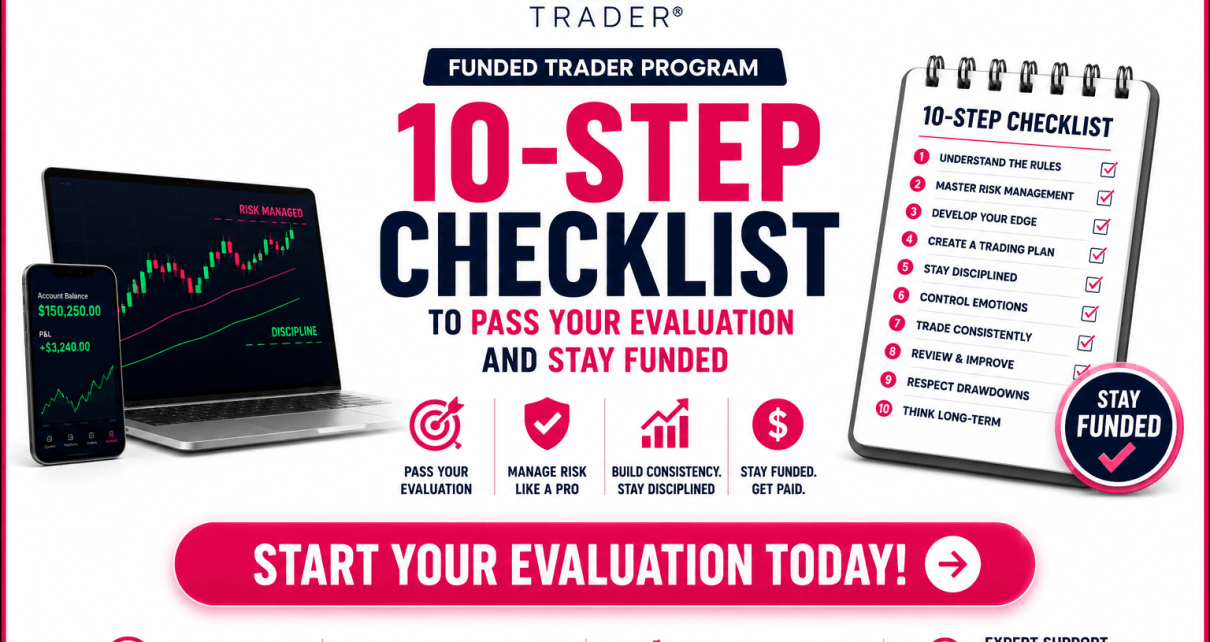
Now that we have covered the basics of the OneUp Trader funded trader program, let’s get into the 10-Step Checklist!
The Complete 10-Step Funded Trader Evaluation Checklist
After reviewing the trading habits of thousands of traders, we identified 10 behaviors that are commonly shared by those who consistently perform well. While every trader develops their own approach, these attributes appear time and time again among those who achieve long-term success.
Step 1: Have A Plan On How You Will Tackle The Evaluation
The traders who perform well time after time are the ones who treat trading like a business, not a hobby. Everything must be planned. Successful traders in the OneUp Trader funded trader program often tell us that when they first join the evaluation stage, they are excited to get going, but end up hitting the drawdown and blowing their first two or three accounts.
Only then do they start to realize that they need to have a proper plan in place and think about how they will treat the evaluation.
It is important to study the rules and have a plan of action. It is not for all traders, but setting goals such as daily targets can be very useful in the evaluation stage. Setting a daily loss limit for yourself is also extremely useful because we see far too many traders do well for a few days, get close to the target, only to end up blowing it on one bad day and a lack of discipline.
One Liner: Know exactly how you will trade. The evaluation, trading plan, daily loss limits, and goals are essential.
Step 2: Choose the Right Account Size
Your account size should match your trading style. It does not mean the bigger the account, the better the trader. It comes down to knowing your system and then calculating how much you need to trade with. Remember that the larger the account is the bigger the profit target is too. If you are a trader who only takes one trade a day with a risk of $200 per trade, a smaller account might be exactly right.
Many very successful traders who have made withdrawals have traded the 25K or 50K account, look at this trader for example, Jack, a bond trader who withdrew nearly $40,000 from his 50K account.
One Liner: Calculate what account size is right for you and base it on your strategy.
Step 3: Build a Consistent Trading Routine
Having a routine in trading helps to train you to recognize that trading should be treated as a business and not as a hobby. Too many traders ignore this element, and they eventually lull themselves into a false sense of security. The flip side of this can happen too, where a trader gets completely consumed by the markets and is not able to separate themselves from it. They check the markets when they are eating with family, at the gym, anything really.. This can become a very unhealthy habit.
Having a routine includes the times you trade and when to walk away. This was, you can keep control of yourself and not become a victim of the market.
Slightly longer than a one-liner: Put yourself in one of these two positions and decide for yourself which is for you. A trader who checks the market first thing they wake up, eats with family, checks the market, and constantly obsesses over whether a possible trade is there. Now put yourself in the shoes of a trader who has set hours he trades, doesn’t deviate from them, and when that schedule is finished, does an analysis of his day, then stops trading and doesn’t think of the markets until the next day again.
Step 4: Master One Strategy
Have you heard of the saying, ‘chasing the holy grail’. We are always looking for something different, something that could be better than what we currently have. In trading, this is probably the biggest trap that traders get caught in, and it is a huge hindrance to success. It also wastes a lot of time.
Traders can spend years and years switching from system to system until eventually giving it all up. It is important to look for ways to refine your strategy and improve it, but if you are someone who is always looking for the next best indicator that is going to make you rich, it needs to be stopped.
One liner: Instead, find a setup that you trust, and that you like, something that you feel good about. Build a system around that and then focus on your trader mindset to train yourself to never take trades outside of your plan.
Step 5: Manage Risk Like a Professional
Risk management is one of the most important skills a trader can develop. It is vital for the longevity of any trading account. Good risk management beats a good strategy any day of the week!
Take a look at this article on risk management: Mastering Risk Management In Funded Accounts
One Liner: Protecting capital should always come before chasing profits.
Step 6: Focus on Consistency Instead of Speed
Many traders become overly aggressive because they want to pass an evaluation as quickly as possible. At the OneUp Trader-funded trader program, it is possible to successfully complete an evaluation very quickly, but that doesn’t mean that it should. It is far better to take the time necessary for the specific strategy that you are trading instead of trying to force something. Remember to always ask yourself if a professional trader would take this trade, keep your head and stay cool, and think in probabilities, not with emotion.
One Liner: The traders who succeed tend to focus on quality setups, consistent position sizing, and steady progress. They understand that evaluations reward disciplined execution more than short bursts of performance.
Step 7: Track and Review Every Trade
Keeping a trading journal is fundamental to success in financial markets. Why is it so important? Simply because it helps you identify your strengths and weaknesses, it also holds you accountable to follow your trading plan. A trading journal doesn’t work if you do not stick to your plan.
How else can a trader improve if they do not have a data set to analyze? Successful traders keep up-to-date trading journals and look over them regularly. Let’s say, for example, that you trade Crude Oil and you notice that over a few months, Wednesdays, you are net negative. You realize that the inventory report comes out on that day, and so the market is more volatile than normal. A decision can be made to either skip trading that day completely or to adjust the strategy to be more in line with what can work that day.
One-liner: Trading journals are a cornerstone for improving.
Step 8: Control Your Emotions
Trading psychology plays a major role in trading overall, and funded trader programs are no different.
Losses are inevitable, but how you respond to them matters. Focusing on the mindset side of trading is as important, if not more than, your actual strategy.
One liner: Emotional control is often what separates consistent traders from inconsistent ones and ultimately determines your success.
Step 9: Trade Your Plan, Not Market Noise
One liner: Again, we come back to the point of sticking to your plan. Instead of listening to others, the news, buying the best new indicator, stick to your plan and trust it.
Step 10: Have a Monthly Budget To Spend On Evaluations
Have a budget that is reasonable to spend on evaluations because the costs can rack up quickly. This is important because it stops traders from falling into the trap of gambling or going for lucky shots in evaluations. If you build in bad habits, the longer you stay with them, the more difficult they will be to break.
One liner: Treat funded trading like a business and spend within your limits on evaluations.
How to Use This Checklist During Your Evaluation
The most effective way to use this checklist is to make it part of your daily routine.
Before each trading session, review the steps, confirm your account rules, and revisit your trading plan. Make sure you understand what you’re looking for in the market and how you’ll respond if conditions change.
After the session ends, spend time reviewing your trades and identifying areas where you followed your process well or where improvements can be made.
Frequently Asked Questions About Funded Trader Programs
How long does it take to pass a funded trader evaluation?
There is no fixed timeline. Some traders complete an evaluation within a few days, while others take longer. The focus should be on consistency and following the process rather than rushing to reach the finish line.
What happens if I hit my drawdown limit?
If you exceed the account’s drawdown parameters, the evaluation will end. Many traders use the experience as a learning opportunity, review what went wrong, and approach their next evaluation with a stronger plan.
Is a funded trader program better than trading a personal account?
That depends on the trader’s goals and circumstances. Many traders appreciate the ability to access larger capital while operating within a structured risk management framework.
Can I withdraw profits after getting funded?
Yes. Once funded and after meeting the applicable payout requirements, traders can request withdrawals according to the program rules.
What is the most important factor in passing a funded trader evaluation?
Consistency is usually the deciding factor. Traders who follow a plan, manage risk carefully, and remain disciplined tend to perform better than those who focus only on profits.
Conclusion
A funded trader program can be a valuable opportunity for traders who want to develop their skills and avoid risking their own capital.
The traders who succeed are not always the most aggressive or the most technically advanced. More often, they are the traders who understand the rules, manage risk effectively, and stick to a repeatable process.
If you approach your evaluation with patience, discipline, and realistic expectations, you’ll give yourself a much better chance of passing and maintaining a funded account.