


To become a funded trader, choose a program that fits your trading method, and pass its evaluation by meeting the profit target without breaking its loss limits or other rules. You then trade under the funded account’s rules and request withdrawals when you qualify.
For futures traders, the important numbers are the profit target, the remaining drawdown allowance, and the total cost of participating. A $50,000 account does not necessarily give you $50,000 to lose, and passing an evaluation does not guarantee a payout.
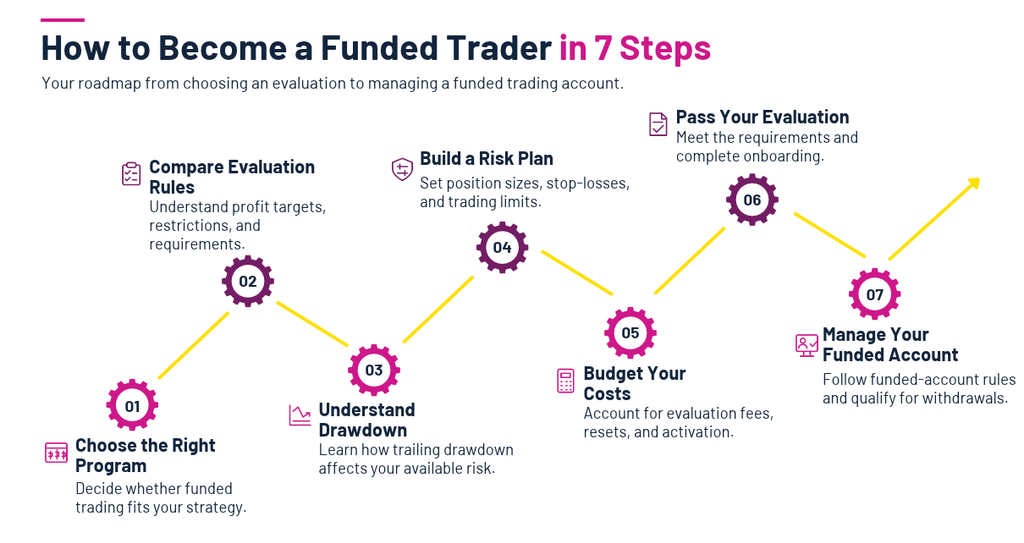
The process has seven practical steps:
- Decide whether a funded program suits you.
- Compare evaluation and funded-account rules.
- Understand how the drawdown threshold moves.
- Build and test a position-sizing and risk plan.
- Set a budget for fees and unsuccessful attempts.
- Complete the evaluation and onboarding.
- Manage the funded account and qualify for withdrawals.
What is a funded trader?
A funded trader participates in a prop firm’s trading program in order to receive a share of eligible trading profits. In an evaluation-based program, you first demonstrate that you can trade within specified performance and risk limits.
The account’s label does not tell you whether orders reach a live exchange. Programs can include different stages:
| Stage | What happens | What to clarify |
|---|---|---|
| Evaluation | You trade a simulated account against the program’s targets and rules. | Fees, minimum days, loss limits, and passing requirements. |
| Simulated funded account | You continue in simulation and may qualify for real payouts under a contract. | How payouts are earned and whether a live-account pathway exists. |
| Live funded account | Orders are executed in the live market using the firm’s capital. | Risk limits, costs, responsibilities, and withdrawal terms. |
Not every funded trading program operates in the same way. Some offer simulated evaluations followed by funded accounts, while others provide opportunities to trade live capital. Before choosing a program, you should understand how each stage works, whether trades are simulated or executed in live markets, and what requirements apply to withdrawals.
Funding also does not make trading cost-free. Evaluation subscriptions, resets, activation charges, and optional software can cost real money even when trading takes place in simulation. A trading program is not a salary, and its payouts should not be treated as dependable income.
Step 1: Decide whether a funded program suits your trading
A funded program may suit you if you already have a repeatable trading strategy, can trade within its restrictions, and can afford the evaluation costs without relying on a payout.
Before signing up, check whether you can:
- Explain your entry, stop, exit, and position size before placing an order.
- Use the platform correctly, including canceling orders and closing positions.
- Show a trade journal that includes losing sessions, commissions, and rule compliance.
- Trade during the permitted hours without conflicting with work or other commitments.
- Stop trading when your personal loss limit is reached.
- Lose the entire evaluation budget without affecting essential expenses.
If these are still unresolved, sim trade first.
Consider the alternative as well. A personal futures account gives you different freedoms and responsibilities, including responsibility for trading losses and margin obligations. A funded program adds rules, fees, and payout conditions. Neither arrangement makes an untested strategy profitable. The National Futures Association’s guidance on risk capital is a useful starting point when deciding what you can afford to commit.
Step 2: Compare the rules before choosing an evaluation
Start with the market and your trading system, then choose an account. A bigger balance is not automatically a better fit, so look over your back-test results, find what your max drawdown for that period was, and make sure the evaluation you sign up for has enough breathing room in case you go through a losing period.
Build a comparison using the actual rules for both the evaluation and funded stages:
| Check | The question to answer before paying |
|---|---|
| Eligibility and provider | Can you trade from your location, meet the age and identity requirements, and identify the company responsible for your agreement and payouts? |
| Profit target and loss limits | What net profit is required, and how much room is there before a breach? |
| Drawdown calculation | Is it static or trailing? What raises it, when does it update, and what causes a breach? |
| Trading restrictions | Do the contract limits, news rules, holding times, and prohibited practices fit your method? |
| Time and consistency requirements | Are there minimum trading days, deadlines, activity requirements, or limits on how profits are distributed? |
| Total cost | What will you pay initially, on renewal, after a reset, and after passing? |
| Funded stage and payouts | Is the account simulated or live? What must remain in it, what can be withdrawn, and when? |
| Platform and support | Does your exact platform connection work, and can you obtain written answers to unclear rules? |
Keep a copy of the terms that apply to your purchase using either an AI tracker or a simple Excel sheet.
OneUp Trader’s evaluation options
OneUp Trader evaluates traders based on a set of pre-determined rules. There is no discretion at the review phase, meaning that any trader who successfully completes the evaluation is guaranteed funding. OneUp Trader’s account options include the following evaluation parameters, checked on November 24, 2026:
| Account size | Net profit target | Trailing drawdown allowance |
|---|---|---|
| $25,000 | $1,500 | $1,500 |
| $50,000 | $3,000 | $2,500 |
| $100,000 | $6,000 | $3,500 |
| $150,000 | $9,000 | $5,000 |
| $250,000 | $15,000 | $5,500 |
The evaluation rules specify at least 10 trading days for the Evaluation account and five for Pro Evaluation, excluding holidays and weekends. These are minimum requirements, not promises that you will pass within that time.
The published evaluation schedule also requires positions to be closed by 3:15 PM Central Time, with no trading until 5:00 PM CT. Check the applicable holiday schedule and product restrictions before planning a session.
Express Funding is a separate route for eligible previously funded traders, with a three-trading-day minimum. It should not be confused with Pro Evaluation.
Compare the current subscription options and billing terms for your selected plan. Confirm its activation charge and renewal terms before checkout.
Check the platform before committing
OneUp’s supported platforms include NinjaTrader, R|Trader Pro, Quantower, and others. Compatibility and the cost of using a platform are separate questions.
Its funded-account fee guidance says funding partners cover the listed exchange data feeds. It identifies R|Trader Pro and NinjaTrader Desktop version 8.1 as included funded-stage options; other platform charges remain the trader’s responsibility. Check the exact connection and license you intend to use.
Step 3: Understand drawdown before choosing position size
The drawdown threshold is the account value you must stay above under the program’s rules. It is different from the drawdown allowance, which is the distance used to establish that threshold.
For a hypothetical $50,000 account with a $2,500 allowance, the initial threshold is $47,500. Your initial room for losses is $2,500—not the account’s headline balance.
Static, end-of-day trailing, and intraday trailing drawdown
There are two separate questions: Does the threshold move? And when and from what account value is it calculated?
| Model | How the threshold works | Practical consequence |
|---|---|---|
| Static | Remains at a specified fixed level. | Profits can increase the distance above the threshold. |
| End-of-day trailing | Rises using qualifying end-of-day balances. | Intraday highs generally do not raise it, but the established threshold can still be enforced during the session. |
| Intraday trailing | Rises as the specified account measure reaches new highs during trading. Some models include open profits. | Giving back an unrealized gain can leave less room for the next trade. |
An end-of-day trailing drawdown does not necessarily mean losses are monitored only at the market close. Some programs calculate their drawdown threshold using the closing account balance but enforce that threshold throughout the following trading session. Traders should understand both how their drawdown threshold is calculated and when a breach can occur.
Example: a profitable trade can leave less room for losses
Example: How a Break-Even Trade Can Fail an Evaluation
Consider a trader with a $50,000 evaluation account and a $2,500 trailing drawdown.
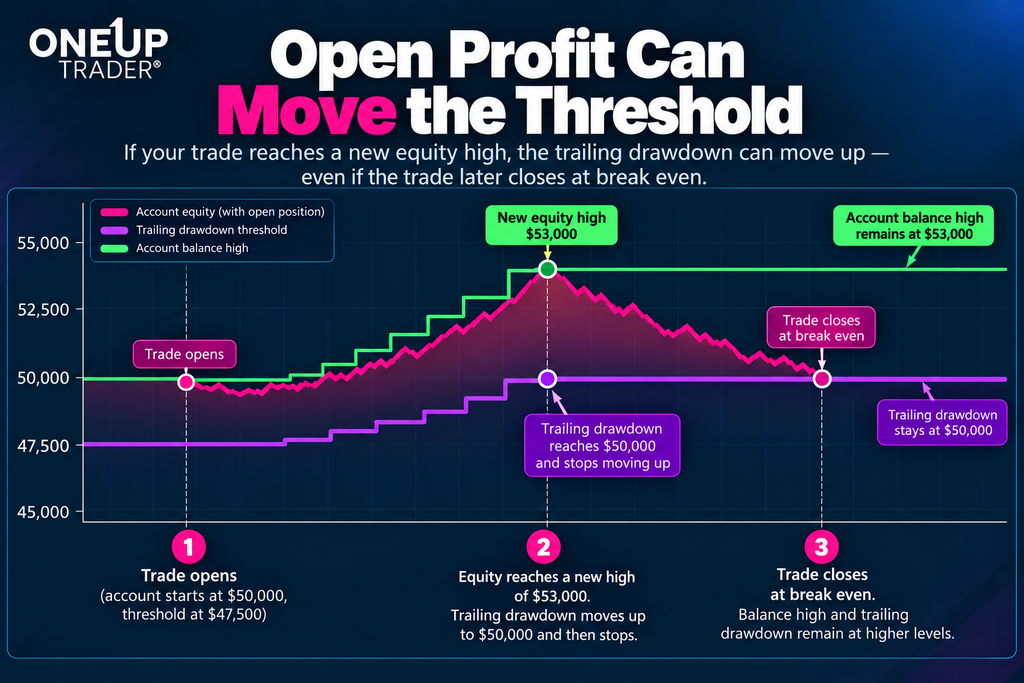
The account begins with a liquidation threshold of $47,500. As the trader’s open position moves into profit, the account equity rises, and the trailing drawdown threshold moves upward with it.
Suppose the position reaches $3,000 in unrealized profit, bringing account equity to $53,000. By this point, the trailing drawdown threshold has reached $50,000, where OneUp Trader’s rules prevent it from rising any further.
Now imagine the market reverses, giving back the entire unrealized gain.
| Event | Account equity | Trailing drawdown threshold |
|---|---|---|
| Trade opens | $50,000 | $47,500 |
| Open position reaches its highest profit | $53,000 | $50,000 |
| Equity falls back to breakeven | $50,000 | $50,000 |
The important lesson: Although the trade has returned to breakeven, the account has touched its liquidation threshold. Under OneUp Trader’s evaluation rules, this constitutes a drawdown breach, even though the position did not produce a realized trading loss.
This is why futures traders must monitor unrealized profits, the trailing drawdown threshold, and their remaining risk allowance throughout a trading session—not just their closed profit and loss.
For a visual explanation of how OneUp Trader’s trailing drawdown works, watch the video below. It demonstrates why monitoring unrealized profits and the liquidation threshold is essential during an evaluation.
Compare the profit target with the drawdown limit
For a $3,000 target and $2,500 initial allowance, the target is 1.2 times that allowance. A $15,000 target with a $5,500 drawdown is approximately 2.73 times the allowance.
This ratio is a useful comparison, but it does not predict your chance of passing. Trailing behavior, position limits, costs, and your strategy’s losing sequences all matter. A larger account label can come with a much larger target without a proportional increase in room for losses.
Step 4: Build and test a risk plan
Your plan should connect the trade’s stop distance to the account’s remaining loss allowance. Do not choose a contract count first and then squeeze the stop into a convenient dollar amount.
Write down the market you will trade, the conditions that qualify as a setup, the entry trigger, where the idea becomes invalid, and how you will exit. Add your trading hours, news restrictions, maximum simultaneous exposure, and session stop conditions.
Calculate risk from the stop
For a single futures contract:
Estimated trade risk = stop distance in points × dollars per point + commission and slippage allowance.
For multiple contracts, multiply that estimated per-contract risk by the number of contracts. Slippage is the difference between the price you expect and the price at which an order fills; actual losses can exceed the estimate.
CME specifies MES at $5 per index point, with a 0.25-point tick. Each tick is therefore $1.25 per contract.
Suppose your hypothetical plan permits $125 of estimated risk for a trade, the setup needs a 10-point stop, and you allow $5 per contract for combined commissions and slippage. That $5 is an illustrative assumption, not a quoted OneUp fee.
| Calculation | Result |
|---|---|
| Stop risk for one MES: 10 × $5 | $50 |
| Estimated total risk per MES: $50 + $5 | $55 |
| Two MES contracts | $110 |
| Three MES contracts | $165 |
Two contracts fit this hypothetical budget; three do not. The account’s contract limit may require an even smaller position. If one contract exceeds your budget, use an eligible smaller contract or skip the trade.
Use the remaining allowance as a constraint
Risking 1% of a $50,000 headline balance means risking $500. Against a $2,500 loss allowance, that consumes 20% of the starting room in one trade, before any additional execution costs.
Even a fixed $110 trade becomes more significant when the account deteriorates: it is 4.4% of $2,500 but approximately 15.7% of $700. Recalculate from the current threshold, not only from the account size selected at signup.
Treat correlated positions as combined exposure. Buying two equity-index contracts in different markets can create similar directional risk; two tickets do not necessarily diversify the loss.
Set a personal daily stop
A provider’s daily loss limit and your own session stop serve different purposes. The provider’s rule defines an account restriction; your personal stop should preserve enough room to trade another day.
For example, a hypothetical plan might stop after two full planned losses or $250 of net session losses, whichever occurs first. With estimated $110 losses, two stopped trades use $220. Before every new entry, check that its planned risk fits both the remaining session budget and the remaining account allowance, with room for execution uncertainty.
These amounts illustrate the process, not a universal risk recommendation. A daily loss limit can also pause trading or fail an account depending on the provider; verify which consequence applies. OneUp’s published evaluation options have no fixed daily loss limit. The trailing threshold still matters.
Test the strategy against the exact rules
Review a meaningful sample of trades before paying for an evaluation. As a practical starting exercise, you could examine 50–100 setups across different conditions, then forward-test the method in simulation. That sample size is a working exercise, not proof of an edge.
Record net results after costs, average winner and loser, longest losing sequence, worst session, and every rule violation. If the program trails intraday highs, track the account’s path during trades; a list of closing results alone can miss a breach.
For example, a test with a 40% win rate, $180 average net winner, and $100 average net loser has an observed average of:
(0.40 × $180) − (0.60 × $100) = $12 per trade.
That describes the sample. It does not forecast earnings, account for every possible losing sequence, or guarantee that the method fits an evaluation. Simulated fills and emotions can also differ from live trading, as explained in OneUp’s risk disclosure.
Step 5: Budget for the full attempt
Set an amount and a time period you are prepared to spend before starting. Include the possibility of receiving no payout.
The cost can include evaluation payments, renewals, resets or replacement evaluations, activation charges, platform subscriptions, and any separately charged data. Trading commissions may reduce the account’s performance even when they are simulated rather than separately billed to your card.
Here is a hypothetical budget:
| Expense | Calculation | Cost |
|---|---|---|
| Evaluation access | Three billing periods × $80 | $240 |
| One reset | One × $60 | $60 |
| Activation after approval | One × $100 | $100 |
| Total through activation | Before optional services | $400 |
If the evaluation fails permanently before approval, the activation charge in this example would not arise, but the earlier payments would still have been spent. Paying for several accounts multiplies your cash exposure.
At OneUp, billing renews every 30 days until account submission for review or cancellation. The billing page also specifies activation charges and paid resets. Resetting does not move the renewal date, and renewal does not automatically erase your trading history.
Choose a stopping condition in advance—for example, a maximum total spend followed by a return to practice. After a failed attempt, diagnose whether the cause was the strategy, sizing, execution, or a rule misunderstanding before paying again.
Step 6: Complete the evaluation and onboarding
Reaching the profit target is one requirement. You must also meet the account’s minimum trading days and consistency rule.
Use net profit. The evaluation information confirms that simulated commissions and fees affect the result used for funding eligibility.
Check consistency as well as total profit
OneUp Trader’s evaluation consistency rule compares the largest winning day with the sum of the next three best days, which must reach at least 80% of that largest day.
If the largest day is $1,000 net, the comparison amount is $800. Other best days of $350, $300, and $200 total $850, satisfying that numerical test.
What happens after passing?
At OneUp Trader, submitting the account for review involves contacting the evaluation team. The funding process includes a trader questionnaire, identity documentation, the trader contract, and the applicable activation payment before funded-account access.
Step 7: Manage the funded account and qualify for withdrawals
Treat the funded stage as a fresh rule review. The method that passed the evaluation must also fit the requirements that apply afterward.
How payout eligibility works
A profit you make is not necessarily an amount you can withdraw. Programs may require some profits to remain in the account, minimum qualifying days, a minimum transfer, or other conditions.
For a program that requires profits to remain above a specified reserve, a useful first calculation is:
Potentially eligible gross profit = current balance − starting balance − required retained profit.
Treat a negative result as zero. Then apply the program’s other eligibility rules, your profit share, and any fees.
In an account with a $50,000 starting balance, $2,500 required retained profit, and $55,000 current balance:
- Potentially eligible gross profit is $2,500.
- At an assumed 90% share, the trader receives $2,250 before fees.
- If the program debits the full $2,500 gross distribution, the account balance becomes $52,500.
The amount received and the amount removed from the account are different in this example. Confirm your provider’s accounting before submitting a request.
Also calculate the account’s remaining room afterward. If its loss threshold is fixed at $50,000, the hypothetical withdrawal reduces the cushion from $5,000 to $2,500. Plan the next trade from that smaller cushion.
OneUp Trader withdrawals
OneUp Traders’ published withdrawal terms retain $1,500, $2,500, $3,500, $5,000, and $5,500 for the respective account sizes listed earlier. The minimum transfer is $1,000 of the trader’s share. Its profit arrangement provides 100% of the first $10,000 in eligible withdrawals and 90% thereafter, subject to applicable fees.
For accounts covered by the weekly policy, one withdrawal per calendar week has no additional Priority processing fee. Further eligible bank-wire requests that week incur a 10% Priority fee on the trader’s share after the profit split. The allowance applies per trader across funded accounts and resets Monday at 12:00 AM Central Time.
Traders funded before November 4, 2026 retain daily withdrawals under their existing agreements.
Payment methods have separate limits, fees, and delivery times. Review the withdrawal instructions; processing and receipt are distinct stages.
Request a withdrawal deliberately
Before submitting:
- Confirm eligibility and the amount that must remain in the account.
- Calculate your profit share and applicable fees.
- Check the remaining drawdown cushion and permitted position size after the deduction.
- Submit through the funding provider’s stated process with accurate payment details.
- Keep the approval and payment records, including records needed for your local tax obligations.
Avoid increasing risk to reach a payout minimum by a particular date. The account must remain compliant while you work toward it.
Common mistakes that prevent sustainable funding
| Mistake | A more useful response |
|---|---|
| Sizing from the advertised account balance | Calculate risk against the current loss threshold and your personal budget. |
| Buying a discounted account before reading its rules | Check that the funded-stage requirements fit your method too. |
| Increasing size to finish the profit target quickly | Keep size within the risk plan you tested. |
| Treating a reset as the solution to repeated losses | Identify the failure and test the correction before spending again. |
| Focusing only on closed profit | Monitor open exposure and any intraday threshold movement. |
| Withdrawing every eligible dollar automatically | Calculate the account cushion and scaling consequences first. |
| Counting on payouts to cover urgent expenses | Keep essential spending separate from uncertain trading income. |
Frequently asked questions
How long does it take to become a funded trader?
It takes as long as needed to meet the evaluation objectives without breaking the rules, followed by account review and onboarding. Minimum trading days set the earliest possible eligibility; they are not a typical completion time or a guarantee.
Can a beginner become a funded futures trader?
Theoretically, yes. A beginner can work toward funding, but eligibility to enter an evaluation is different from readiness to trade it. Ensure you are fully prepared before signing up for an evaluation by having a system, an understanding of the rules, and a budget for evaluation fees.
Can you get funded without passing an evaluation?
Some offer products described as ‘instant funding’ at a much higher sign-upcost. Skipping an evaluation does not remove trading restrictions, fees, or payout conditions, and the account may still be simulated. There are no instant funding options at OneUp Trader.
What should you do if you fail an evaluation?
Review the trades and the rule that caused it. Figure out if it was a strategy or mindset problem. Work toward finding a solution for the next attempt.
If the rules and costs fit your strategy, learn more about getting started on an evaluation below