


Introduction
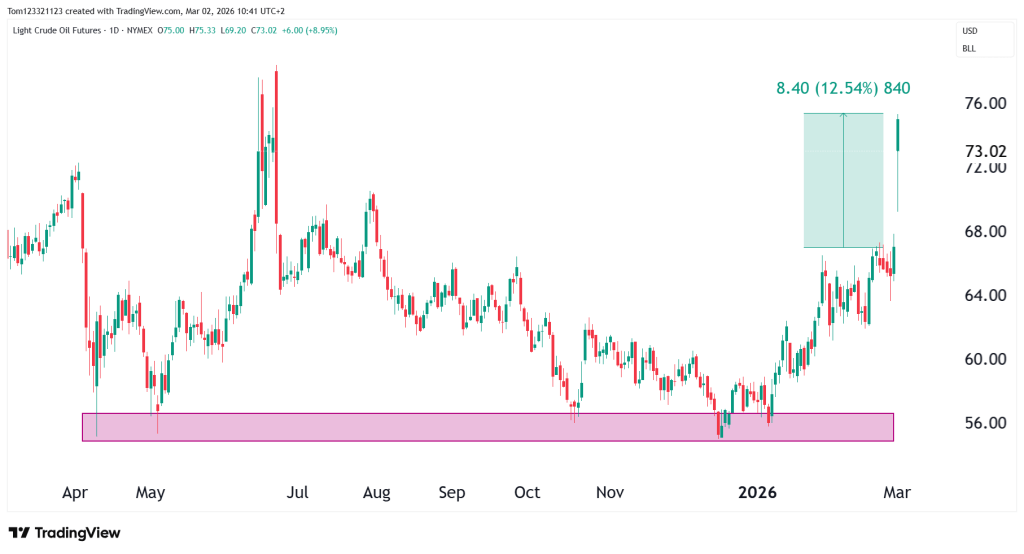
After a weekend full of major turmoil in the Middle East, Crude Oil (CL) has exploded higher, rallying 12.54% in early Monday trade. Any further developments of the crisis will be closely watched by investors, and all traders should be wary of the volatile swings we are likely to see in the market this week.
We can take a look at the technicals, but we must keep in mind that in an environment like this, the price action will be almost solely dependent on the geopolitical factors.
What Just Happened in Crude Oil?
- Price broke out from the $64–$68 consolidation range after the weekend’s developments.
- Strong, impulsive daily candle.
- Cleared prior lower-high structure.
- Repriced supply risk linked to Middle East conflict.
Middle East War Developments & Oil Prices
Recent tensions in the Middle East have pushed oil markets back into risk mode. Traders are worried that fighting or political escalation could interrupt supply, especially with so much attention on the Strait of Hormuz. That narrow shipping lane carries roughly 20 percent of the world’s oil, so even the hint of a threat there can move prices quickly.
As concerns grow, shipping costs and insurance rates for tankers often rise, and some vessels reroute as a precaution. Energy traders who were betting on lower prices have rushed to close those positions, which adds upward pressure on crude. At the same time, investors are building a larger geopolitical risk premium into oil prices. In simple terms, they are adding extra cost to reflect the chance that something could go wrong.
Importantly, oil markets do not wait for actual supply to be disrupted. Prices adjust based on risk, not just reality. When there is a credible threat to key infrastructure or shipping routes, benchmarks like WTI react almost immediately.
On top of that, recent developments have added to the uncertainty. There have been increased naval patrols in the Gulf, reports of drone and missile activity in the region, and renewed warnings from regional governments about potential retaliation. OPEC+ supply discipline and already tight spare capacity in some producing countries have also amplified the market’s sensitivity to any new risk.
Even if no barrels are ultimately lost, the fear alone is enough to push prices higher. That is what we are seeing in the market right now.
Market Structure & Trend
Daily Chart – Breakout Confirmed
Even though the breakout is bullish, we cannot confirm that this is now suddenly the emergence of a new bullish trend and a shift in momentum. The market is too volatile at the moment and any piece of news can send it in either direction.
In order for a solid bullish trend to confirm, we would need to see the escalations slow down, stability come into the price action and volume, and steady higher highs and higher lows form on the chart. If traders and investors are simply pricing in fear or greed, we could see wild swings in the near term.
Key Technical Levels for Crude Oil
Immediate Resistance
$75–$77:
First major supply area from prior 2025 breakdown zone.
$80:
Psychological resistance and prior structural pivot.
If war escalation continues, oil could test $80 faster than most expect.
Support
$68–$70:
Breakout zone. This should now act as first support on pullbacks.
$64–$65:
Former consolidation ceiling.
$55–$56:
Majordemand and long-term invalidation level.
As long as CL holds above $68, the breakout structure remains intact.
Scenarios Going Forward
Bullish Continuation
If Middle East tensions escalate further, CL could push toward $80–$85 as supply risk becomes more aggressively priced in.
Controlled Pullback
Price retraces toward $70 breakout level while maintaining bullish structure.
De-escalation Shock
If diplomatic progress reduces supply concerns, oil could quickly retrace back into the mid-$60s.
Estimated Probability Table
| Scenario | Description | Probability |
|---|---|---|
| Continued upside | Move toward $80 | 45% |
| Pullback to breakout retest | $68–$70 support test | 35% |
| Sharp reversal | De-escalation drops oil below $65 | 20% |
Final Takeaway
Keep an eye on the news!
This analysis is for educational and informational purposes only and does not constitute trading advice or a recommendation to buy or sell any futures contracts. Futures trading involves significant risk and may not be suitable for all investors. Always conduct your own research and consult with a licensed financial professional before making trading decisions.


