



- Market participants expect the Fed to keep interest rates unchanged.
- Traders expect the Bank of Canada to hike borrowing costs by 25 basis points.
- Qatar sent mediators to Tehran on Sunday to try to broker peace.
Currency futures traded cautiously on Monday as market participants awaited several major central bank policy meetings. At the same time, traders are keeping an eye on developments in the Middle East. Inflation worries eased after reports that mediators from Qatar were in Iran on Sunday.
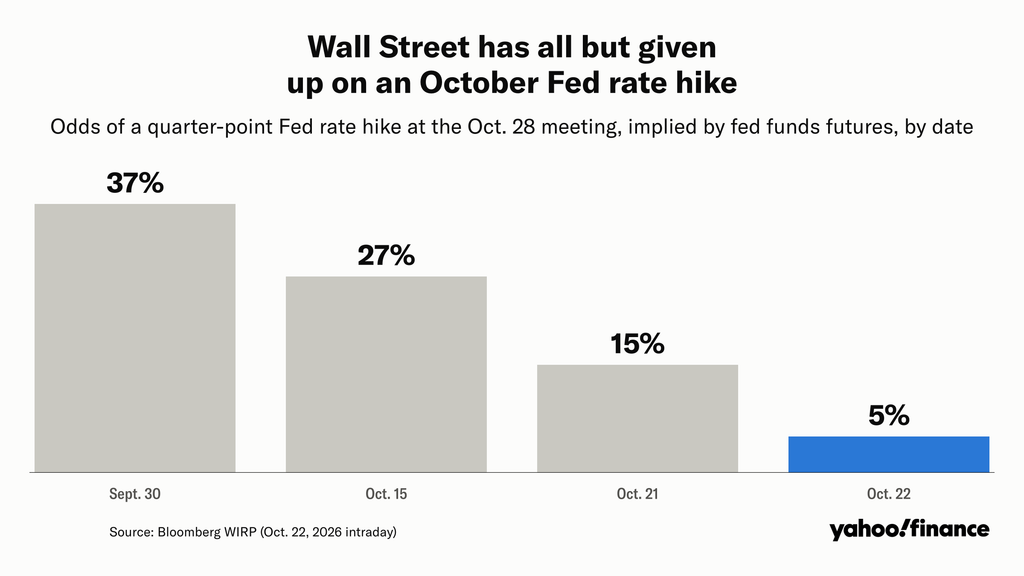
October rate hike chances (Source: Bloomberg WIRP)
The new week comes with policy meetings in several countries that will shape currency markets. In the US, market participants expect the Fed to keep interest rates unchanged at the meeting. However, recent data have revealed hotter-than-expected inflation. At the same time, consumer spending in the economy remains strong. Therefore, market participants will pay close attention to the message about future moves.
Other central banks that are likely to hold this week include the European Central Bank and the Bank of Japan. Nevertheless, both banks have assumed hawkish stances amid rising global inflation. Therefore, there is a chance they will hike in the future. Still, the ECB has the difficult task of balancing growth and inflation. The Eurozone economy depends heavily on imported fuel. Therefore, price increases increase the risk of a recession.
Meanwhile, traders expect the Bank of Canada to hike borrowing costs by 25 basis points, which will likely boost the Canadian dollar. However, if the tone at the meeting is cautious, the currency could drop since the hike has mostly been priced in.
“Forward guidance could matter more than the decisions themselves,” said Chris Weston, head of research at Pepperstone, in a note.
“The decisions themselves may be largely discounted. The real issue that could move the dial in short-term rates and, by extension, is how policymakers shape expectations for subsequent meetings and whether markets need to reprice the forward rates curve.”
Elsewhere, traders are watching developments in the Middle East, which are shaping oil markets. Last week, inflation worries increased after reports that the US and Israel were planning a heavy attack on Iran right after the midterm elections in November. However, these concerns eased when news revealed that Qatar had sent mediators to Tehran on Sunday to try and broker peace in the region.
An escalation after the November elections could send oil higher, increasing rate hike expectations around the globe.