



Deciding how to fund your trading is an important step for any futures trader. You may have savings available for a personal account, or you may prefer to work toward funding through a prop firm evaluation. Both routes have benefits, costs, and risks worth understanding before you commit.
With a personal account, you trade your own capital and have more control over how you manage it. An evaluation gives you a way to trade the markets without having to risk any of your own money. You pay for the evaluation, and you need to follow the requirements to pass on to the funding stage.
For newer traders, the decision often comes down to how much personal money they can afford to risk. More and more experienced traders are moving to prop firms to alleviate the stress that self-funded accounts can come with. So what is best for you?
In this guide, we compare the two routes and explain where OneUp Trader’s evaluation and funded path may fit your trading plan.
Prop firm vs. your own money. What’s the difference?
- Self-funding means depositing your own capital into a futures brokerage account.
- An evaluation means paying to pass a rule set determined by the firm.
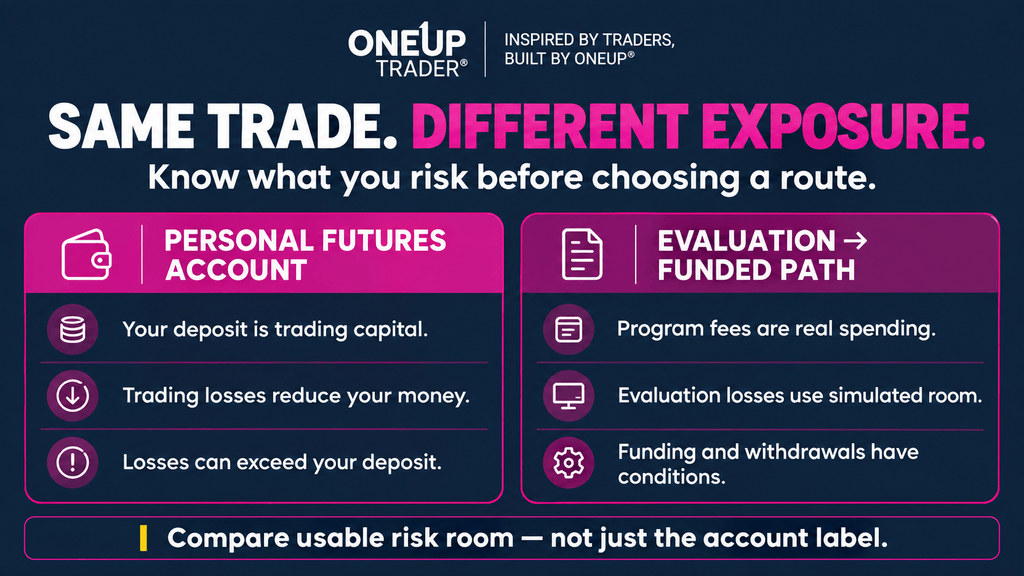
- Personal-account losses reduce your own money.
- Evaluation losses mean you don’t lose any of your own money; real spending includes program charges and any repeat attempts.
- A personal account offers more strategy flexibility, subject to broker, exchange, and regulatory requirements.
- The funded route adds performance and account rules, including conditions for withdrawals.
For OneUp Trader specifically, the evaluation is simulated. Successful completion leads to review and, if approved, an account with a funding partner.
What do you risk when you fund your own futures account?
Your deposit becomes trading capital. Losses, commissions, and other trading costs reduce it. Futures use leverage: a relatively small deposit can support exposure to a much larger contract value. That can make both gains and losses substantial compared with the cash in your account. Yes, this means that you can go into negative on the account and owe the broker money. This can happen if the broker doesn’t provide negative balance protection. For new traders who haven’t experienced volatility, a news release can be extremely damaging.
Margin is the money required to support a position, not the maximum you can lose. Initial margin applies when opening a position; maintenance margin is the level needed to keep it. Requirements can change with market conditions. Read your broker’s rules for intraday and overnight positions rather than assuming one quoted margin applies everywhere.
CME’s margin guidance explains the distinction. The National Futures Association also warns that traders may have to cover losses beyond the amount they expected to commit, as we explained above. CME Group
There is emotional pressure too. A losing session can feel different when the money came from months of saving. That is why living expenses, emergency savings, and money needed soon should stay outside the trading account.
What do you risk in a futures prop firm evaluation?
An evaluation changes the financial exposure. You pay for an evaluation package rather than depositing the advertised account balance as your own trading capital. Prices vary by account size, with OneUp Trader’s lowest-priced option at $65 for a $25,000 account.
Before you start, budget for the full cost of the process. This includes the subscription fee, renewal timing, any optional resets or repeat attempts, and any activation charge that applies to your plan. Please check current pricing and cancellation terms before committing. A modest initial payment can add up to significant spending if attempts keep restarting.
How do a personal account and the funded route compare?
| Factor | Self-funded futures account | OneUp evaluation and funded path |
|---|---|---|
| Capital at risk | Your deposited capital; losses can exceed it | Evaluation charges and repeat-attempt costs; the firm will never ask you to cover any losses incurred in the account |
| Rules | Broker, exchange, regulatory, margin, and account requirements | Evaluation requirements, followed by the funding partner’s agreement and withdrawal conditions |
| Upside | You retain net trading profits without a prop-firm profit split | Successful traders earn a percentage of profits made, 90% at OneUp Trader |
| Downside | Direct financial losses, margin pressure, and responsibility for account funding | Evaluation costs can add up if not properly budgeted |
| Flexibility | Usually more freedom over strategy and holding periods, within broker requirements | OneUp Trader has fairly lenient rules and can improve a trader’s ability over the long term |
| Best for | Highly experienced traders with affordable risk capital who value independence | Traders who do not want to risk their own capital |
OneUp Trader’s capital guidance states that its funding partners provide the capital for the funded account and that traders are not responsible for trading losses.
Who does self-funding fit best?
Self-funding can fit a highly experienced trader who has money set aside specifically for trading, has proven themselves in a simulated environment, and wants control over everything.
The trade-off is that you need enough capital for the strategy’s normal losing periods, margin requirements, and unexpected execution costs. The smallest deposit a broker accepts is not automatically enough to trade your plan responsibly. This is not to mention that high emotional control, discipline, and the ability to set and follow a trading plan need to be of the highest quality when a trader goes this route.
When does an evaluation fit a beginner trader?
A newer trader may understand their setup but reasonably prefer not to go through the hassle of opening a personal account and risking their savings. An evaluation offers a defined set of requirements to work toward. It can make position sizing, recordkeeping, and stopping rules concrete. OneUp Trader doesn’t limit the number of attempts a trader has before getting funded, so the evaluation can be an excellent way to practice. This is because it gives the feeling of a real account with something on the line without the risk of capital.
Before starting an evaluation, every trader should understand contract values, stops, costs, and the platform they intend to use.
Practice the same rules in simulation first. Record enough trades to see whether the strategy has a reasonable basis after costs and whether you can follow it through losses. Simulated results do not guarantee live performance, but they can reveal basic problems before you pay.
Why would an experienced trader choose the funded route?
An experienced trader may already have a workable strategy but prefer to keep more personal capital outside a trading account. The attraction is access to firm-provided trading capacity. That can be useful when the trader’s own affordable deposit limits the positions their tested strategy would otherwise support.
Before choosing a plan, compare your records with its rules. Would your historical losing periods reach the trailing threshold? Would your holding times fit? Would a few unusually large days create a consistency issue?
Consider open profit as well as closed results. A strategy that regularly gives back a large part of an open winner may fit an intraday trail poorly.
Does a larger account mean more buying power?
Not by itself. Compare three things: the cash you commit, the max position size, and the losses you can withstand while remaining eligible to trade.
Hypothetical comparison: A trader deposits $10,000 into a personal account but sets a personal stop-trading limit of $1,000 in losses. Another uses a $50,000 evaluation with $2,500 of available drawdown room.
| After four hypothetical net losses of $200 | Personal account | Evaluation |
|---|---|---|
| Trading losses | $800 | $800 simulated |
| Remaining room under the stated limit | $200 | $1,700 |
| What changed financially? | Personal trading capital fell by $800 | Simulated drawdown room (max loss) became smaller |
For more details, read how OneUp Trader’s trailing drawdown works.
Which skills transfer between the two routes?
Both routes need the same basics to be followed: a trading plan with a defined setup, a stop loss, logical position sizing, and a trading journal.
That starts before you enter a trade. Place your stop where it makes sense for the setup, then calculate how many contracts you can trade within your risk limit, allowing for fees and slippage. If the smallest position still risks too much, let the trade go.
The same discipline applies to your account as a whole. Keep track of how far it has fallen from its peak and how much room you have left to trade. In an evaluation, that means understanding the firm’s trailing drawdown. With your own money, it means setting loss limits and respecting them.
Your journal should help you review those decisions. Record why you entered, how you managed the trade, and whether you followed your rules. A planned loss and an impulsive loss may cost the same amount, but understanding the difference helps you identify what needs to improve.
Why consider OneUp Trader for this path?
OneUp Trader is worth considering if you want a trusted, long-established futures-focused evaluation.
The evaluation rules cover permitted products, trading hours, position limits, profit objectives, and consistency. That gives you specific conditions to rehearse before purchasing. Help Desk
For a prepared newer trader, this funded trader program offers structure without any risk whatsoever. For an experienced trader, it offers additional trading capital while preserving personal finances outside the account.
Our guide to passing a prop firm evaluation and getting paid explains how to plan for both stages.
Start An Evaluation Today
What should you ask before choosing either route?
Use these questions before depositing money or signing up for an evaluation:
- Can I afford the personal losses or total evaluation spending without affecting my essential expenses?
- Have I tested my setup after costs and recorded its losing periods?
- Do I understand contract values, margin, and order execution?
- Does the smallest practical position fit my risk budget?
- Have I set a per-trade limit, a daily stopping rule, and a point where I pause to review?
- If self-funding, do I understand liquidation terms and possible losses beyond my deposit?
- If evaluating, do I understand the trail, consistency rule, trading hours, renewals, and cancellation terms?
- Have I checked the funded agreement, eligibility, and withdrawal requirements?
- Does this route fit my strategy without forcing trades or unnecessary size?
You do not have to commit to one route forever. Simulation, a small personal account, and an evaluation can serve different purposes as your experience develops.
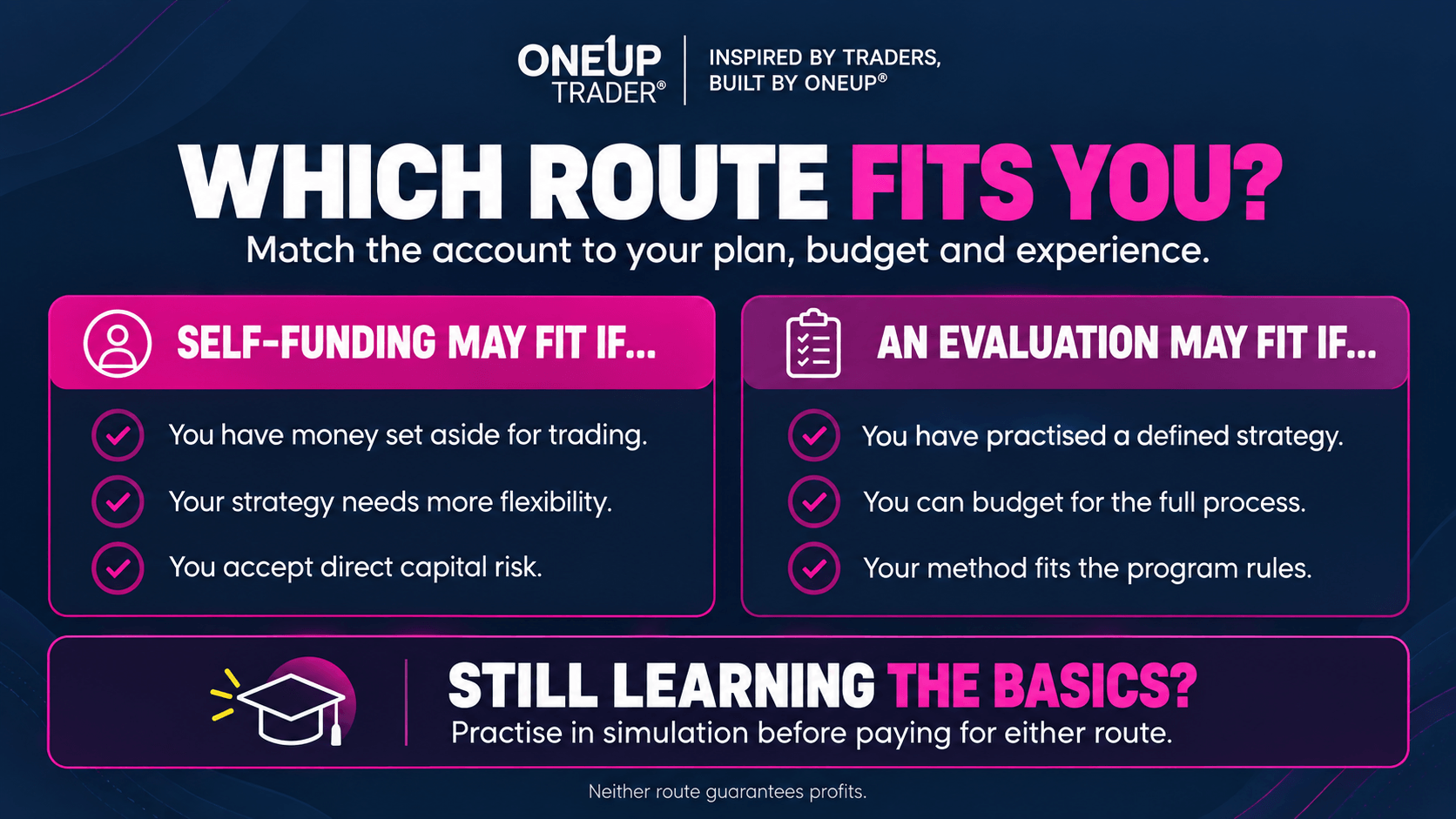
If the evaluation route fits your plan and budget, check OneUp’s current account options. Choose based on usable room and rules you can follow, rather than the biggest balance on the page.
This article is for educational purposes only and is not financial, investment, legal, or tax advice. Futures trading involves substantial risk; personal-account losses can exceed deposits. Examples are hypothetical. Evaluations, funding, and payouts are not guaranteed. OneUp information was checked on 7 October 2026. Rules, fees, eligibility, and agreements may change; verify current provider and broker documents before proceeding.


