



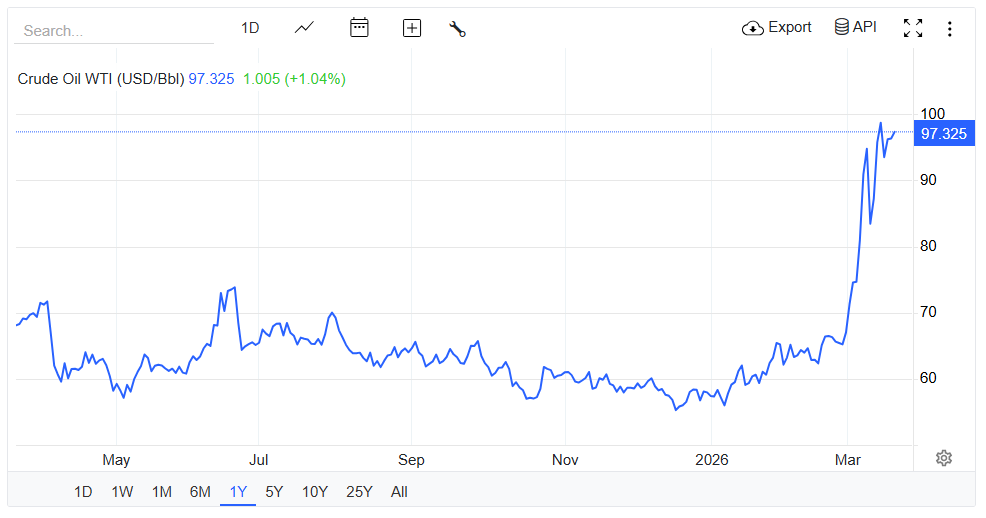
- Crude oil prices surge beyond the $100 mark as Israel attacks Iran’s South Pars gas field.
- President Trump has put the Jones Act on hold for 60 days to counter unstable energy markets, but the impact remains limited.
- The oil prices could rally to $150 or more if the Strait of Hormuz remains closed and war escalates further.
Crude oil prices surged significantly this week as tensions rose in the Middle East, supply chains were disrupted, and prices rose sharply, making markets worry that the energy crisis will last a long time.
The war between the US, Israel, and Iran has effectively closed the Strait of Hormuz, a key waterway that carries about a fifth of the world’s supply. Iran has said it will attack ships that go through the route, stopping shipments and causing a major oil shortage around the world.
Brent crude prices have shot up above $110 per barrel, sometimes getting close to $120. US crude prices are around $100. Experts say prices could go up further, to $150 to $200, if war continues. Recent attacks on Iran’s South Pars gas field and retaliatory attacks on important energy facilities in Qatar, Saudi Arabia, and the UAE have raised concerns about supply and added a strong geopolitical risk premium.
The supply shock has already had a big effect on Asian economies that rely heavily on oil from the Gulf. To save fuel, the Philippines has started working four days a week. Indonesia, on the other hand, is trying to protect its limited reserves. Despite the release of 400 million barrels from strategic reserves, the global market still lacks about 10 million barrels per day.
China, being the largest oil buyer, also remains under immense pressure.
Beijing has been able to diversify its energy mix thanks to years of strategic planning. It gets a big pile of its energy from Russia and relies heavily on domestic coal, which makes up more than half of its electricity generation. China has also built up massive oil reserves, which are thought to be between 900 million and 1.4 billion barrels. This gives them a buffer of up to three months.
But higher crude oil prices are still making fuel and industrial costs go up. Prices of gasoline and diesel in China have already gone up, and the country’s petrochemical industry is under more pressure.
To make it easier to move fuel around the country, US President Donald Trump has put the Jones Act on hold for 60 days as the markets stay unstable. But experts say the effect may not be substantial because of problems with refining.
Oil markets remain strongly bullish, even though geopolitical risks are rising and supply problems are getting worse. Future price direction is uncertain depending on how long the Strait of Hormuz is closed and how the conflict as a whole develops.
If you are looking to trade the current crude oil volatility, use the promo code CRUDE10 to avail a 10% discount.