


- Crude oil futures ticked higher as attacks on shipping and energy infrastructure rose sharply in the Middle East.
- Iran’s continued oil exports through the regional waters suggest a lower likelihood of a blockade of the Hormuz corridor.
- As long as the war situation persists, prevailing uncertainty could keep the prices elevated.
On Thursday, crude oil futures rose sharply amid more frequent attacks on shipping and energy infrastructure in the Middle East. The situation has raised concerns about long-term supply disruptions through the Strait of Hormuz, which is one of the most important oil transit routes in the world.
During Asian trading hours, Brent crude, the global benchmark, rose above $101 a barrel. The price of WTI was close to $95. Since the start of the Iran conflict in late February, Brent has surged by almost 38%. This shows that energy markets are becoming riskier due to geopolitical factors.
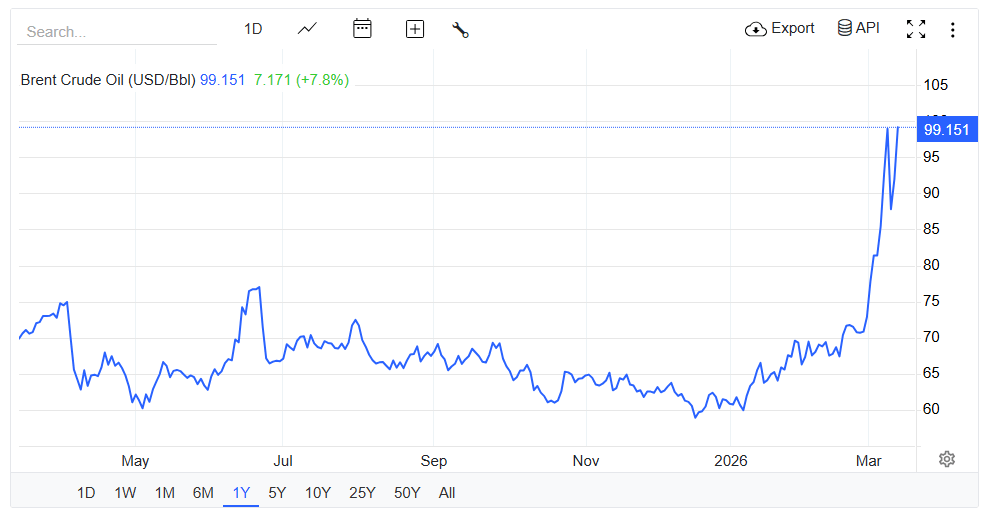
The rise comes even though the International Energy Agency (IEA) made an unprecedented coordinated move. Its 32 member countries agreed to release 400 million barrels from strategic petroleum reserves, which is the largest emergency stockpile release in history. Markets still don’t believe that the measure will make up for problems caused by attacks on shipping in the Strait of Hormuz.
Attacks on ships and energy infrastructure in the region linked to Iran have sharply cut exports from Gulf producers, and shipping through the narrow waterway has slowed down a lot. Maritime data show at least 13 confirmed attacks on ships since the conflict began. This has raised insurance costs and forced some producers to cut back on production.
On the other hand, Iran has continued to send crude oil at a steady rate. According to tanker tracking data that Reuters looked at, about 13.7 million barrels of Iranian oil have been shipped since February 28, when Israel and the US attacked the country. Kpler, a company that monitors ships, says exports may be even higher, with about 16.5 million barrels shipped in the first 11 days of March.
That means about 1.1 to 1.5 million barrels a day, which is close to Iran’s average exports last year of about 1.69 million barrels a day. Satellite images show that several very large crude carriers are still loading at Iran’s Kharg Island export terminal. This means shipments could increase in the next few weeks.
Analysts say that Iran’s ability to keep moving oil through regional waters may make Tehran less likely to completely block the Hormuz corridor. But if the US tries to take Iranian tankers, it could make the situation even worse.
Attacks in the region, on the other hand, continue to threaten supplies. Drone strikes started a fire at Oman’s Salalah port, and Iraq stopped all oil terminal operations for a short time after two tankers were attacked near the Al-Faw export area.
Market participants are also concerned that the Strait might stay partially blocked for weeks, which could leave a supply gap of 15 to 20 million barrels per day.
Traders are becoming less certain that the situation will be resolved quickly, as naval escorts remain too risky and regional tensions are rising. This keeps crude futures firmly above $100.