


- Iran and Oman agreed to jointly manage the Strait and share the revenues.
- The US plans to sanction Iran to punish the country’s economy.
- The US core PCE price index increased by 0.2% as expected.
Oil prices fell on Thursday after Iran reached a deal with Oman to manage the Strait of Hormuz. At the same time, market participants were relieved when the US chose to use sanctions against Iran, pausing the missile and drone attacks. Meanwhile, US inflation numbers met expectations, keeping Fed rate hike expectations steady.
Iran recently decided to pursue talks with Oman regarding the control of the Strait of Hormuz. Reports on Wednesday revealed that the two had agreed to jointly manage the Strait and share revenues. This was a step in the right direction as traders hope for further de-escalation of tensions in the Middle East. As a result, oil prices fell.
Oil has been declining since the week began. The move came after reports indicated that the US plans to sanction Iran to punish the country’s economy. Although the move shows that the two nations are still at odds, it is better than exchanging missiles and drones. Consequently, traders will worry less about the destruction of oil facilities and loss of lives.
Market participants had hoped for a deal between the US and Iran to reopen the Strait of Hormuz. However, to this point, the two have failed to agree. Moreover, the US was against talks between Iran and Oman. As a result, oil has mostly risen in August. The new developments, however, have eased concerns about supply disruptions, allowing the market to pull back. Nevertheless, with no clear peace deal, tensions could escalate at any time.
“It is unclear whether US policy to economically isolate Iran will prove effective. But if the US measures do work as intended, Iran’s ability to respond via increased violence becomes a growing risk for energy markets to consider,” CBA wrote in a note on Monday.
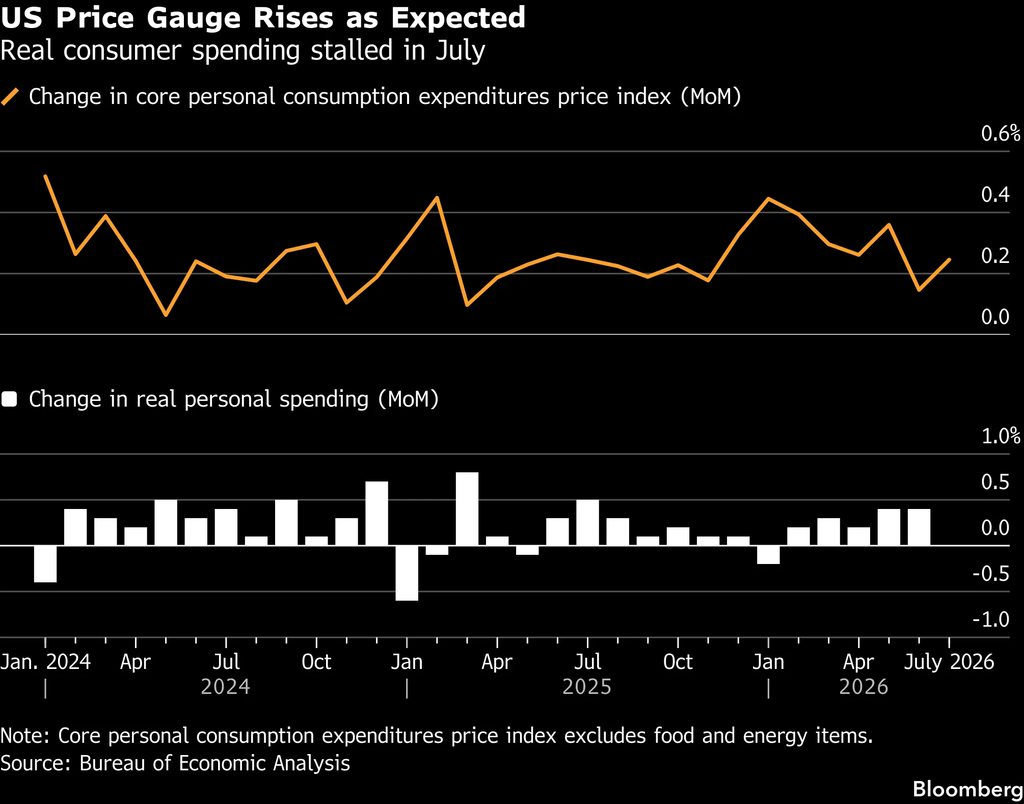
US core PCE (Source: Bloomberg)
Elsewhere, US data released on Wednesday showed that the core PCE price index rose 0.2% as expected. Anything higher or lower would have changed expectations for a Fed rate hike. As it is, traders are pricing a 63.6% chance that the Fed will keep interest rates unchanged in September.
Last week’s FOMC minutes revealed that policymakers are ready to raise borrowing costs if inflation remains elevated. However, this might become more difficult to do if the economy is also slowing down.