


Introduction
Today, we are looking at the impressive story of a French trader from Lyon. Joseph discovered financial markets in 2019 but primarily traded crypto rather than futures, as we offer at OneUp Trader. That year, Bitcoin nearly doubled and attracted a lot of attention from retail traders and the public. Joseph became more and more involved in the financial markets from that point and even started teaching people about cryptocurrency.
He told us that he got involved in markets because they fascinated him, and he loves the combination of freedom, accountability, and performance-based work.
“Trading rewards discipline and self-improvement, which motivates me every day.” – Joseph
Joseph is a 27-year-old freelancer by trade, and because he is based in the European time zone, he can trade the US session with his chosen platform, Ninjatrader. Over 71 trades, he lost more often than he won, which on the surface sounds like a losing trader or a strategy that is not sustainable. Looking at how he actually traded explains more about making money in the markets than any winning streak would, and today, we are going to take a deeper dive into how he prepares for the trading day, his statistics, and his trading strategy.
Statistics
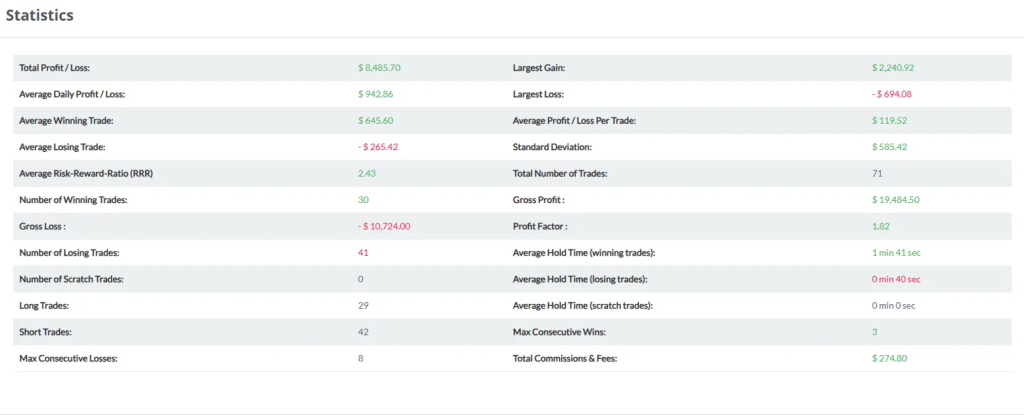
The most important number in Joseph’s record isn’t the $20,591 that he withdrew. It’s the 40 seconds he holds a losing trade on average before closing it. He won fewer than half his trades across that stretch and still came out with a five-figure profit, and the way he handled his losses is the reason why. This is super interesting and shows us just how much discipline this trader has. Most traders hold onto losers for way too long, but Joseph understands that there is no point to that in the long term for his performance.
The win rate is a distraction
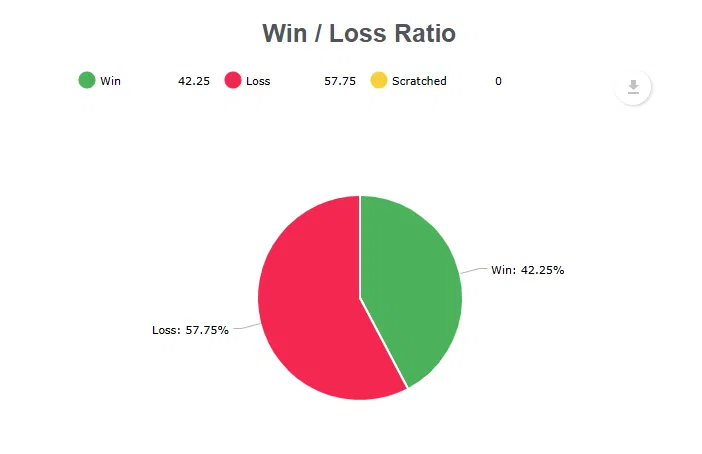
Joseph won 42.25% of his trades: 30 winners against 41 losers. If we focus solely on that, it looks bad, but a win rate on its own tells you almost nothing. It only means something once you put it next to your average win and your average loss.
The numbers that matter here are the profit factor of 1.82 and the total profit of $8,485.70, off an average daily profit of $942.86. A profit factor of 1.82 means Joseph made $1.82 for every dollar he lost, and he did it while being wrong on the direction most of the time.
The math the win rate hides
Joseph’s average winner was $645.60, and his average loser was $265.42, a risk-reward ratio of 2.43 to 1. His winners come in roughly two and a half times bigger than his losers, so the wins outweigh the losses even though there are fewer of them. His biggest win of the period was $2,240.92, while his largest loss was held to $694.08.
That gap is the whole game and the reason why he was able to achieve what he did. He doesn’t need to be right often; he just needs to make sure being right pays far more than being wrong costs, and his numbers show he does exactly that.
What we as traders can take from this is that every trading system is unique, but as long as you concentrate on the basics and remain disciplined, you can also make withdrawals from a prop firm.
Eight losses in a row didn’t blow his account
His worst stretch shows how durable his system is. At one point, Joseph took eight losing trades in a row, and his best winning streak was only three. Plenty of traders would blow up under that kind of run, usually by oversizing the next trade to ‘win it all back.’
Traders should calculate how much their strategy can withstand if they have 10 losses in a row, and if they want to be extra safe, 20 losses in a row. From this calculation, you can develop a risk management plan on position sizing that will give you room for at least 20 losses before hitting the max drawdown of the specific evaluation you are on.
Let’s look at an example on the $50K account at OneUp Trader
The drawdown is $2,500 on that account. If your average loss is, say, for example, $50 on one MNQ contract, that gives 50 possible losing trades in a row before the drawdown is hit. On two contracts, that changes to 25, so a trader in this example should not really be trading more than two contracts at a time.
To turn this into a position-sizing method, use your trading results to estimate how much drawdown your strategy needs.
Measure your edge
Take a representative sample of trades, ideally several hundred, and calculate your win rate, average win, and average loss, including costs. A 60% win rate with $50 average wins and $50 average losses produces an expected profit of:
(0.60 × $50) − (0.40 × $50) = $10 per trade.
That is a long-run average; losses can still cluster together. (This calculation goes further, but that is not the purpose of this article)
What Joseph actually gets right
Underneath the statistics, his edge is his mental approach rather than his actual trading technique or strategy. He prepares the same way for every session, reviewing price action and marking his key levels before the New York open, then waiting for high-quality setups rather than forcing trades. And when a trade goes against him, he accepts it in 40 seconds rather than arguing with the market.
He plays sports in the morning and completes his freelance tasks for the day at that time as well, so that when the New York session opens, he is fully focused on trading. Joseph also said, ‘Sometimes I lose patience and take trades I shouldn’t. I can also be too ambitious with profit targets instead of securing profits earlier.’ This shows us that no one is perfect, even for a trader who has withdrawn 5 figures; there is always room to improve!
He rated his OneUp Trader experience a 9 out of 10, found the platform very easy to set up, and said the evaluation “promotes discipline and realistic risk management.” That lines up with everything else about him, because discipline and risk management are the whole method.
The takeaway
Joseph’s record shows that you don’t need to win most of your trades to get paid. He was right on just 42% of his 71 trades, yet he withdrew $20,591 from his OneUp Trader account. The reason is simple: his average winner was 2.43 times bigger than his average loser, and he made $1.82 for every dollar he lost.
His edge doesn’t come from a secret setup. It comes from discipline. He gets his sport and freelance work done in the morning, marks his key levels before the New York open, waits for quality setups, and cuts losing trades in about 40 seconds. Even a run of eight straight losses couldn’t knock him off course because his position sizing gave him room to absorb it.
The lesson for every trader is clear: size your positions so you can survive a long losing streak, keep your losses small, and let your winners do the heavy lifting. Get the psychology right, and the numbers follow.