



estimated reading time: 9 minutes
Dan bought his first $25,000 evaluation on a Sunday night, mostly to see how it would go.
Dan isn’t one person. He’s a bunch of traders we hear from every week, but his approach is the same as all of them. He had a few setups he liked, a general sense that Nasdaq moved well in the morning, and a profit target of $1,500 that looked very reachable. He had no written plan, no daily limit, and no clear idea of what a good day or a bad day would look like. He was trading on hope.
Sarah bought the same evaluation that same week. Before she placed a single trade, she wrote one page covering the setup she would take, the market conditions it needed, how much she would risk, what she wanted to make each day, and what would make her stop trading for the day.
Both of them knew the rules, but only one of them really knew what they were trying to do.
Sarah passed in eleven trading days, while Dan lost his account in a few days. His strategy wasn’t worse than hers. The difference was that she had decided in advance what she was doing and why, and he was making those decisions as he went.
What passing actually takes
Passing a prop firm evaluation and getting paid later comes down to decisions you make before the session, not hope during it:
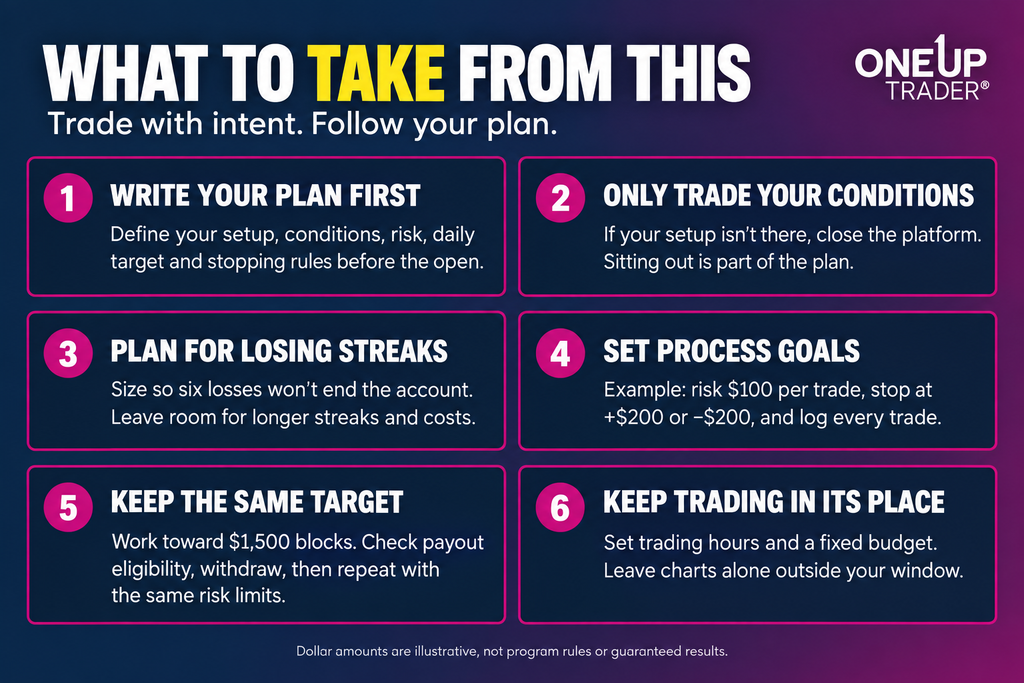
- Write a one-page plan before you trade: setup, required market conditions, risk per trade, daily target, and what makes you stop for the day.
- Only take your setup when the conditions are present. Skip chop and other days where your edge isn’t there.
- Size so that a normal losing streak can’t close the account. For example, a 45% win-rate strategy often sees about six losses in a row over 100 trades — your risk per trade must survive that.
- Use a daily loss limit (and a daily profit stop) so one frustrated session doesn’t wipe out the evaluation.
- Treat the rules as part of the plan: know how trailing drawdown and consistency work before you set targets or size.
- When you’re funded, keep repeating the same-sized target that got you there (for example, $1,500 blocks) instead of sizing up to chase bigger months.
- Before you buy an evaluation, check the firm’s withdrawal minimum, payout frequency, buffer, and any clause that can void a payout after you’ve earned it.
When should you trade your setup in an evaluation?
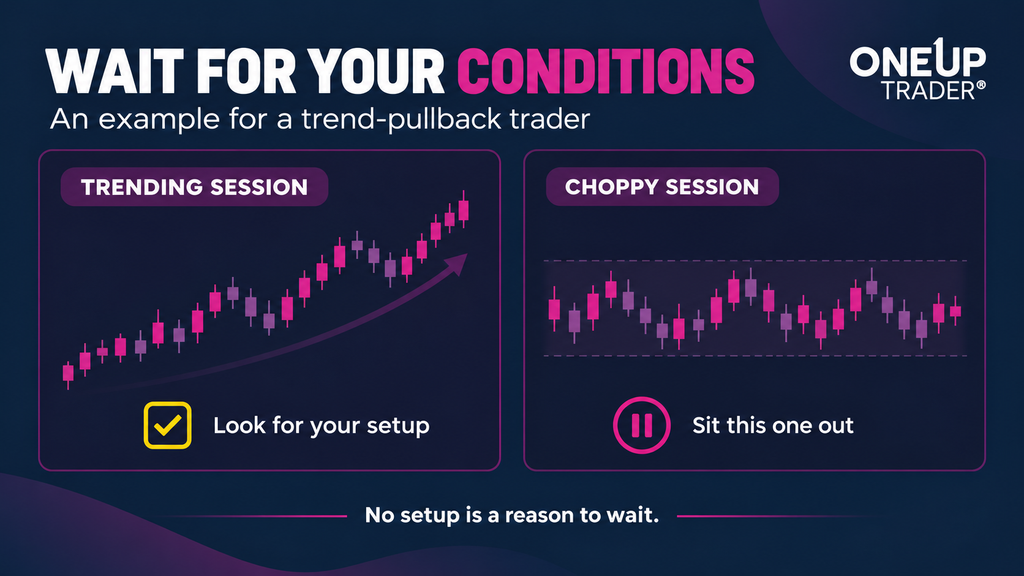
Every strategy has conditions under which it works and conditions under which it doesn’t. A trend-following setup does well on days when the market picks a direction and stays there. On choppy, range-bound days, it gets stopped out repeatedly. A mean-reversion strategy has the opposite problem. Neither one is broken. Each one only works in certain conditions.
Most traders know this in general but don’t act on it. They take their setup in every kind of market, lose on the days it was never going to work, and conclude the strategy has stopped working. They then get back on the hamster wheel in search of the next holy grail strategy.
Sarah’s setup is a pullback entry in the direction of the trend on the micro S&P 500 during the first 90 minutes of the session. She knows the conditions it needs: the market has to break out of the opening 30-minute range and hold.
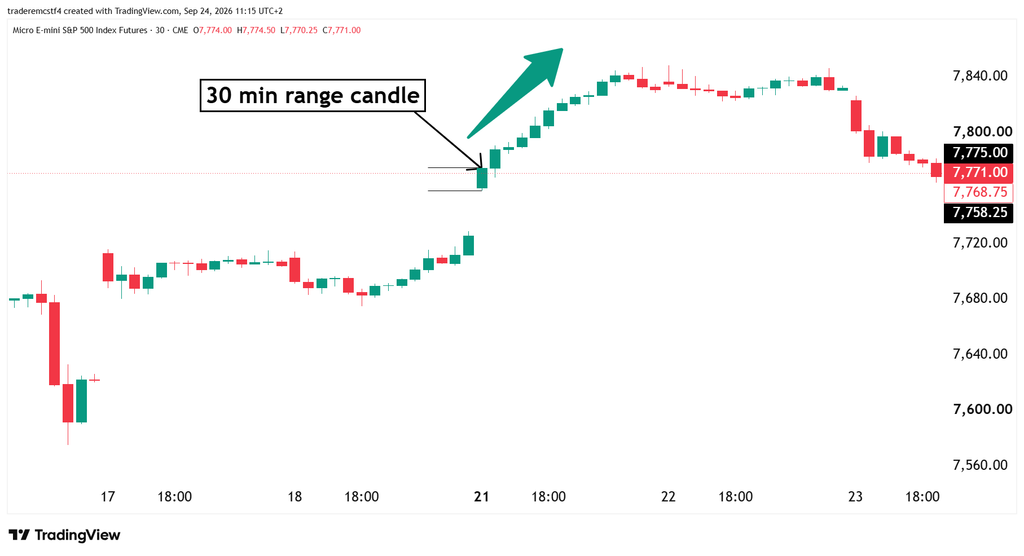
If it opens inside the prior day’s range and chops back and forth, her setup has no edge, and she knows that before the open. So on those days, she doesn’t trade. She stays patient, knowing that tomorrow is another day and the market is not going anywhere.
That sounds passive, but it’s one of the most useful skills in trading. A trader who takes 60 trades in their own conditions will almost always beat one who takes 100 trades in every condition, because the extra 40 trades were mostly losers.
How do you size risk so a losing streak doesn’t fail the account?
Even under the right conditions, a good strategy will often lose, sometimes several times in a row. The math shows why. Take a strategy that wins 45% of the time, with winners about twice the size of its losers. That’s a solid edge, making around a third of your risk per trade on average. But over 100 trades, there’s roughly a 70% chance it hits six losses in a row at some point.
Traders who don’t expect this, read the streak as a sign that something is broken with their system. They switch setups, add size to win it back, or trade outside their conditions to force a winner. That’s how a normal losing streak turns into a closed account.
Traders who expect it, build it into their system. Start with your own numbers. Take your win rate from your journal and work out the losing streak you should expect over your next 100 trades. For a 45% win rate, that’s around six losses in a row. Then size your trades so that streak can’t close the account. Sarah risks $100 a trade, so six straight losses cost her $600, which is 40% of her $1,500 drawdown. That’s painful but survivable. At $250 a trade, the same streak would cost $1,500 and end the account.
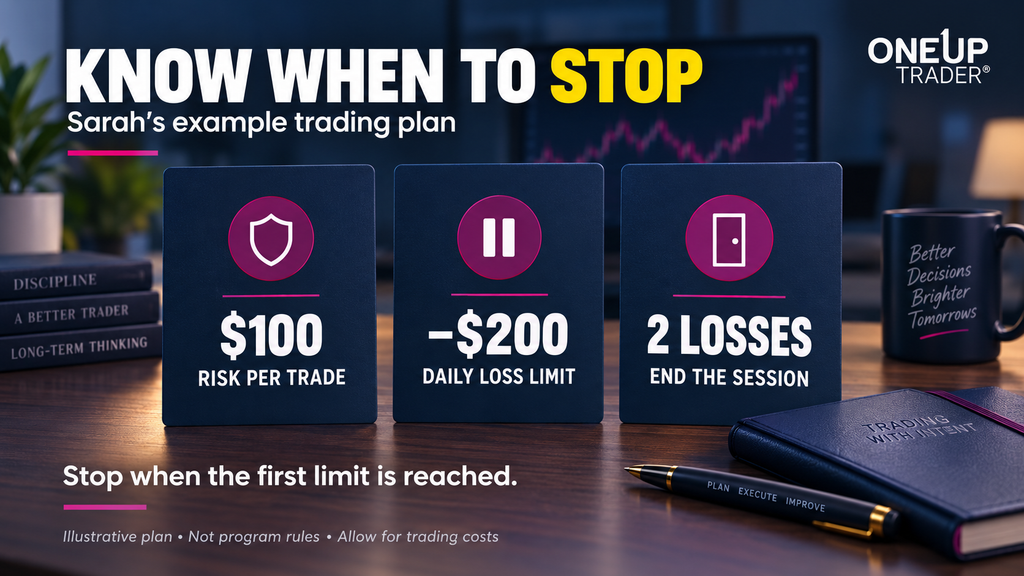
Her daily limit helps too. She stops after two losses, so a six-trade losing streak is spread across three separate days instead of hitting her all in one session. That gives her time to reset between sessions instead of trading through the streak in one frustrated morning.
Knowing your expected streak also tells you when to change something and when to leave the system alone. If a streak stays within the normal range, the system is working and nothing needs to change. If it runs well past that, to nine or ten losses, that’s when to review the journal. Check whether those trades followed the plan and whether the market conditions were actually there. If they were, the edge may have faded. If they weren’t, the problem is execution, not the strategy.
How do trailing drawdown and consistency rules change your plan?
The rules matter, but mainly because they shape your plan. You can’t set a sensible daily target without knowing how the consistency rule works, and you can’t size trades without knowing how the drawdown moves.
Sarah’s evaluation had a $1,500 target and a $1,500 trailing drawdown. The drawdown follows her peak balance upward and never moves back down, so she measures her risk from her highest balance of the day, not her closing balance.
Her risk per trade is $100: two micro S&P contracts with a 10-point stop. That gives her roughly fifteen losing trades before she hits the drawdown, and fewer as it trails. Her daily stop is $200. Her daily target is $150 to $200, which gets her to the profit target in eight to ten sessions. That’s also enough days to keep her profits spread out and stay well clear of the consistency rule.
Dan was risking $400 a trade on a full Nasdaq contract, which gave him about three and a half losing trades of room. Do you see where the error is? There is a reason why risk management is the most important aspect in trading.
What daily goals work during a prop firm evaluation?
“Get funded” isn’t a goal you can act on during a trading session. It is also far too broad, with insufficient focus. Think of a magnifying glass: the further you hold it away from an object, the wider the light beam is; the closer you hold it, the smaller and more focused it becomes, and it can even burn a hole in concrete.
Sarah’s goals are this way: small and specific. Today, she will take her setup if the conditions show up and skip it if they don’t. She will risk $100 per trade. She will stop at +$200 or -$200, or after two losses. She will log every trade and mark whether it followed the plan.
None of those depend on the market. She can meet every one of them on a losing day, and on most days she does. The profit comes from doing that consistently across enough sessions.
This also changes what a good day means. A day where she saw a choppy open, took no trades, and closed the platform by 10 a.m. counts as a success, because she followed the plan.
Take a moment to look at the difference between these two traders. Dan has goals and wishes, but he still treats trading like a hobby: he guesses a general direction, hopes it works, and decides what to do in the moment. That approach can produce a few good days. It rarely survives an evaluation’s drawdown rules.
Sarah treats trading like a small business. She has a written plan, clear risk limits, and a definition of a good day that doesn’t depend on being green. If you had to bet on which approach has the higher chance of getting funded and staying paid, you’d bet on hers. That’s the shift most traders need to make.
How do you get paid after you’re funded?
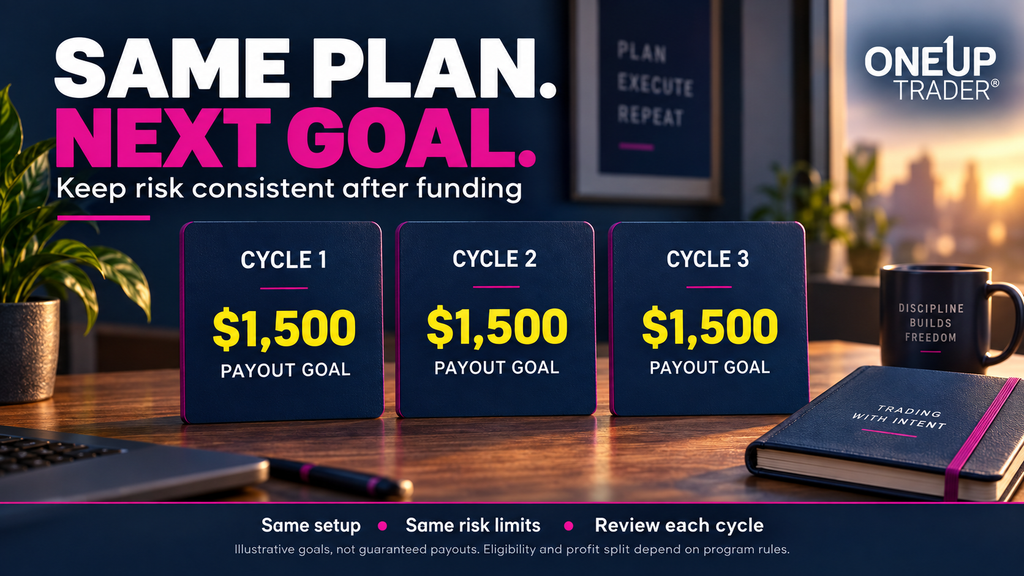
Traders often run into trouble after they get funded because their goals suddenly get bigger.
During the evaluation, $1,500 felt like a sensible target. Once they’re funded, it seems too small. The account is real, the profit split is real, and they start thinking about $10,000 months. They add size and trade more often. The drawdown still follows the same rules it did during the evaluation, so the added risk catches up with them quickly.
Sarah takes the opposite view. She has already shown she can make $1,500 on this account size under these rules, and a funded account doesn’t change that. So each payout cycle is treated as a repeat of the evaluation she already passed.
Her first goal is to clear the buffer, the amount most programs require above the starting balance before any withdrawal is allowed. After that, she works in $1,500 blocks: she hits the target and requests the withdrawal, then starts the next block with the same daily limits and the same risk per trade. She checks that $1,500 clears OneUp Traders’ minimum withdrawal and fits its payout schedule.
On OneUp Trader
Before you treat $1,500 as a payout goal, check three things on OneUp Trader’s live payout page: the smallest amount you can withdraw, how often payouts go out, and how much profit you must keep in the account before you can withdraw. Use that page, not this article, because those numbers can change.
Eight of those withdrawals in a year add up to $12,000 before the profit split. Most traders never take out anything like that because they spend their funded accounts chasing much bigger numbers.
Small targets also keep the pressure down. She never has much open profit at stake, a bad week sets her back one block rather than ending the account, and each withdrawal proves the plan works.
That’s also why the payout policy deserves as much attention as the evaluation rules. When we surveyed our own traders, 150 responded, and 77% told us that a firm’s withdrawal policy is the most important factor they consider when choosing where to trade. Before you buy an evaluation, check the minimum withdrawal, the payout frequency, the buffer requirement, and any clause that allows a payout to be voided after it’s been earned.
Trading shouldn’t take over your life
A trader who is stressed trades worse, and trading on hope produces a lot of stress. If you don’t have a plan, every tick matters, every loss feels personal, and you end up checking charts at dinner.
Sarah has set hours and a schedule that she trades. She trades her 90-minute window, reviews her trades for fifteen minutes, and then gets on with her day. She does this because she wants to improve, and it is vital that all traders develop this attitude and mindset.
She doesn’t have the trading app on her phone. If the conditions aren’t there, she’s done early.
She also pays for evaluations from a fixed monthly budget, the same way she’d pay for a course or a subscription. If an account fails, she doesn’t feel pressure to buy another one immediately to make the money back, which is how many traders go through three accounts in a month.
A few signs your trading is causing too much stress: you’re checking positions outside your trading hours, you’re thinking about yesterday’s losses during today’s session, or you’re sleeping worse. When that happens, the answer is usually to trade less. That might mean a smaller size, a shorter window, or a few days off. The market will still be there.
What passing actually requires
Dan wasn’t a bad trader. He was trading without clear intentions. Every decision was made in the moment, under pressure, while hoping it would work out.
Sarah made her decisions before the session started: what she’d trade, when she’d trade it, how much she’d risk, when she’d stop, and what she was aiming for. During the session, she just carried out that plan.
Passing an evaluation and getting paid comes down to that difference. Know your strategy well enough to recognize when conditions don’t suit it. Set goals you can meet on a losing day. When you’re funded, keep making the same $1,500 you made to get there. And make sure trading remains one part of your life rather than the whole of it.
Start Your Evaluation With OneUp Trader Today
FAQ
When should you trade your setup in a prop firm evaluation?
Only when the conditions your setup needs are present. If the market is choppy or stuck inside a range where your edge does not apply, skip the day. Fewer trades in the right conditions beat more trades in every condition.
How do you size risk so a losing streak does not fail the account?
Use your journal’s win rate to estimate a normal losing streak (for a 45% win rate, about six losses in a row over 100 trades is common). Set risk per trade so that streak stays inside the drawdown. A daily loss limit spreads damage across sessions instead of ending the account in one morning.
How do trailing drawdown and consistency rules change your plan?
Trailing drawdown rises with your peak balance and does not give room back, so you size from your high-water mark, not only from the start of the day. Consistency rules mean you cannot dump the whole profit target into one or two huge days — daily targets should stay modest and repeatable.
What daily goals work during an evaluation?
Goals you can hit on a red day: take only planned setups, risk a fixed amount per trade, stop at a set win or loss for the day (or after a set number of losses), and log whether each trade followed the plan. “Get funded today” is not a session goal.
How do you get paid after you are funded?
Clear any buffer the firm requires, then work in the same-sized profit blocks you used to pass (for example, $1,500). Request the withdrawal, reset, and repeat. Check the live payout policy for minimum withdrawal, frequency, and rules that can void a payout.
What should you check before buying an evaluation?
Minimum withdrawal, payout frequency, buffer before you can withdraw, and any clause that lets the firm void a payout after you have earned it. Withdrawal terms matter as much as the evaluation rules.
Disclaimer: This article is for educational purposes only. It is not financial, investment, or trading advice. Prop firm rules, drawdowns, and payout policies differ by firm and can change. Futures trading involves substantial risk of loss and is not suitable for every trader. Always read the firm’s current evaluation and payout terms before you buy an account or request a withdrawal.

