




- Trump said he would not agree to a peace deal without nuclear talks.
- The US economy expanded by 2.0%, missing the forecast of 2.2%.
- This week, market participants will focus on the US nonfarm payrolls data.
Currency futures strengthened last week as a surge in oil prices fueled inflation concerns. As a result, most major central banks that held policy meetings adopted a cautious tone. The rally in oil prices came as tensions in the Middle East intensified, with Trump rejecting Iran’s new proposal to end the war.
It was a busy week with the big five central banks all holding their policy meetings. There was uncertainty about the future for most amid the ongoing Iran war. Oil jumped on Wednesday after Trump said he would not agree to a peace deal without nuclear talks. As a result, negotiations between the US and Iran have stalled. As energy prices climb, goods and services become more expensive. As a result, economies heat up quickly, forcing central banks to increase interest rates.
Higher interest rates boost their currencies as investors rush for the bigger yields. However, central banks must also consider growth. Balancing inflation and growth can be tough. For instance, the European Central Bank has the difficult task of ensuring the economy does not tip into a recession, and inflation remains under control. As a result, the euro ended the week nearly flat.
On the other hand, the dollar had a bearish week despite rising demand for safe-haven assets. The decline came after big losses on Monday when Iran presented the US with a new proposal to end the war.
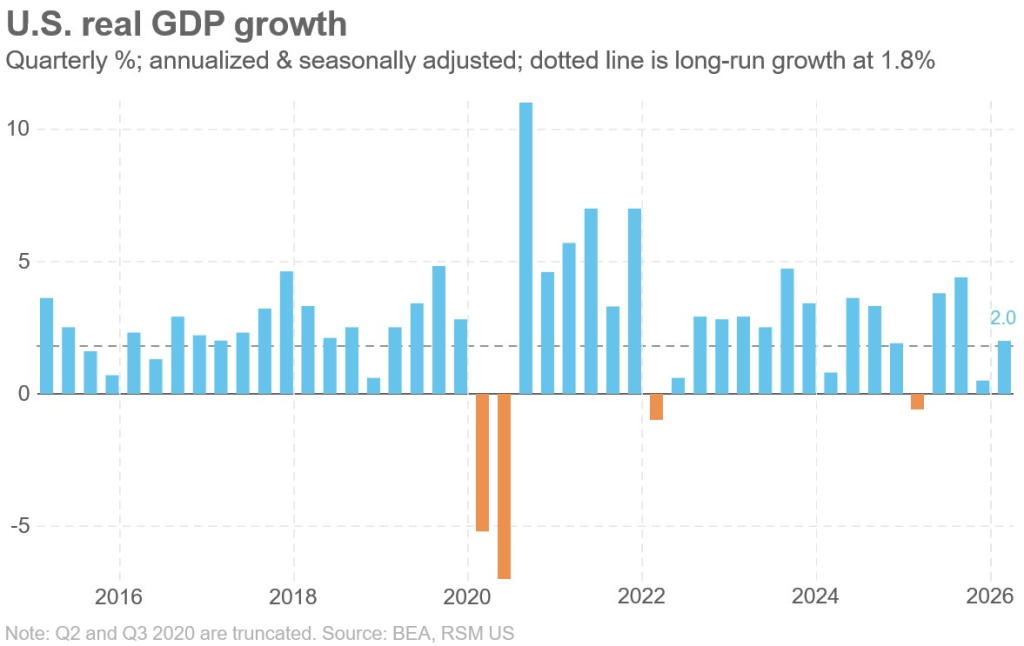
US GDP (Source: The Real Economy)
Furthermore, data on Thursday revealed that the US economy expanded by 2.0%, missing the forecast of 2.2%. The report eased worries about inflation and an overheating economy. At the same time, it reduced pressure on the Fed to tighten monetary policy.
Other central banks that kept interest rates on hold were the Bank of Japan, the Bank of Canada and the Bank of England.
Elsewhere, the Australian dollar eased on Wednesday after data showed consumer inflation rose 4.6%, missing the forecast of 4.8%. At the same time, a decline in gold prices weighed on the commodity currency.
This week, market participants will focus on nonfarm payrolls data from the US that will give more clues on the state of the labor market. Economists believe employment will increase by 60,000, a drop from the previous month’s 178,000.