



- Crude oil prices continue surging further as the Middle East war escalates.
- The Strait of Hormuz blockade has reduced oil production due to a lack of storage capacity.
- Higher oil prices could increase global inflation, triggering an energy shock.
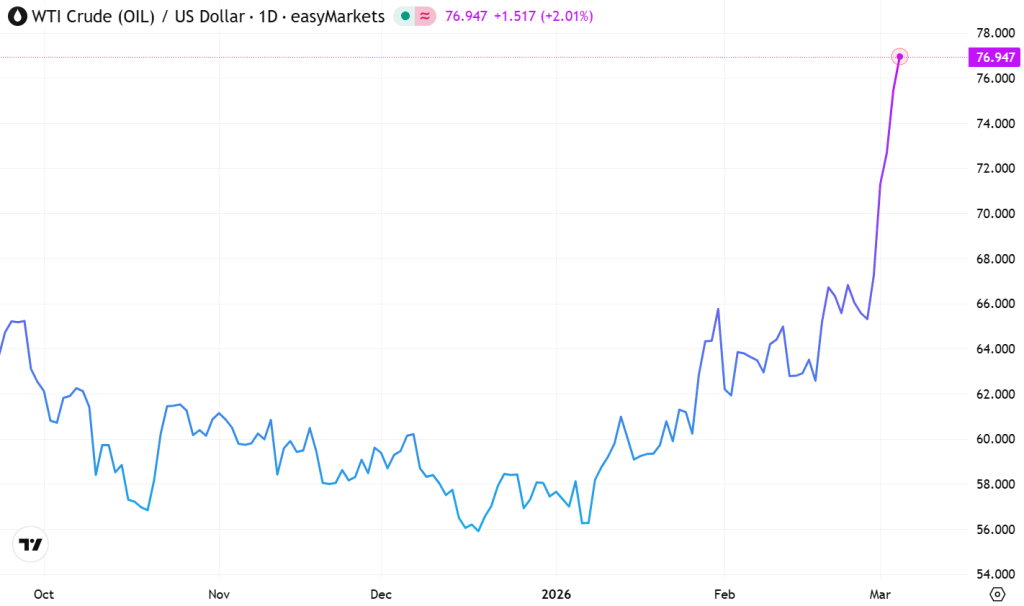
Crude oil prices rose further in Thursday’s Asian session as the U.S.-Iran conflict worsened, tightening supply expectations and halting flows through the Strait of Hormuz. Brent crude rose more than 2% and was trading close to $83 per barrel. Meanwhile, WTI rose toward $76.60, adding to an 11% rise earlier in the week.
The geopolitical background remains the key factor. The U.S. military attacked an Iranian warship, and Senate Republicans supported President Donald Trump’s military campaign, showing that Washington isn’t interested in de-escalation. Tehran has responded with attacks all over the region, which keeps shipping risks high and energy markets on edge.
The Strait of Hormuz, which is responsible for about 20-27% of the world’s oil trade and a large part of LNG flows, has had almost no traffic for five days in a row. According to J.P. Morgan, about 329 oil ships are stuck in the Gulf. Iraq, the second-largest producer in OPEC, has cut production by almost 1.5 million barrels per day as it can’t store or export the oil. Qatar has also declared force majeure on LNG exports, indicating that normal production is unlikely to resume for at least a month.
Most oil fields in the area can technically restart in a few weeks, but the main problem right now is logistics, not geology. Crude oil can’t reach global markets as Gulf Cooperation Council (GCC) countries lack sufficient storage capacity, while shipping routes are blocked. Markets are now balancing two scenarios:
• Short-lived disruption: sharp spike, then retracement
• Multi-week shutdown: genuine supply shock, inflation returns hard
The risks are high for economies that rely on oil imports, like India and the EU, which get almost 90% of their crude from other countries and rely heavily on Hormuz transit. A sustained $1-per-barrel rise in oil prices makes the import bill much larger and adds to inflationary pressures.
Prices are likely to stay unstable in the near future. A sharp drop could occur if there is any diplomatic progress, but as long as shipping problems and military escalation persist, the risk premium in crude will remain strong.