


- US equities struggle amid the Middle East crisis and surging oil prices.
- President Trump’s recent comments about a potential end to the war provided mild support to the equities.
- Due to higher energy prices, markets remain concerned about inflation, keeping a close watch on the CPI data due this week.
US equities are entering a period of greater uncertainty amid rising tensions in the Middle East and surging oil prices, with market valuations stretched. This makes investors cautious about a probable correction in the S&P 500.
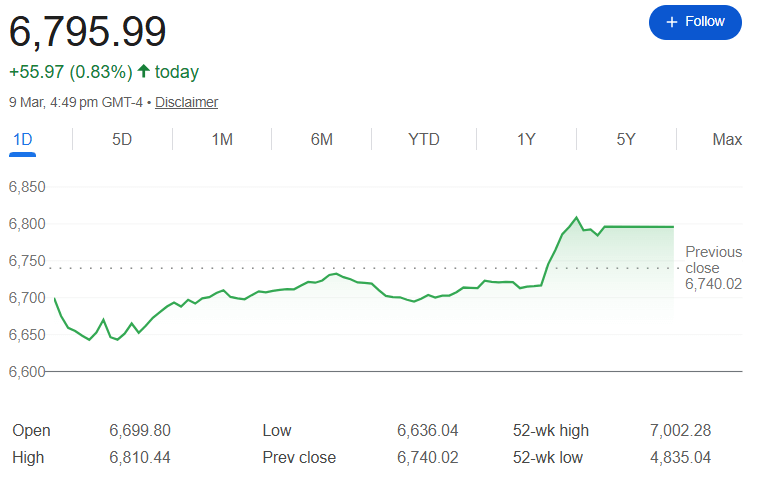
On March 9, Wall Street analysts said the conflict in Iran could push the market lower, especially if energy supply problems worsen. The S&P 500 is currently trading near 6,740, down about 3% from last month. Technical analysts are keeping an eye on a key support level around 6,700. Jonathan Krinsky, the chief market technician at BTIG, says that if the index breaks that level below, it could move toward its 200-day moving average, which is a sign of a change in the long-term trend.
Market participants were more concerned after Andrew Tyler’s trading desk at JPMorgan Chase turned “tactically bearish” on US stocks. The bank said that the S&P 500 could drop as much as 10% if tensions escalate, possibly falling to 6,270. It also said that markets might not be taking geopolitical risks seriously enough.
The rise in crude oil prices is at the heart of investors’ worries. Brent crude oil briefly rose above $110 per barrel amid concern that the blockage of the Strait of Hormuz could cut off a large share of oil from the global market. The strategic shipping route carries about one-fifth of the world’s oil trade by sea, so any restrictions on it would be a big threat to energy markets.
Concerns about inflation are already rising because of higher oil prices. Inflation in the US was 2.4% in January, which is still above the Federal Reserve’s 2% target. Rising energy costs could push prices even higher. That makes it harder for the central bank to see how its policies will change after it cut rates three times in late 2025 but stopped easing earlier this year. Now, the markets are wondering if there will be any more rate cuts before the end of 2026.
US stocks bounced back on Monday after Donald Trump said the conflict might end sooner than expected, even as risks rose. The Dow Jones Industrial Average rose 0.5%, the S&P 500 rose 0.8%, and the Nasdaq Composite rose 1.4% as investors welcomed signs that tensions might ease.
But volatility is still high. Market sentiment is still largely driven by changes in oil prices, uncertainty about Iran’s leadership under Mojtaba Khamenei, and the risk of disruptions to global energy flows.
Investors are closely monitoring geopolitical events and the upcoming US inflation data. These could determine whether the current turmoil turns into a bigger stock market correction or is just another temporary shock.