



- Crude oil futures continue to rally amid geopolitical developments in the Middle East that raise concerns about supply disruptions.
- Reduced US crude stocks amid weather effects add more to the tighter supply.
- Overall, the risk of oversupply later this year remains intact, which could pare the recent gain in oil contracts.
Crude oil futures are locked in a geopolitically driven rally, with Brent pushing toward the high $60s and WTI into the mid-$60s, marking three consecutive days of gains and roughly a 5% advance since January 26.
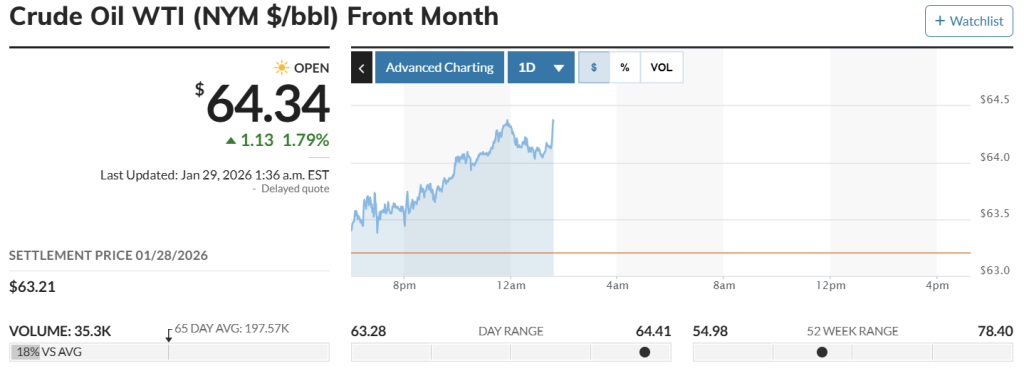
The primary driver is escalating Middle East tension centered on Iran, a key OPEC producer pumping around 3.2 million barrels per day. The deployment of a US aircraft carrier group and President Trump’s increasingly hawkish rhetoric have increased the likelihood of an attack on Iranian assets or leadership. This has raised the geopolitical risk premium by about $3-4 per barrel. If tensions rise further, Brent could reach around $72.
Fundamentals support this risk bid with near-term tightening. US crude inventories dropped by 2.3 million barrels to 423.8 million in the week of January 23, indicating firmer refinery runs and tighter availability. Weather-related disruptions are amplifying this effect. A severe winter storm is estimated to have shut in up to 2 million barrels per day, roughly 15% of US output.
At the same time, crude and LNG exports from Gulf Coast ports briefly fell to zero. Kazakhstan’s Tengiz field, which is set to restore less than half of its normal production by early February after a fire and power problems, is another supply problem that adds to the tightening story.
OPEC+ has also decided to keep the pause on more output increases, which helps keep prices from falling even though the overall balance for 2026 still points to a possible glut. On the macro side, a steady Federal Reserve policy stance, signs of US economic resilience, and a weaker US dollar are providing marginal demand and financial support, making dollar-denominated crude more attractive.
Nonetheless, several analysts stress that the current rally is heavily risk‑premium‑driven. Once Middle East and weather-related supply concerns ease, selling pressure is likely to re-emerge, with WTI potentially gravitating back below the $60 area as markets refocus on the prospective oversupply later in the year.