



- US stocks rebounded, led by technology and AI companies, as investors shifted focus to this week’s economic data and earnings.
- The Nasdaq outperformed, boosted by strong gains from chipmakers like NVIDIA and Broadcom, and a jump in Oracle after upbeat analyst views on its AI partnerships.
- Market attention turns to key economic releases, such as retail sales and inflation, which may influence Federal Reserve policy and the strength of the market rally.
US equities extended their rebound on Monday. Gains were led once again by beneficiaries of big tech and AI as investors looked past last week’s turbulence. They turned their focus to a heavy slate of economic data and corporate earnings.
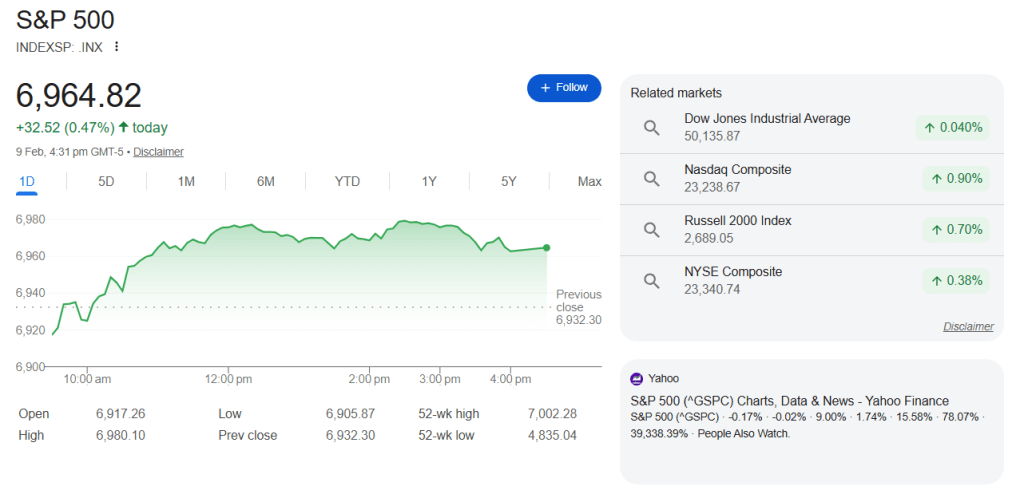
The S&P 500 rose about 0.5% to 6,964.82, marking a second straight increase. The Dow Jones Industrial Average, on the other hand, only rose 0.04% to a record 50,135.87. The tech-heavy Nasdaq Composite rose 0.9% to 23,238.67. Investors were once again interested in growth and AI-related stocks after a software-led rout.
Chip and AI infrastructure leaders once again did most of the lifting. NVIDIA and Broadcom’s stocks went up about 2.5% and 3.3%, respectively. This is part of a rally that has added about $1 trillion to the S&P 500’s market value in the last few sessions. After an analyst upgrade, Oracle’s stock jumped by almost 10% as investors hope its partnerships with OpenAI and major cloud providers will sustain strong demand for its AI-driven cloud capacity.
The rebound comes after a whipsaw week in which fears over AI disruption and stretched software valuations triggered sharp selling across parts of the technology complex, even as the Dow broke through the 50,000 milestone for the first time. Strategists say tech’s forward price-to-earnings multiple has shifted from a premium to a discount relative to its five-year average. This has led some investors to view the pullback as an opportunity to buy more tech stocks rather than as a reason to leave the sector.
Market leadership remains narrow. Hardware, semiconductors, and AI infrastructure attract capital, while generic software and business models seen as automation-vulnerable are repriced lower. Banks and broader financials lagged as investors awaited guidance on interest rates and credit conditions.
Attention now turns to a dense run of economic releases. Retail sales data comes on Tuesday. The delayed January jobs report arrives on Wednesday. The consumer price index will be released on Friday. Payroll growth is expected to slow, and inflation is expected to ease toward a roughly 2.5% annual rate. Traders see this week’s numbers as key for the Federal Reserve’s interest-rate path and for whether the latest buy-the-dip in US equities can become a durable rally.

