


- Gold futures edge higher after the recent US CPI rally.
- Political pressure and the Fed’s dovishness keep the bullion in the positive zone.
- Central bank purchases provide a solid floor for the gold, making the dips a buying opportunity.
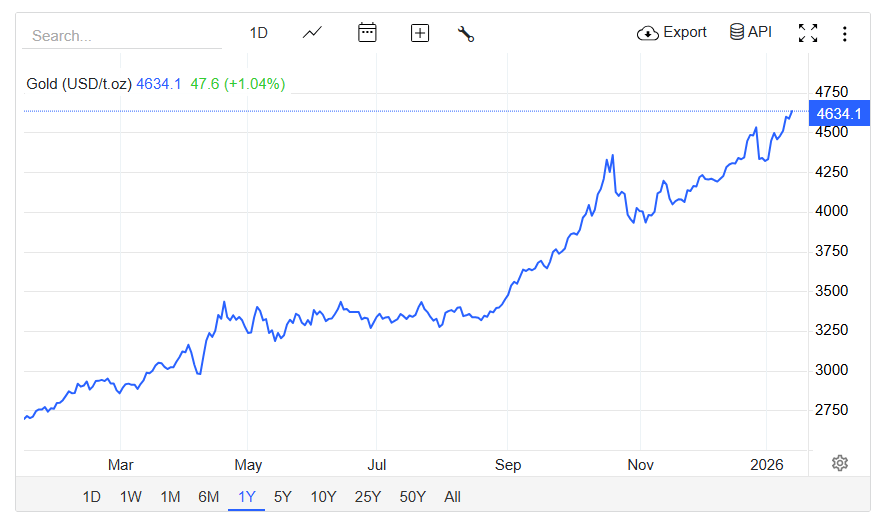
Gold futures are trading near record territory as the macro backdrop increasingly supports higher prices. Spot gold briefly hit a new all-time high around $4,635 an ounce, while front-month futures pulled back slightly to settle near $4,599 after the initial spike. Even with that intraday reversal, the broader picture remains exceptionally strong; over the past 12 months, gold has gained about 70%, reflecting persistent demand for safety and inflation protection.
The weaker US inflation data sparked the most recent leg of the gold rally. In December, the headline CPI went up 0.3% month over month and 2.7% YoY. However, the core CPI rose only 0.2% MoM and 2.6% YoY, which was less than expected.
For futures markets, this matters because it strengthens the case for the Federal Reserve to begin cutting rates later this year. Lower policy rates and falling real yields reduce the opportunity cost of holding non-yielding assets, making long positions in gold futures more attractive relative to cash and bonds.
Political pressure is reinforcing that narrative. Following the inflation release, US President Donald Trump called on Fed Chair Jerome Powell to cut rates “meaningfully” and publicly criticized his performance, as Powell’s term is set to end in May. This visible tension over the Fed’s independence adds an extra risk premium to US monetary policy and, by extension, to the dollar. This makes gold a useful hedge against policy uncertainty.
In addition to the cyclical rate story, structural forces continue to support the gold futures market. Global investors and central banks are responding to elevated geopolitical risks, concerns over large US fiscal deficits, and fears of sanctions by diversifying away from dollar-denominated assets.
In the second quarter of 2025, central banks bought an estimated 166 tons of gold. Poland, Turkey, and India were the largest buyers, and surveys indicate that nearly 95% of central banks plan to increase their purchases. This steady demand from the official sector, along with strong long-term investment performance, establishes a solid foundation for gold futures.
It also suggests that pullbacks are more likely to bring in hedging and accumulation than to mark a lasting top, as long as expectations for eventual Fed easing and ongoing geopolitical strain stay the same.