

Introduction
Crude oil markets remain under pressure as the multi-year pullback continues, with CL trading near a well-defined long-term support zone mentioned in our previous analysis. Price has retraced sharply from the 2022 highs and is now trying to stabilize after months of lower highs and lower lows. While volatility has cooled compared to prior years, uncertainty around global growth, OPEC supply, and demand expectations continues to impact the price.
Let’s take a closer look at the technicals and what we can learn from them.
Market Structure & Trend
Monthly chart
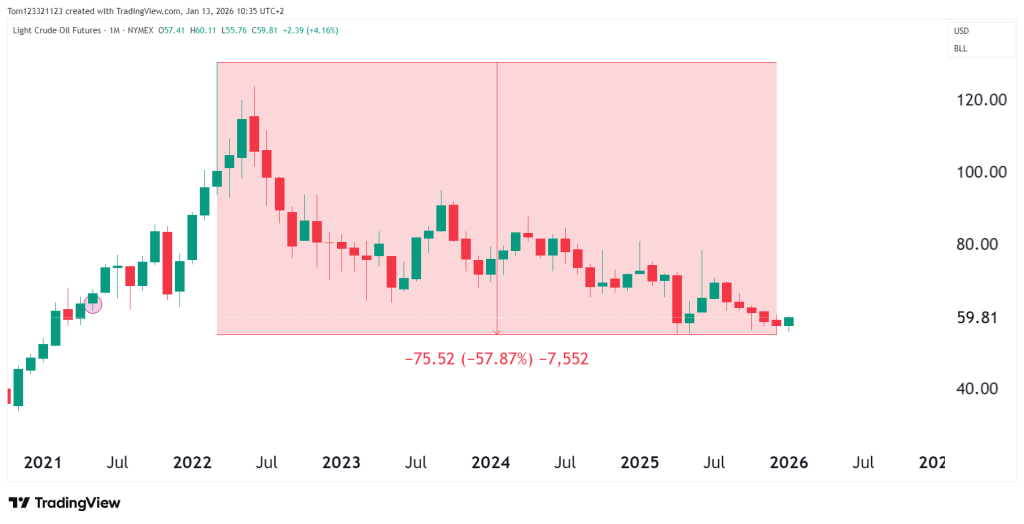
The monthly chart shows the decline since 2022 of 57.87%. This has erased most of the gains from the previous rally, but the price has been stabilizing. The key characteristic for this time frame is the lower highs, and as the range of the candlesticks is reducing, a possible break in either direction becomes more likely. The trend however is still bearish and a possible descending triangle pattern is emerging, looking at lower time frames will help us see this better.
Weekly chart
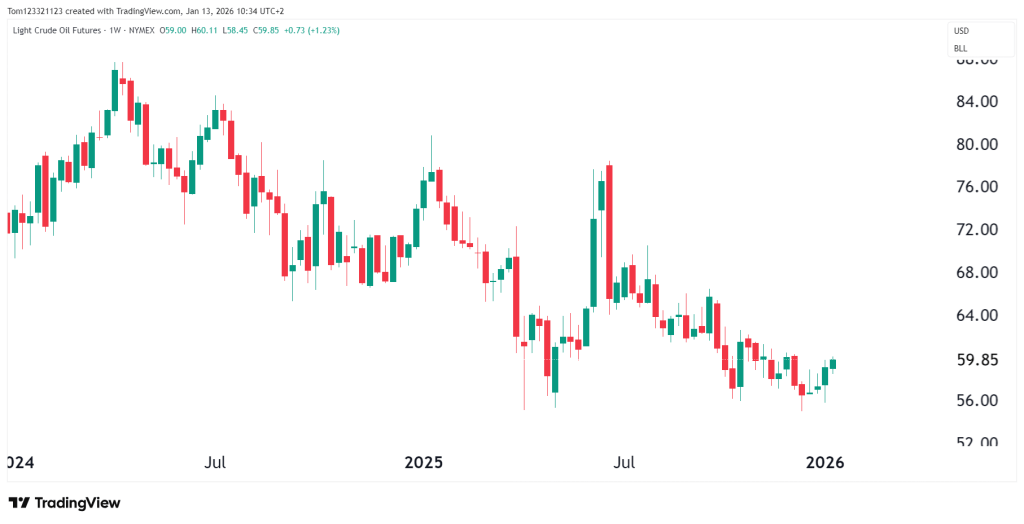
On the weekly timeframe, we can see the downtrend from a different perspective, with price consistently failing to reclaim prior resistance zones. Each rally attempt over the past year has been met with selling pressure, resulting in a sequence of lower highs.
That said, recent candles suggest stabilization rather than acceleration lower. The market is beginning to consolidate near support, which often leads to a mean-reversion bounce or a continuation move once direction is resolved.
Daily chart
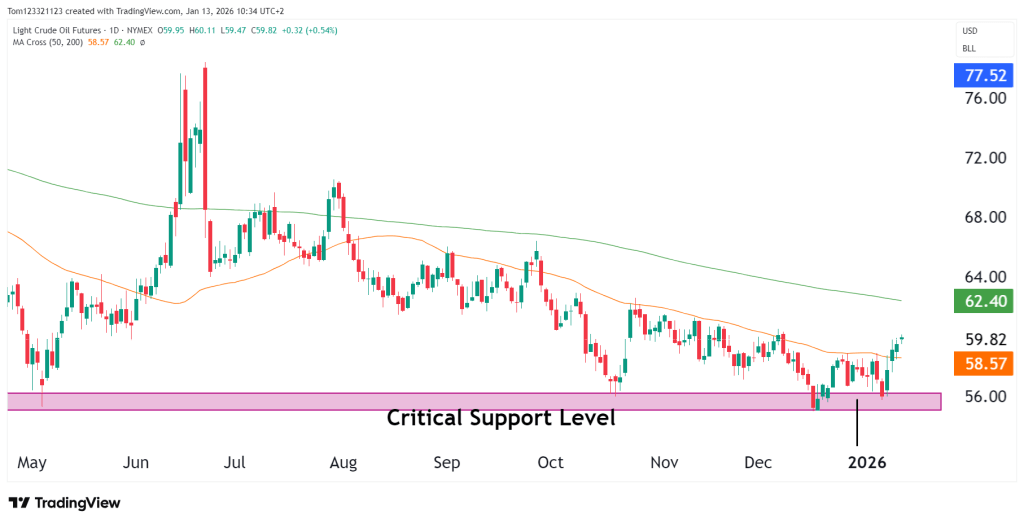
The daily chart shows price reacting cleanly off a clearly defined critical support zone near the mid-$50s. Buyers have stepped in multiple times to defend this area, and the most recent bounce has pushed price back toward the moving averages.
The 50-day and 200-day moving averages remain overhead and continue to slope lower. For the bulls, sustained price above the 50-day MA would be an early sign of improving momentum. Until then, rallies risk being corrective in nature as the bears will be looking to short into them.
Key Technical Levels
Resistance
- 60.50–62.50: Near-term resistance and moving average confluence
- 65.00–67.00: Prior breakdown zone and key weekly resistance
- 72.00+: Major structural resistance and trend reversal level
A sustained move above $65 would significantly improve the medium-term technical outlook.
Support
- 55.00–56.00: Critical long-term support zone
- 52.00–53.00: Range low and downside extension if support fails
- 48.00–50.00: Major psychological and historical demand area
A clean break and acceptance below $55 would shift risk firmly back to the downside.
Looking Forward
Bullish reversal:
A sustained hold above the $55 support zone followed by price remaining above $62 could open the door for a recovery toward the $65–$67 resistance area.
Sideways consolidation:
Price continues to trade between $55 and $62 as the market digests the longer-term decline and awaits clearer fundamental catalysts.
Bearish continuation:
A decisive break below $55 would likely trigger a continuation lower toward $52 and potentially the $48–$50 zone.
Estimated Probability Table
| Scenario | Description | Estimated Probability |
|---|---|---|
| Sideways consolidation | Basing above $55 support | 40% |
| Bullish reversal | Reclaiming $62 and higher | 30% |
| Bearish continuation | Breakdown below $55 | 30% |
Fundamentals to Watch
Crude oil is being influenced by both supply control and uncertain demand. OPEC+ production choices are still a major factor, as members try to support prices without losing market share. Demand expectations also depend heavily on global growth, especially from China and other emerging markets.
Broader economic factors matter too. Moves in the U.S. dollar, interest rate expectations, and overall risk sentiment can all affect oil prices. With crude trading near long-term support, unexpected economic data, geopolitical events, or inventory reports could trigger the next major move.
This analysis is for educational and informational purposes only and does not constitute trading advice or a recommendation to buy or sell any futures contracts. Futures trading involves significant risk and may not be suitable for all investors. Always conduct your own research and consult with a licensed financial professional before making trading decisions.