



- US equities lost $700 billion as the new tariffs and AI disruption triggered outflows to emerging markets.
- The rotation occurs despite a weaker dollar, which makes foreign assets expensive.
- Overstretched US stock prices have pushed investors to move away from AI leaders to cyclical stocks.
US equities plummeted as domestic investors pulled money out of Wall Street at the fastest rate since at least 2010. They moved their money to cheaper, higher-performing overseas markets, while new tariff risks and AI disruption hurt sentiment.
According to LSEG/Lipper data, US-based investors have pulled out about $75 billion from US equity products in the last six months, including $52 billion since the start of 2026. This is the biggest outflow for the first eight weeks of a year in at least 16 years. At the same time, about $26 billion has gone into emerging market stocks this year. South Korea and Brazil led the way with $2.8 billion and $1.2 billion, respectively.
The rotation occurs even though the dollar is weaker, which makes foreign assets more expensive in US terms. This is after a long period when US stocks, especially Big Tech, performed well due to post-crisis growth and the AI boom. The S&P 500 has risen about 14% over the last year, but foreign markets have done better in dollar terms. For example, Japan’s Nikkei is up 43%, Europe’s STOXX 600 is up 26%, China’s CSI 300 is up 23%, and South Korea’s KOSPI has doubled.
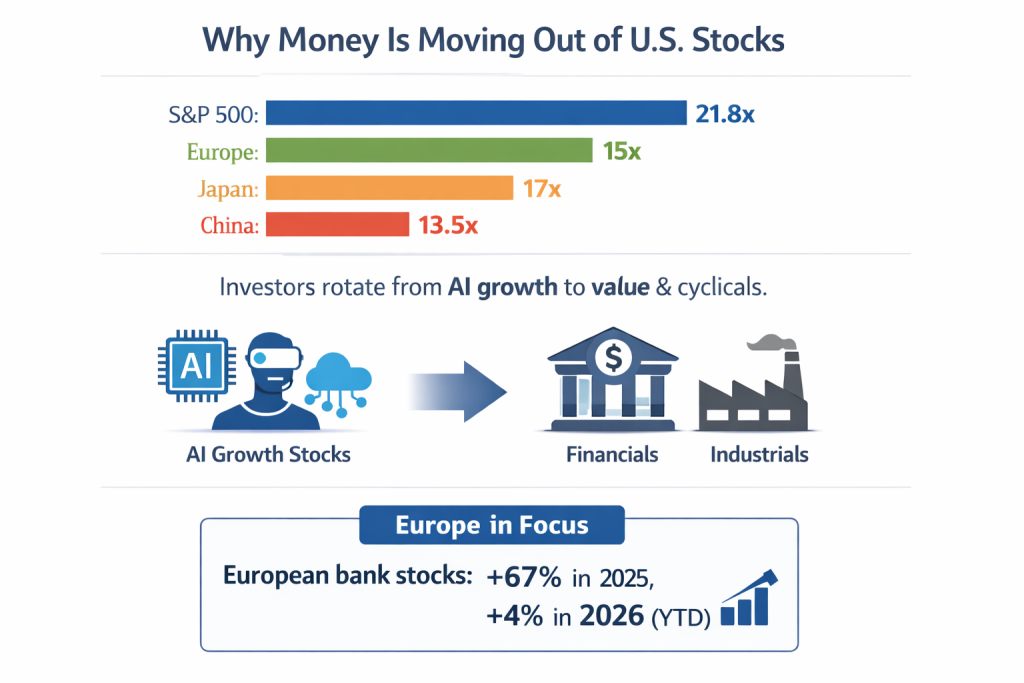
Strategists say that stretched US stock prices are a big reason. The S&P 500 is worth about 21.8 times its future earnings. In Europe, it’s worth about 15 times, in Japan, 17 times, and in China, 13.5 times. Investors are moving their money from high-growth AI leaders like Nvidia, Meta, and Microsoft to value and cyclical stocks, such as financials and industrials, which are more common in Europe and Japan. For example, European banking stocks rose 67% in 2025 and have risen another 4% this year.
The short-term price action has weakened. A sudden sell-off wiped out almost $700 billion in US market value in a single day. IBM’s stock fell about 13% after AI company Anthropic pointed out tools that could automate COBOL modernization, which is a major source of income for IBM. Investors also reevaluated AI’s disruptive effects, along with President Donald Trump’s new 15% tariffs and the ongoing legal uncertainty surrounding US trade policy. This caused broader technology, software, cybersecurity, and consumer-related stocks to fall.