


- US equities remain soft amid recent tariff concerns, pushing the major indices lower.
- Investors are eyeing the Q4 earnings season to anticipate equity growth in 2026.
- Some strategists consider the recent weakness as a dip-buying opportunity as the tariff-related dust settles.
US equities enter the week under pressure, with futures pointing sharply lower as investors react to President Trump’s latest tariff threats on key European allies over Greenland. Dow, S&P 500, and Nasdaq 100 futures are all indicating a weak open after the Martin Luther King holiday, marking the first full market response to plans for tariffs that start at 10% on Feb. 1 and rise to 25% on June 1.
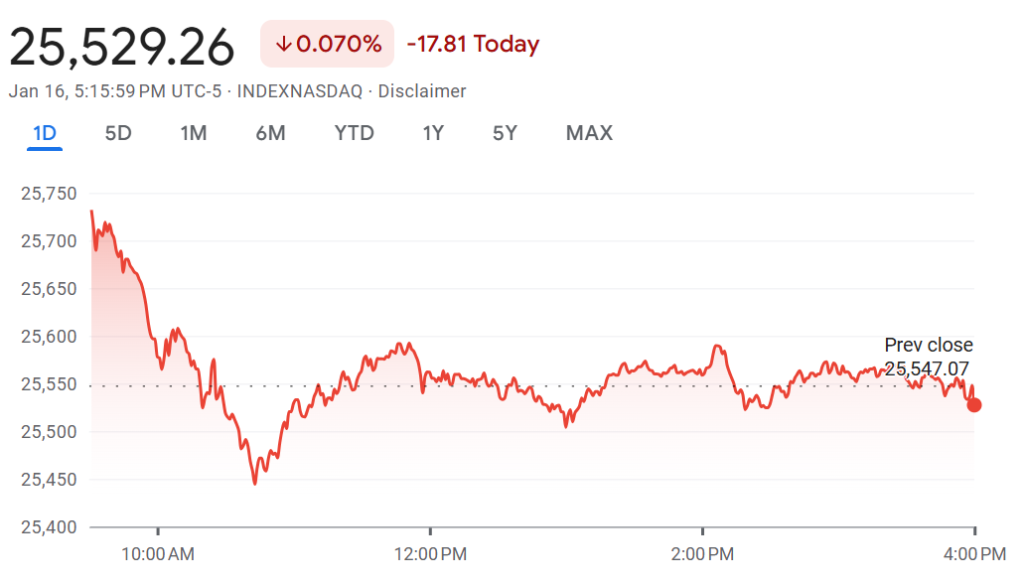
The move revives fears of a transatlantic trade conflict just as many investors had assumed peak tariff risk was behind them. European stocks have already adjusted, with autos and luxury names selling off, while defense names are catching a bid amid rising geopolitical tensions.
This comes at a delicate moment for US equities. The S&P 500, Dow, and Nasdaq have all posted back-to-back losing weeks after three consecutive years of double-digit gains driven by US mega‑caps and AI-linked names. There is significant dispersion below the surface. Companies that make things across the world, especially in Europe and China, now face new policy risks, while companies that focus more on the US look better positioned.
Despite this, many global investors remain structurally underweight in US equities versus the MSCI World’s heavy US weight, so any tariff-driven pullback is being watched closely as a potential entry point rather than a clear trend break.
Earnings season is the immediate test. Q4 results and, more importantly, 2026 guidance from firms like Netflix, Johnson & Johnson, Charles Schwab, and Intel will have to validate expectations for roughly 12–15% earnings growth in the S&P 500.
If management teams highlight tariff uncertainty, weaker global demand, or a more cautious stance on AI-related spending, the market’s recent wobble could deepen. On the other hand, some strategists see tariff-driven weakness as a “buy the dip” opportunity, arguing that attention will quickly swing back to fundamentals.
Meanwhile, macro and structural currents are shifting. As geopolitical tensions rise, safe havens like gold and silver are reaching record highs. At the same time, the NYSE’s move toward tokenized securities and 24/7 trading signals a major change in how US stocks are traded and settled.
Near term, though, price action will be dominated by tariff headlines, the Supreme Court’s looming tariff ruling, and whether earnings can carry US equities through another year of elevated expectations.