



- Gold futures break record highs as institutions continue buying momentum.
- Declining real yields and dovish Fed expectations favor long gold positions.
- Institutions anticipate a $6,000 gold price in 2026, amid underlying conviction.
Gold futures are trading in an environment with record spot prices, strong flows into safe havens, and a structurally weaker US dollar. Spot gold has gone above $5,200 per ounce for the first time, up more than 20% since the beginning of the year. US gold futures for near-term delivery also reflect this rise. Traditional industrial demand is not driving the term structure as much as macro hedging and expectations surrounding US monetary policy.
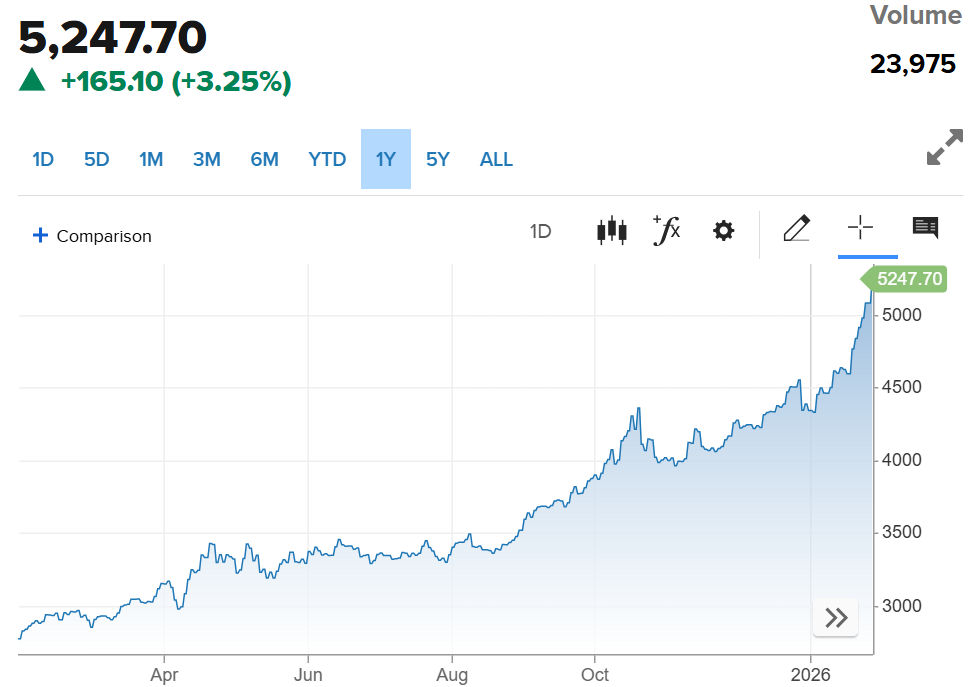
The primary driver of the current futures rally is the sharp decline in the US dollar, hovering near a four-year low amid what analysts describe as a crisis of confidence. Political signals that support a weaker dollar have reinforced the perception that US officials are fine with the dollar losing value, leading to a shift away from the dollar towards non-dollar assets. Since gold and the dollar have a strong inverse relationship, this has led to higher futures prices, with investors continuing to buy dips.
Federal Reserve expectations are the second key pillar. Markets widely anticipate no immediate change at the current meeting, but positioning is increasingly built around a lower‑rates path once the new Fed chair is appointed. The prospects of declining nominal and real yields reduce the opportunity cost of holding non-yielding assets, making long gold futures an attractive macro trade. Weak consumer confidence data and concerns about a softening labor market reinforce the case for easier policy, underpinning bullish sentiment across the futures curve.
Geopolitical risk adds another layer of support. Protracted conflicts, trade tensions, and doubts over alliance cohesion are sustaining safe‑haven demand. Episodes of increased uncertainty have caused gold to move sharply, with futures reacting quickly to headline risk but keeping most of their gains afterward, showing firm underlying conviction.
Technically, near-term resistance is centered on the $5,240 zone, which has already been tested in spot and is important for front-month futures. A major bank projection of gold reaching $6,000 per ounce by 2026 illustrates how institutional expectations are skewed to the upside, anchored in persistent central‑bank and investor demand for non-dollar, tangible reserves.
Overall, gold futures reflect a late-cycle, volatility-rich, yet structurally bullish regime, characterized by currency weakness, dovish policy expectations, and elevated geopolitical risk.