

Introduction
Crude Oil Futures (CL) are trading close to a clear long-term support area. After a long stretch of downside pressure, price is starting to steady. The overall trend is still corrective, but recent price action shows that selling has slowed. Buyers are beginning to step in and defend this level.
Crude is now at an important turning point. What happens next should give more clarity on direction. This area could turn into a solid base if buyers continue to hold it, or it could simply be a short pause before prices move lower again.
To better understand the risk and potential, let’s break down the technical setup in more detail.
Market Structure & Trend
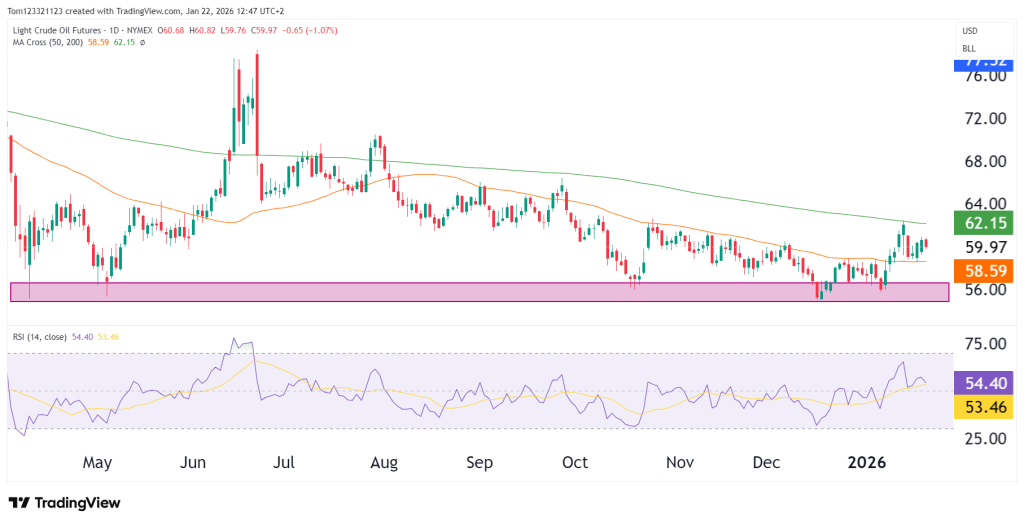
Daily chart
On the daily chart, crude oil has continued to hold the 55–56 support area. This zone has acted as a demand level several times over the past few months. Each time price has tested this area, buyers have stepped in, stopping a clean breakdown and reinforcing it as an important floor.
Recently, price has moved back above the 50-day moving average, which is now starting to flatten after a long decline. This alone does not mean the trend has turned higher, but it does suggest that selling pressure is easing and momentum to the downside is weakening.
The 200-day moving average is still above price and continues to slope lower. This confirms that the broader trend remains bearish to neutral. For a stronger bullish shift, price would need to reclaim the 200-day and hold above it.
Key Technical Levels
Resistance
- 60.00–61.00: Near-term resistance and prior range highs
- 62.00–63.00: 200-day MA and major trend resistance
- 67.00+: Upper range and bearish trend invalidation level
Failure to reclaim the 62–63 area would keep rallies corrective in nature.
Support
- 55.00–56.00: Critical long-term support zone
- 52.00–53.00: Downside extension if support fails
- 48.00–50.00: Major psychological and historical demand area
A decisive break below 55 would reopen downside risk toward the low-50s.
Looking Forward
Bullish stabilization:
Price holds above 55 and continues to build value above the 50-day MA, opening the door for a move toward the 62–63 resistance zone.
Sideways consolidation:
Crude remains range-bound between 55 and 61 as the market digests prior losses and waits for clearer supply-demand signals.
Bearish continuation:
A failure to hold 55 would likely trigger a continuation move toward 52 and potentially the 48–50 zone.
Estimated Probability Table
| Scenario | Description | Estimated Probability |
|---|---|---|
| Sideways consolidation | Holding 55–61 range | 40% |
| Bullish stabilization | Push toward 62–63 | 35% |
| Bearish continuation | Breakdown below 55 | 25% |
Fundamentals to Watch
Crude oil remains very sensitive to both macroeconomic trends and supply-related factors. On the supply side, decisions from OPEC+ continue to shape medium-term price expectations. The group controls roughly 40% of global oil supply, so even small changes in production targets can have an outsized impact on prices. OPEC+ often has to balance two competing goals: keeping prices stable while also protecting market share against rising production from countries like the United States.
Weekly inventory data is another key input for the market. Reports from the U.S. Energy Information Administration (EIA) show whether demand is keeping up with supply. Rising inventories usually signal weaker demand, while consistent drawdowns suggest consumption is improving. Refinery utilization rates also matter, as higher run rates often reflect stronger fuel demand, especially during peak driving or travel seasons.
Helpful reference: https://www.eia.gov/petroleum/
On the macro side, global growth expectations play a major role. Crude oil demand is closely tied to economic activity, particularly in large consumers such as the U.S., China, and Europe. U.S. dollar strength is another important factor. Because oil is priced in dollars, a stronger dollar tends to pressure prices, while a weaker dollar can provide support by making oil cheaper for non-U.S. buyers.
OPEC market outlook reports: https://www.opec.org/opec_web/en/publications/338.htm
Overall risk sentiment also feeds into price action. When markets are optimistic and risk appetite is strong, crude often benefits. When recession fears or financial stress return, oil prices tend to come under pressure.
With crude trading near a long-term support area, it may not take a major shift to drive the next move. Even modest changes in growth expectations, inventory trends, or OPEC+ policy could be enough to push prices higher or trigger another leg lower.
Bottom Line
Crude oil is attempting to stabilize at a major support zone after a prolonged decline. While the broader trend remains corrective, downside momentum has slowed, and early signs of base-building are emerging. For now, the market remains range-bound, with 55 acting as the key line separating stabilization from renewed weakness.
This analysis is for educational and informational purposes only and does not constitute trading advice or a recommendation to buy or sell any futures contracts. Futures trading involves significant risk and may not be suitable for all investors. Always conduct your own research and consult with a licensed financial professional before making trading decisions.