



- US interest futures remain mixed, reflecting resilient US economic data and the Fed’s easing narrative.
- SOFR futures and 30-day Fed futures imply no rate cuts until June and September.
- 30-year bond futures reflect heavy Treasury issuance, a larger fiscal deficit, and uncertain inflation dynamics.
US interest futures remained mixed this week, reflecting cautious sentiment as the Fed remains uncertain about the pace and timing of easing in 2026 and beyond. In particular, the recent upbeat US NFP data reveals a resilient US economy, giving the central bank a further cushion to hold rates.
At the short end of the curve, SOFR futures and 30-day Fed funds imply the target range will stay around current levels for the next few meetings. The CME FedWatch tool shows very low odds of a near-term hike. The June and September contracts are priced at the beginning of the cutting cycle, implying a 50-75 bps rate reduction by late 2026, which is not an aggressive path.
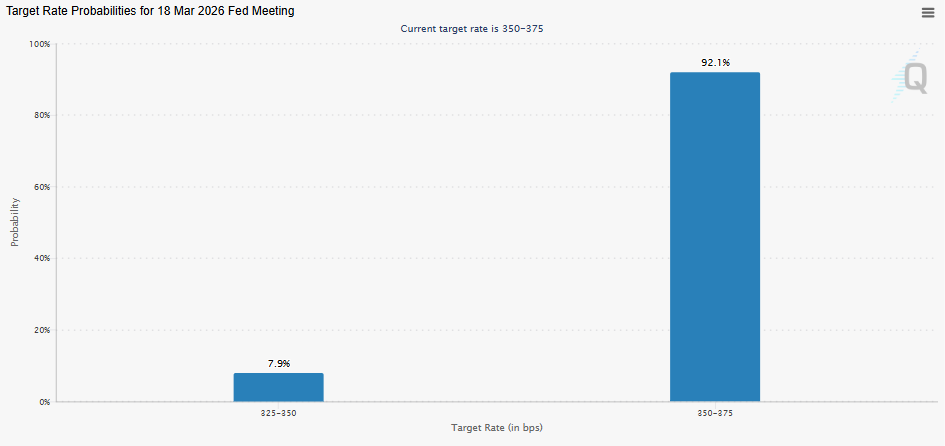
Near-dated SOFR futures that reflect overnight funding costs reveal a shallow downside until early 2027. This highlights the odds of a higher-for-longer approach rather than a rapid easing to ultra-low rates. Market participants consider this a sign of resilient growth and stubborn services inflation despite cooling goods prices.
On the other hand, 10-year US Treasury note futures remain consistent with a cash yield, staying well above the post-financial crisis norm. The 10-year spot yields have fluctuated near the mid-single-digit range in recent weeks. Deferred 10-year note futures extending into 2027 and 2028 reflect only a modest decline, which signals investors’ expectations of long-term neutral rates.
At the very long end, 30-year bond futures reflect elevated premia, raising concerns about heavy Treasury issuance, large fiscal deficits and uncertain inflation dynamics. As a result, short-term futures prices are gradually easing, but long-dated contracts do not indicate a low-rate future. The divergence leaves positioning highly sensitive to Fed communication and each inflation data point.
Futures markets are now signaling a new regime: the Fed is done with tightening, but investors anticipate a slower, more conditional downside path. Meanwhile, a long-term rate structure remains higher than the rest of the world.