



- US interest futures remain choppy as markets wobble between expectations of gradual cuts and sticky inflation.
- The recent US data complicates the Fed’s path, as Q3 GDP beat expectations while Core PCE remained unchanged.
- Markets await US PMI data and Fed guidance for further directional bias.
The US interest futures market is hesitant, moving in both directions. The front end isn’t fully discounting the easing story, but it’s also struggling to price in aggressive near-term cuts. Fed Funds futures (ZQ) and SOFR futures (SR3) still show a split. Markets are fine with a “hold next meeting” base case, but they also anticipate a rate reduction later in the year if growth finally slows.
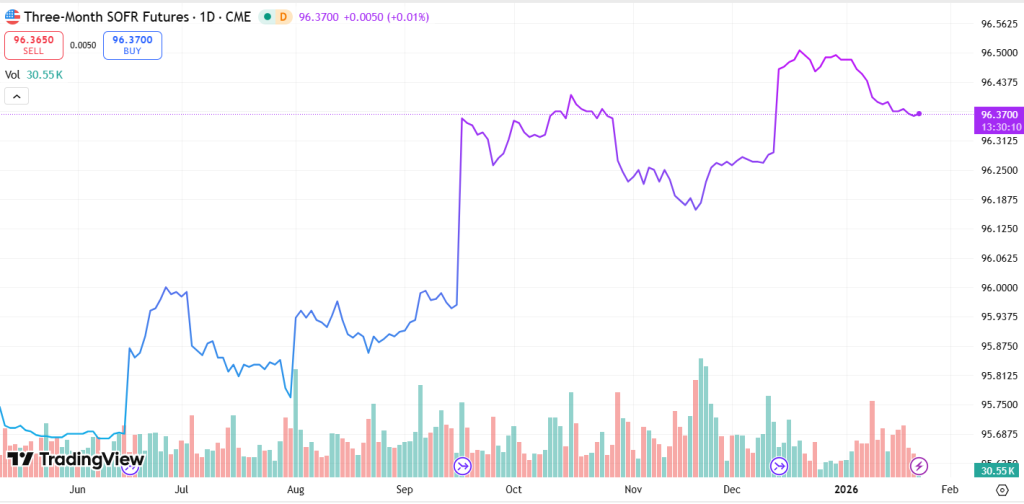
The most recent US macro mix has worsened the tension. Core PCE has been strong enough to keep the Fed on its toes, and the strength of Q3 GDP has made it harder for the market to justify a quick easing cycle. That mix has pushed prices towards a slower, delayed path instead of a clear re-acceleration in cuts, even though the broader dollar has been sensitive to geopolitical developments.
The SOFR strip is where most of the real debate is concentrated. The SR3 contracts in the middle of the curve are where “soft landing with gradual cuts” and “inflation doesn’t cooperate” are fighting it out. It appears flows have been tactical rather than conviction-based. Fast money has faded data extremes, and real money interest has primarily come from options structures that benefit from rate path uncertainty. Markets believe timing is unclear, but volatility is too low if the next few announcements change the story.
Treasury futures are sending a similar, but not identical, message. The inflation and Fed reaction function hold the policy-sensitive 2-year future (ZT) steady, while the 10-year (ZN) and the long bond complex (ZB and UB) are pulled by term premium and supply factors, even when the front end briefly rises.
That cross-current keeps curve expressions in focus, with traders watching whether the next repricing is led by front-end policy expectations or by longer-end premium.
The next thing to look at is the US S&P Global PMI. If the data comes in strong, it could make it harder for the front-end to rally and push back, easing expectations a little bit. Contrarily, if it comes in weak, it could reopen earlier, weighing on the front-end contracts.
As we get closer to the weekend, liquidity is drying up, making headlines more sensitive. After a week of cross-asset volatility, positioning looks lighter. Any change in what the Fed says could quickly open up two-way risk on the SR3 and ZT screens this session.