


- Crude oil futures gained after Ukraine attacked Russian energy infrastructure.
- Rising US inventories and softer demand keep the medium-term oil bias to the downside.
- Expected Fed easing could lend mild support to oil prices in the near term.
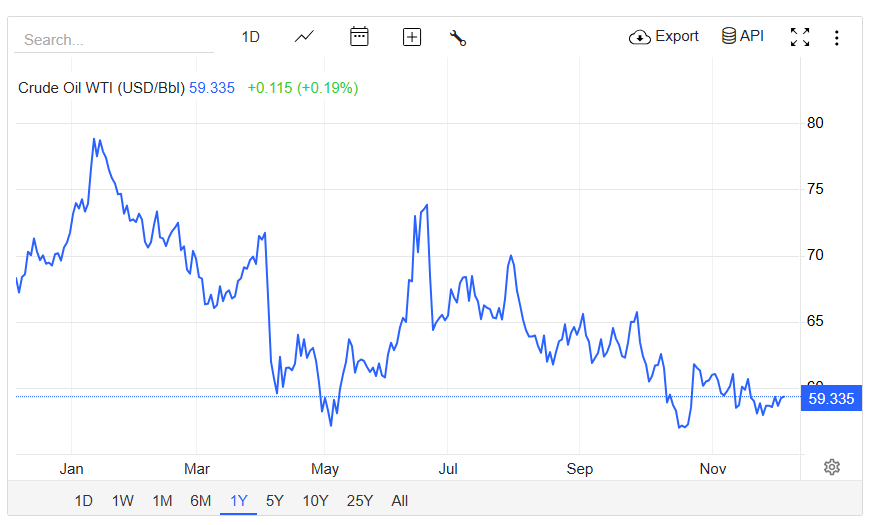
Crude oil futures gained modestly in Thursday’s Asian session, supported by renewed geopolitical worries and a weaker dollar. However, the broader outlook remains capped by the softening demand and rising US inventories. WTI futures hover above $59.00 after a 0.5% gain, while Feb Brent trades just below the $63.00 mark.
The recent boost in price came after a Ukrainian drone strike on Russian energy infrastructure, targeting the Druzhba pipeline in the Tambov region. Although the pipeline operators have not reported any supply disruption to Slovakia and Hungary, the repeated precise attacks have triggered uncertainty in the markets.
According to Consultancy Kpler, Ukraine’s strategy has evolved into a coordinated effort to damage refinery operations that are central to Russia’s oil export. Consequently, the throughput of Russian refineries has declined to nearly 5 million barrels per day, down about 335k bpd from a year earlier. Hence, the US-Russia peace talks ended without tangible progress, thereby increasing the likelihood of a prolonged geopolitical risk persisting.
On the other hand, the support is increasing, offset by weak demand from the US. The latest EIA report showed crude inventory build of 574k barrels, defying expectations for a sizeable drawdown. US demand has failed to keep pace with supply, limiting the upside in oil futures.
The US macroeconomic conditions offered a partial cushion as the markets are more confident of a Fed rate cut in the upcoming meeting. Fed funds futures now imply a 90% chance of a 25 bps rate cut next week. A decline of 32,000 jobs in the ADP report, followed by a softer ISM Services PMI, weighed on the dollar, supporting the mild upside in crude oil.
The structural changes in the benchmark landscape are also shaping the long-term price behavior. Murban crude has seen a surge in futures trading on IFAD, with daily volume above 57 million barrels earlier this year. The Dubai basket, which includes Oman, Dubai, Upper Zakum, and Al-Shaheen, now represents more than 3.5 million barrels per day, playing a crucial role in Asian oil pricing.
Despite recent geopolitical support, the medium-term bias for crude oil remains bearish as global supply grows while softer economic data signals decreased demand. Analysts anticipate the markets to remain choppy to bearish as they head into 2026.